
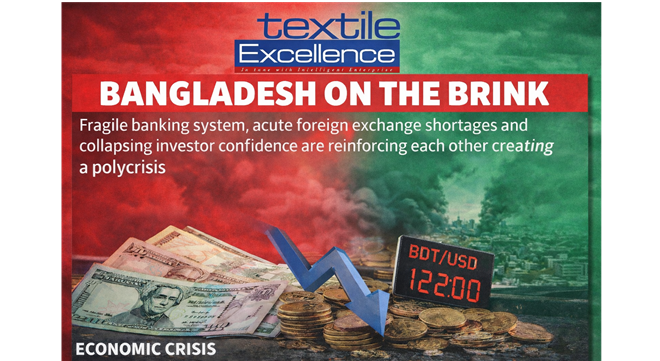
Bangladesh On The Brink
A fragile banking system, acute foreign exchange shortages
and collapsing investor confidence are reinforcing each other, creating a
polycrisis that risks worsening social instability.
Bangladesh’s economy, already fragile at the time of the
August 2024 coup, has entered a sharp downward spiral since. While the country
has made headlines for radicalisation, extremism and political violence, the
deeper and more enduring crisis lies in its economy. A
fragile banking system, acute foreign exchange shortages and collapsing
investor confidence are reinforcing each other, creating a polycrisis that
risks worsening social instability.
Foreign exchange stress is the clearest warning signal.
Bangladesh’s forex reserves fell from a peak of US$ 46 billion in 2020–21 to US$
26.7 billion in 2023–24, indicating sustained hard-currency outflows and an
overvalued currency. As an import-dependent economy for fuel, fertiliser and
food, Bangladesh has tried to keep the taka artificially strong to limit
inflation. The result has been repeated episodes of sharp devaluation when the
pressure becomes unbearable. The most recent adjustment was a 7% devaluation in
May 2024. Since then, the taka has been kept almost flat at around 122 BDT to
the US dollar, even as currencies of stronger economies such as India and China
have weakened.
Analysts estimate that if the taka were allowed to float
freely, it would trade closer to 135–140 BDT per dollar. Instead, authorities
have restricted “non-essential” imports, including electronics, vehicles and
even capital goods. Capital machinery imports have declined for three
consecutive years, undermining future growth. Reflecting these constraints, the
IMF has revised Bangladesh’s 2025 GDP growth forecast downwards for the fourth
time.
Forex shortages are distorting markets. Despite global rice
prices being at their lowest since 2017, domestic prices in Bangladesh remain
high because traders lack the dollars needed to import and exploit arbitrage
opportunities. At the same time, foreign companies are struggling to remit
profits due to deliberate administrative hurdles. Of the estimated US$ 18.9
billion invested in Bangladesh, companies reinvested US$ 1.13 billion in
retained earnings in 2024–25 because funds could not be repatriated. Fresh FDI
fell to just US$ 554 million, less than half its 2020–21 peak.
Political instability has compounded economic stress. Since
August 2024, the interim government has cracked down on business leaders linked
to the previous regime. The arrest of Beximco vice-chairman Salman F Rahman led
to the closure of 16 textile factories employing 40,000 workers. Similar
actions against other major conglomerates have further shaken investor
confidence.
Underlying everything is a deeply distressed banking system.
Non-performing loans now account for around 35% of outstanding credit,
rendering banks effectively insolvent and unable to lend. Fixing balance sheets
will either force losses on depositors or require monetary expansion that
weakens the taka, both politically and economically painful.
With an overvalued currency and a paralysed banking sector,
Bangladesh has few good options. Without restoring financial stability, growth
will remain elusive, prolonging economic hardship and social unrest.
As an import-dependent economy for fuel, fertiliser and food, Bangladesh has tried to keep the taka artificially strong to limit inflation. The result has been repeated episodes of sharp devaluation when the pressure becomes unbearable. The most recent adjustment was a 7% devaluation in May 2024. Since then, the taka has been kept almost flat at around 122 BDT to the US dollar, even as currencies of stronger economies such as India and China have weakened.
Subscribe To Textile Excellence Print Edition
If you wish to Subscribe to Textile Excellence Print Edition, kindly fill in the below form and we shall get back to you with details.
Newsletter
Subscribe To Textile Excellence Mailing List


- December 09, 2022
'There Is Very High Acceptance For India

- December 09, 2022
'Advanced Machines & Service, Customer C

- October 09, 2023
First-time In The World: Rieter’s Auto

- July 28, 2026
Arvind Eyes Leadership In India's Premiu

- June 01, 2020
Karl Mayer Enables Automated Production

- June 05, 2023
Ultimax - All New Revolutionary Rapier W

- June 09, 2025
DyStar Becomes A Wholly Owned Subsidiary
- July 28, 2026