
Engineering The Blackest Black: Riflebird Shows The Way
Black usually sounds simple, until you try to make the
blackest black.
Scientists call it ultrablack: a colour that reflects less than 0.5% of
incoming light. It is prized for cameras, telescopes, and solar panels—and
notoriously hard to make. Worse, many ultrablack materials lose their darkness
when viewed from an angle.
Now, a team at Cornell University has cracked the problem -
with help from a bird.
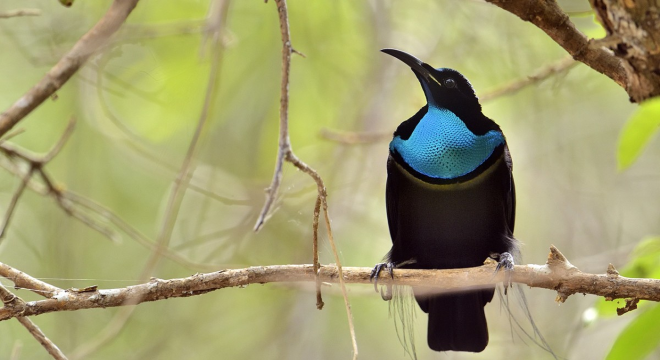
Inspired by the magnificent riflebird, whose feathers appear
impossibly black, researchers at Cornell’s Responsive Apparel Design (RAD) Lab
have created the darkest fabric ever reported. And unlike previous ultrablack
materials, this one is wearable, scalable, angle-independent—and made from
wool.
Nature, it turns out, has been doing ultrablack better than
humans for millennia.
The riflebird’s feathers don’t rely on pigment alone. Their
secret lies in microscopic structures - tightly packed barbules that trap light
and force it to bounce inward until almost none escapes. The Cornell team
decided to copy that trick.
Their process is surprisingly simple and elegant. First,
they dyed white merino wool using polydopamine, a synthetic version of melanin,
the same pigment found in birds, fish, and butterflies. Then they placed the
fabric in a plasma chamber, where controlled etching created nanofibrils - tiny
spiky structures that mimic the riflebird’s feather architecture.
The result? Light enters the fabric and gets lost.
Instead of reflecting outward, light ricochets between the
nanofibrils until it is almost entirely absorbed. “That’s what creates the
ultrablack effect,” explains doctoral researcher Hansadi Jayamaha.
The numbers are striking. The fabric achieved an average
reflectance of just 0.13%, making it the darkest textile ever reported. Even
more impressive, it stays ultrablack across a 120-degree viewing range,
remaining visually unchanged from sharp angles where other materials turn shiny
or grey.
For designers, this changes everything.
“Most ultrablack materials aren’t wearable,” says Larissa
Shepherd, assistant professor and director of the RAD Lab. “Ours is. And it
stays ultrablack even from wider angles.” The research, published on November
26 in Nature Communications, positions ultrablack not just as a lab curiosity,
but as a functional textile.
The implications go far beyond fashion. According to
researcher Kyuin Park, the fabric could be used in solar thermal applications,
helping absorb and convert light into heat. Potential uses include
thermo-regulating camouflage, advanced protective gear, and performance
apparel.
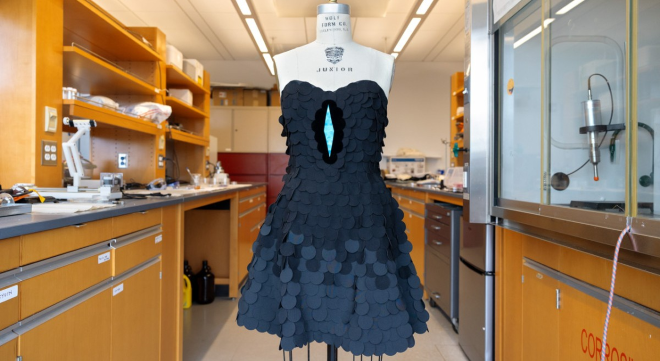
Still, fashion provided the ultimate proof. A dress designed
by Zoe Alvarez ’25, inspired by the riflebird, used the ultrablack fabric
alongside iridescent blue. When image contrast and brightness were altered,
every colour shifted - except the ultrablack. It stayed black. Perfectly.
Cornell has filed for provisional patent protection and is
exploring commercialisation through its Ignite Innovation Acceleration program.
From feathers to fibres, ultrablack has finally found a
fabric-friendly future and it might just redefine what “black” really means.
“Most ultrablack materials aren’t wearable,” says Larissa Shepherd, assistant professor and director of the RAD Lab. “Ours is. And it stays ultrablack even from wider angles.” The research, published on November 26 in Nature Communications, positions ultrablack not just as a lab curiosity, but as a functional textile. The implications go far beyond fashion. According to researcher Kyuin Park, the fabric could be used in solar thermal applications, helping absorb and convert light into heat. Potential uses include thermo-regulating camouflage, advanced protective gear, and performance apparel.
Subscribe To Textile Excellence Print Edition
If you wish to Subscribe to Textile Excellence Print Edition, kindly fill in the below form and we shall get back to you with details.
Newsletter
Subscribe To Textile Excellence Mailing List


- December 09, 2022
'There Is Very High Acceptance For India

- December 09, 2022
'Advanced Machines & Service, Customer C

- October 09, 2023
First-time In The World: Rieter’s Auto

- July 28, 2026
Arvind Eyes Leadership In India's Premiu

- June 01, 2020
Karl Mayer Enables Automated Production

- June 05, 2023
Ultimax - All New Revolutionary Rapier W

- June 09, 2025
DyStar Becomes A Wholly Owned Subsidiary

- July 28, 2026