
India Brings Textiles Under Carbon Market Compliance
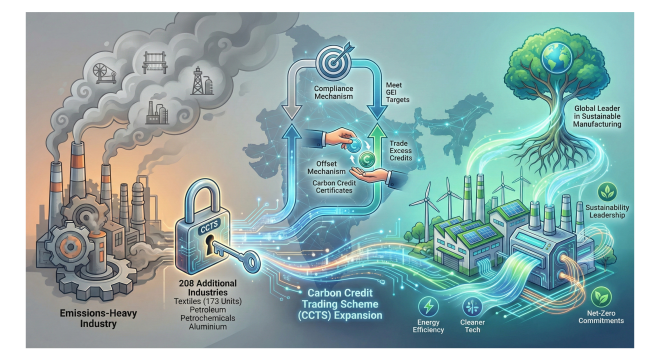
The Government of India has expanded its Carbon Credit
Trading Scheme (CCTS) to include 208 additional carbon-intensive industries,
notably textiles, petroleum refineries, petrochemicals, and secondary
aluminium. The notification now brings the total number of obligated entities
to 490, including 173 from the textile sector, across India’s most
emissions-heavy sectors.
For the textile industry, long a backbone of India’s
manufacturing and export ecosystem, this is a landmark move. Textile mills,
spinning units, and composite facilities will now be required to meet specific
Greenhouse Gas Emission Intensity (GEI) reduction targets, formally integrating
them into India’s carbon market framework. This is more than regulation, it is
a push towards cleaner technologies, energy efficiency, and sustainability.
The CCTS, introduced in 2023, operates through two
mechanisms:
- Compliance
Mechanism – where obligated entities must meet assigned GEI targets.
- Offset
Mechanism – which allows entities that exceed targets to earn Carbon
Credit Certificates, which can then be traded with industries falling
short.
Since its inception, the Indian Carbon Market (ICM) covered
sectors like aluminium, cement, chlor-alkali, and pulp & paper,
encompassing 282 entities. Bringing textiles into this fold is a major
milestone given the sector’s size, energy consumption, and role in industrial
output.
Officials say this expansion reflects years of technical
assessment and stakeholder engagement, ensuring the framework is practical for
diverse textile units, from large spinning mills to composite facilities. By
incentivising emission reduction while allowing trading flexibility, the scheme
aims to balance industrial growth with India’s net-zero commitments.
For textile businesses, the message is clear: adapt or face
rising costs. Mills and garment manufacturers can gain a competitive edge by
investing in energy-efficient machinery, cleaner processes, and leveraging
carbon credits as an additional revenue stream. Over time, this could position
India’s textile industry as a global leader in sustainable manufacturing.
India’s textile industry at a glance
The Indian textile sector is massive and fragmented:
- Over
15,000 textile mills nationwide, including spinning and composite units.
- Around
1,700+ cotton textile mills, primarily spinning and composite facilities.
- Millions
of handlooms and powerlooms in weaving.
- Tens
of thousands of processing and finishing units.
- Over
77,000 apparel manufacturing units engaged in garment production.
This decentralised network powers India’s industrial output
and employment but also creates challenges in standardising energy efficiency
and carbon compliance.
Why only 173 textile units are obligated
The CCTS notification lists 173 textile units as obligated
entities. This seems low compared to thousands of industry players, but there’s
logic behind it:
- Only
the largest, most energy-intensive facilities are covered initially - steam
boilers, thermal plants, electric kilns, and continuous dryers.
- Facilities
with the highest GHG emissions per unit of output are targeted first.
- Smaller
mills, independent weavers, most powerlooms, and many processing units
fall below mandatory reporting thresholds.
Regulatory focus begins with major emitters. Smaller
facilities may be added later, or incentivised through offset and aggregated
compliance schemes.
Perspective and key insight
- The
rules currently cover top-tier emissions contributors, not the entire
textile sector.
- Expansion
is expected as compliance and reporting systems mature.
- The
focus is on facilities where emission reductions deliver the greatest
measurable impact.
Bottom line: India’s textile sector faces a turning
point. The carbon compliance push is both a challenge and an opportunity, rewarding
innovation, energy efficiency, and sustainability leadership. Textile leaders
who act now will not only comply but can also position themselves as global
front-runners in the emerging low-carbon economy.
Faster CETP establishment improves treatment capacity and compliance. It also enables reuse of treated water, lowering freshwater costs for industrial clusters. Centralised treatment and professional operation lead to more efficient and sustainable industrial practices. By removing bottlenecks without compromising safeguards, the reform strengthens pollution control infrastructure, aligns with India’s sustainability goals, and positions industrial clusters, especially textile and SME-heavy regions, for responsible, compliant, and efficient growth.
Subscribe To Textile Excellence Print Edition
If you wish to Subscribe to Textile Excellence Print Edition, kindly fill in the below form and we shall get back to you with details.
Newsletter
Subscribe To Textile Excellence Mailing List


- December 09, 2022
'There Is Very High Acceptance For India

- December 09, 2022
'Advanced Machines & Service, Customer C

- October 09, 2023
First-time In The World: Rieter’s Auto

- July 28, 2026
Arvind Eyes Leadership In India's Premiu

- June 01, 2020
Karl Mayer Enables Automated Production

- June 05, 2023
Ultimax - All New Revolutionary Rapier W
- June 09, 2025
DyStar Becomes A Wholly Owned Subsidiary

- July 28, 2026