
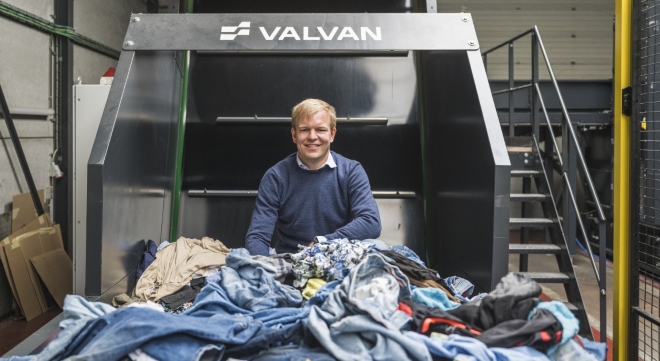
Fibersort Brings Textile Recycling Into Fast Lane
Fibersort,
developed by Belgian machinery maker Valvan, is transforming textile recycling.
The machine can sort up to 2,000 garments per hour, separating them by fibre
type and colour.
From
January 2025, the European EPR Directive mandates separate collection of
textiles for recycling. “Sorting is an important first step,” says Maurits
Vandeputte, Technical Director at Valvan. “Our clothes are made of many
different raw materials, which makes recycling a real challenge.”
Clothing
consumption in Europe produces around seven million tonnes of textile waste
annually. Burning this fabric is unsustainable, and residual waste disposal
will soon be banned across the EU. Belgium is ahead in collection, with about
half of discarded textiles collected separately.
Automating
sorting
Valvan
began automating textile logistics seven years ago. “Sorting centres made money
mainly from clothes they could resell,” explains Maurits. “But online platforms
like Vinted and cheap imports have increased the residual fraction. Pressure is
high, and traditional sorting methods can’t keep up.”
With
artificial intelligence, Fibersort scans each garment with three cameras. A 3D
camera measures size, an RGB camera identifies colour, and an infrared camera
detects fibre type. The machine then sorts items into categories like blue
cotton or red nylon. “The machine is modular: we can add as many categories as
the customer wants,” says Maurits.
Piece-by-piece
processing
Processing
individual garments posed another challenge. Clothes vary in shape and size,
and multiple items can get stuck together. Valvan partnered with Siemens to
develop a custom kinematics solution using a delta picker and robotic arm. “The
delta picker handles long pieces, and the robotic arm separates doubles,” says
Maurits. “We now achieve 1.8 seconds per garment, around 2,000 per hour. Much
faster than humans.”
Plug-and-play
design
“Valvan
asks a lot of us, which keeps us on our toes,” laughs Nick Vanden Broecke, Head
of OEM Sales at Siemens. “We validated all kinematics and controllers. Cycle
times are short, so the system had to be powerful.”
Maurits
adds: “Fibersort is plug-and-play. Customers just connect it, and it works. New
features are backward compatible. Our AI sends commands to the controller via
MQTT or OPC UA, and the hardware keeps up. We’re even exploring capturing
garments on the fly to save another 0.3 seconds per piece.”
The
future of recycling
Thanks
to the Valvan-Siemens partnership, innovation is rapid. Half of Valvan’s
turnover now comes from advanced recycling solutions. In addition to Fibersort,
the company developed Trimclean, which removes buttons and labels from fabrics.
Maurits
concludes: “The future is fully automated. We need to spare people dirty,
repetitive work while keeping valuable resources in Europe. We’ve shown that
even in a tough market, recycling can create value—for our company, our
customers, and society.”
“Fibersort is plug-and-play. Customers just connect it, and it works. New features are backward compatible. Our AI sends commands to the controller via MQTT or OPC UA, and the hardware keeps up. We’re even exploring capturing garments on the fly to save another 0.3 seconds per piece.”
Subscribe To Textile Excellence Print Edition
If you wish to Subscribe to Textile Excellence Print Edition, kindly fill in the below form and we shall get back to you with details.
Newsletter
Subscribe To Textile Excellence Mailing List


- December 09, 2022
'There Is Very High Acceptance For India

- December 09, 2022
'Advanced Machines & Service, Customer C

- October 09, 2023
First-time In The World: Rieter’s Auto

- July 28, 2026
Arvind Eyes Leadership In India's Premiu

- June 01, 2020
Karl Mayer Enables Automated Production

- June 05, 2023
Ultimax - All New Revolutionary Rapier W
- June 09, 2025
DyStar Becomes A Wholly Owned Subsidiary

- July 28, 2026