
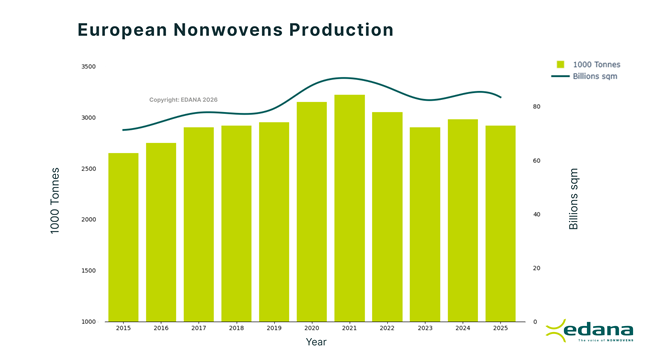
European Nonwovens Industry Shows Resilience Despite 2.2% Production Decline In 2025
EDANA, the international
association representing the nonwovens and related industries, has released its
2025 annual statistics, providing a comprehensive overview of the performance
of the nonwovens sector across Greater Europe.
According to data compiled
by EDANA, total nonwovens production in Europe declined by around 2.2% in 2025,
reaching 2,919,000 tonnes, reflecting a challenging operating environment
marked by softer demand in key segments and rising global competition.
Despite the downturn, EDANA
emphasised the industry’s underlying resilience and adaptability.
Jacques Prigneaux, EDANA’s
Market Analysis and Economic Affairs Director, said: “Despite the negative
impact of several drivers affecting the nonwovens industry, the slowdown in
demand across some key market segments, and increasing competition from abroad,
the European nonwovens industry has once again demonstrated its strength, resilience,
flexibility and ability to innovate.”
Performance across
production technologies showed mixed trends. Spunmelt output declined by 3.3%,
while drylaid technologies remained broadly stable at -0.7%. In contrast,
marginal growth was recorded in hydroentanglement (+0.1%) and needle-punched
bonding (+0.8%), indicating selective pockets of stability within the sector.
End-use markets also
reflected uneven demand dynamics. The hygiene segment, which remains the
largest application area by volume, declined by 2.7% in 2025, reversing a 1.7%
growth seen in 2024. This contraction was primarily driven by weaker
performance in the baby diaper category.
Other key segments showed
varied movement: personal care wipes recorded a slight increase of +0.9%, while
construction-related applications such as building and roofing fell by 6.8%.
The automotive interiors segment declined by 0.9%, and upholstery dropped by
7.1%, reflecting broader softness in industrial and consumer-facing end
markets.
Prigneaux further added: “We
would like to thank participating companies for their continued efforts in
providing data year after year. This direct input from producers, combined with
comprehensive monitoring of the industry, results in a valuable business tool
for our member companies throughout the supply chain.”
Overall, while 2025 marked
a year of mild contraction for European nonwovens production, the sector
continues to demonstrate structural resilience, with technological
diversification and selective end-market stability cushioning the impact of
weaker demand conditions.

Jacques Prigneaux, EDANA’s Market Analysis and Economic Affairs Director, said: “Despite the negative impact of several drivers affecting the nonwovens industry, the slowdown in demand across some key market segments, and increasing competition from abroad, the European nonwovens industry has once again demonstrated its strength, resilience, flexibility and ability to innovate.”
Subscribe To Textile Excellence Print Edition
If you wish to Subscribe to Textile Excellence Print Edition, kindly fill in the below form and we shall get back to you with details.
Newsletter
Subscribe To Textile Excellence Mailing List


- December 09, 2022
'There Is Very High Acceptance For India

- December 09, 2022
'Advanced Machines & Service, Customer C

- October 09, 2023
First-time In The World: Rieter’s Auto

- July 28, 2026
Arvind Eyes Leadership In India's Premiu

- June 01, 2020
Karl Mayer Enables Automated Production

- June 05, 2023
Ultimax - All New Revolutionary Rapier W
- June 09, 2025
DyStar Becomes A Wholly Owned Subsidiary

- July 28, 2026