
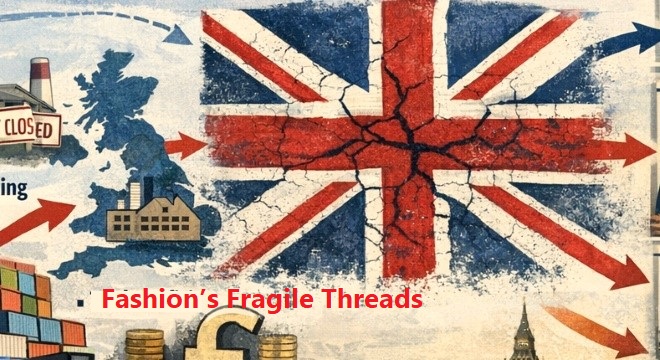
Fashion’s Fragile Threads: How Overseas Reliance Weakens The UK Economy
The UK fashion economy is under
strain because of its heavy reliance on overseas supply chains, with rising
tariffs, shipping costs, and geopolitical risks eroding competitiveness and
forcing brands to rethink sourcing strategies. Industry bodies and policymakers
are now debating onshoring and “safe-shoring” as ways to reduce vulnerability
and strengthen resilience.
Why Overseas Dependence Hurts the UK Fashion Economy
- Trade shocks & tariffs:
Post-Brexit frictions and new US tariffs have disrupted established export
routes, raising costs and undermining confidence in global supply chains.
- Shipping & logistics costs:
Rising freight charges and longer lead times make overseas sourcing less
predictable and more expensive.
- Consumer climate:
Fragile demand in the UK means brands cannot easily absorb higher costs,
squeezing margins.
- Over-reliance on few partners:
Heavy dependence on Asia (China, Bangladesh) and Turkey exposes UK fashion
to concentrated risks.
Current Industry Trends
·
Structural divide:
Textiles (manufacturing, wholesale) show stronger activity, while apparel
manufacturing and retail segments are slowing.
·
Resilience priority:
Companies are shifting from cost-minimization to risk diversification,
exploring “safe-shoring” in politically stable regions like Morocco, Jordan,
Türkiye, and Eastern Europe.
·
Onshoring debate: UK
Parliament recently debated reshoring production to the UK, highlighting
benefits such as shorter lead times, sustainability, and ethical oversight.
Risks & Trade-offs
·
Cost inflation:
Onshoring raises unit costs, potentially making UK fashion less
price-competitive.
·
Investment needs:
Domestic manufacturing requires capital investment in skills, technology, and
infrastructure.
·
Global uncertainty:
Even diversified sourcing cannot fully shield against systemic shocks (e.g.,
shipping crises, raw material shortages).
Key Takeaway and Insights
Here’s a breakdown of the UK apparel categories most exposed to overseas supply risks, based on current trade flows and industry analysis:
·
Cotton garments & fast
fashion are the most exposed because of their
dependence on low-cost Asian supply chains. Any disruption in shipping or
tariffs hits margins immediately.
·
Outerwear & footwear
face moderate risk, with Turkey and Vietnam as critical suppliers vulnerable to
energy shocks and geopolitical instability.
·
Luxury apparel is
less exposed due to higher margins, but customs delays and currency swings
still affect competitiveness.
·
The UK fashion economy’s reliance on
overseas supply chains has become a structural weakness. Resilience now matters more than
lowest cost sourcing. A blended model—combining onshoring,
near-shoring, and safe-shoring—offers the most pragmatic path forward, but it
requires coordinated industry and government support to succeed.
· UK fashion brands need to diversify sourcing
and invest in near-shoring
(e.g., Turkey, Morocco, Eastern Europe) while exploring onshoring niches
(premium knitwear, sustainable cotton). A blended model reduces systemic risk
while aligning with sustainability and ethical production goals.
.png)
The UK fashion economy’s reliance on overseas supply chains has become a structural weakness. Resilience now matters more than lowest cost sourcing. A blended model—combining onshoring, near-shoring, and safe-shoring—offers the most pragmatic path forward, but it requires coordinated industry and government support to succeed.
Subscribe To Textile Excellence Print Edition
If you wish to Subscribe to Textile Excellence Print Edition, kindly fill in the below form and we shall get back to you with details.
Newsletter
Subscribe To Textile Excellence Mailing List


- December 09, 2022
'There Is Very High Acceptance For India

- December 09, 2022
'Advanced Machines & Service, Customer C

- October 09, 2023
First-time In The World: Rieter’s Auto

- July 28, 2026
Arvind Eyes Leadership In India's Premiu

- June 01, 2020
Karl Mayer Enables Automated Production

- June 05, 2023
Ultimax - All New Revolutionary Rapier W

- June 09, 2025
DyStar Becomes A Wholly Owned Subsidiary

- July 28, 2026