
Fewer Orders, Bigger Shifts In Global Apparel Trade
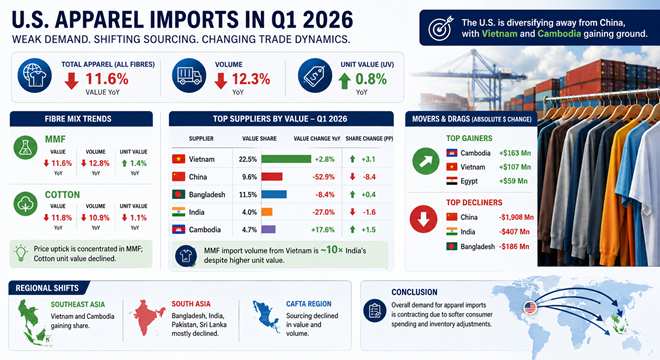
Global apparel sourcing patterns are undergoing a sharp reset in 2026 as weak consumer demand, inventory corrections and changing trade dynamics reshape import markets across North America. Both the United States and Canada reported lower apparel imports in the first quarter of 2026, reflecting softer retail demand and cautious buying by brands and retailers. However, beneath the overall slowdown, sourcing patterns are shifting rapidly. China continues to lose ground in both markets, while suppliers in Southeast Asia such as Vietnam and Cambodia are strengthening their position. South Asian exporters showed mixed performance, with Bangladesh holding relatively stable market share in the U.S. despite lower imports, while India recorded a steep decline. The data also highlights the growing dominance of man-made fibre (MMF)-based apparel in global trade, an area where countries like Vietnam have built significant scale advantages. The latest import trends underline how global buyers are increasingly balancing cost, supply chain reliability, fibre mix and geopolitical risks while diversifying sourcing bases beyond China. U.S. Apparel Import In Q1 2026 Demand contracted, prices edged up marginally o Total apparel value ↓ 11.6% YoY, volume ↓ 12.3%, while unit value (UV) ↑ 0.8%—pointing to price/mix inflation despite softer physical demand. Fibre mix: MMF vs. Cotton o MMF: value ↓ 11.6%, volume ↓ 12.8%, UV ↑ 1.4%. o Cotton: value ↓ 11.8%, volume ↓ 10.9%, UV ↓ 1.1%. Implication: the price uptick is concentrated in MMF; Supplier rebalancing accelerated o Vietnam is #1 (share 22.5%) with value ↑ 2.8% YoY—gaining +3.1 pp of US share. o China slumped (value ↓ 52.9%, ≈ $1908 Mn drop), with share falling 8.4 pp to 9.6%—the biggest single shift in the stack. o Bangladesh declined (value ↓ 8.4%) but share up marginally to 11.5% (+0.4 pp) as overall US imports shrank. o Import volume of MMF based apparel from Vietnam is ~10× India’s volume in Q1-2026 despite higher unit value. o MMF is the dominant category in U.S. apparel imports, but India’s export basket to the U.S. remains heavily cotton-led, resulting in structurally lower share and relevance in the U.S. market. Movers & drags (absolute $ change) o Top gainers: Cambodia (+$163 Mn, value ↑ 17.6%, share +1.5 pp), Vietnam (+$107 Mn, +2.8%, +3.1 pp), Egypt (+59 Mn, +19.3%, +0.5 pp)). o Top decliners: China (−$1908 Mn), India (−$407 Mn, −27%), Bangladesh (−$186 Mn, −8.4%). Regional Shifts o South Asia (Bangladesh, India, Pakistan, Sri Lanka) mostly declined. o Southeast Asia (Vietnam, Cambodia, Indonesia) showed mixed but relatively stronger performance. o Overall CAFTA sourcing declined in value and volume, mirroring the global slowdown. Conclusion o The U.S. is diversifying away from China, with Vietnam and Cambodia gaining ground.
China continues to lose ground in both markets, while suppliers in Southeast Asia such as Vietnam and Cambodia are strengthening their position. South Asian exporters showed mixed performance, with Bangladesh holding relatively stable market share in the U.S. despite lower imports, while India recorded a steep decline. The data also highlights the growing dominance of man-made fibre (MMF)-based apparel in global trade, an area where countries like Vietnam have built significant scale advantages. The latest import trends underline how global buyers are increasingly balancing cost, supply chain reliability, fibre mix and geopolitical risks while diversifying sourcing bases beyond China.
Subscribe To Textile Excellence Print Edition
If you wish to Subscribe to Textile Excellence Print Edition, kindly fill in the below form and we shall get back to you with details.
Newsletter
Subscribe To Textile Excellence Mailing List


- December 09, 2022
'There Is Very High Acceptance For India

- December 09, 2022
'Advanced Machines & Service, Customer C

- October 09, 2023
First-time In The World: Rieter’s Auto

- July 28, 2026
Arvind Eyes Leadership In India's Premiu

- June 01, 2020
Karl Mayer Enables Automated Production

- June 05, 2023
Ultimax - All New Revolutionary Rapier W

- June 09, 2025
DyStar Becomes A Wholly Owned Subsidiary

- July 28, 2026