
EU Moves To Ban Toxic Chemicals In Baby Products
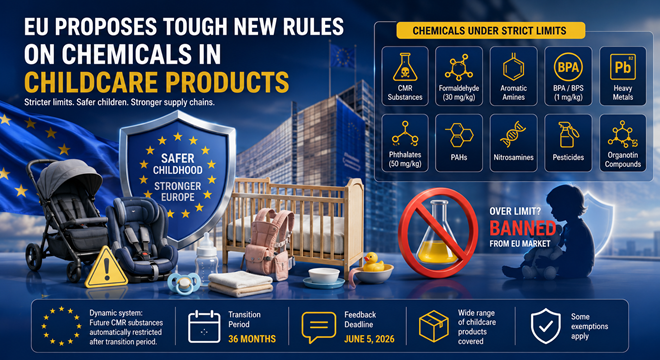
The European Union is preparing one of its toughest crackdowns yet on chemicals used in childcare products — a move that could directly impact textile, plastics and baby product exporters. On May 8, the European Commission published a draft regulation proposing strict new limits on carcinogenic, mutagenic and toxic-for-reproduction (CMR) substances in childcare products sold in the EU. The proposal is still in draft form, but industry players are already on alert because of its wide scope and extremely low chemical limits. The rules would apply to a broad range of childcare products, including strollers, car seats, cots, bassinets, baby carriers, feeding accessories, pacifiers, changing mats, bathing products and infant cushions. EU regulators say children are especially vulnerable to chemical exposure because of skin contact, hand-to-mouth activity and exposure to dust and volatile substances. Key highlights of the proposal Childcare products containing CMR category 1A or 1B substances above permitted levels would be banned from the EU market. The proposal introduces a “dynamic” system, meaning future chemicals added to the EU’s CMR list would automatically become restricted after a transition period. A default concentration limit of 10 mg/kg would apply to many hazardous substances. Formaldehyde, commonly used in textile finishes, adhesives and wood-based materials, would be capped at 30 mg/kg. Aromatic amines linked to azo dyes and pigments used in textiles and leather are heavily targeted. Chemicals such as benzidine, 4-chloroaniline and o-toluidine are included. Bisphenol A (BPA) and Bisphenol S (BPS), widely used in plastics and resins, would each face a strict limit of 1 mg/kg. Heavy metals including lead, cadmium, mercury, arsenic and chromium VI compounds are also covered. Certain phthalates used as plastic softeners, including DEHP, DBP and BBP, would face individual limits of 50 mg/kg. Polycyclic aromatic hydrocarbons (PAHs), nitrosamines, pesticides and organotin compounds are also included in the restriction list. Industry experts say the move could force companies to tighten supplier checks, improve traceability and increase laboratory testing. The EU has included some exemptions. Second-hand childcare products would not fall under the new rules. Certain inaccessible product parts, medical devices and food-contact materials already regulated elsewhere would also be excluded. Businesses will, however, get time to adjust. The proposed restrictions would generally apply 36 months after the regulation officially enters into force. The European Commission is currently accepting feedback on the draft until June 5, 2026.
The EU has included some exemptions. Second-hand childcare products would not fall under the new rules. Certain inaccessible product parts, medical devices and food-contact materials already regulated elsewhere would also be excluded. Businesses will, however, get time to adjust. The proposed restrictions would generally apply 36 months after the regulation officially enters into force. The European Commission is currently accepting feedback on the draft until June 5, 2026.
Subscribe To Textile Excellence Print Edition
If you wish to Subscribe to Textile Excellence Print Edition, kindly fill in the below form and we shall get back to you with details.
Newsletter
Subscribe To Textile Excellence Mailing List


- December 09, 2022
'There Is Very High Acceptance For India

- December 09, 2022
'Advanced Machines & Service, Customer C

- October 09, 2023
First-time In The World: Rieter’s Auto

- July 28, 2026
Arvind Eyes Leadership In India's Premiu
- June 01, 2020
Karl Mayer Enables Automated Production

- June 05, 2023
Ultimax - All New Revolutionary Rapier W
- June 09, 2025
DyStar Becomes A Wholly Owned Subsidiary

- July 28, 2026