
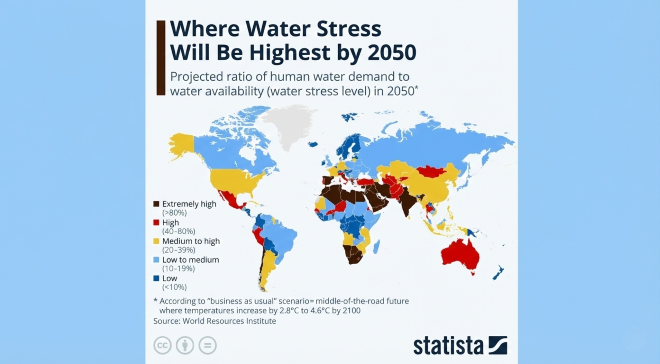
Water Will Decide Who Produces And Who Shuts Down
Water
scarcity will emerge as a geopolitical and economic constraint, not just a
climate issue, by 2026, according to Ernst & Young’s 2026 Geostrategic
Outlook. After decades of carbon-focused climate policy, water is now becoming
a decisive factor shaping industrial strategy, supply chains and global power
equations.
The
stress is already real. Nearly four billion people experience severe water
shortages for at least one month every year. Heatwaves and droughts in 2024–25
showed how quickly water shortages translate into higher food prices,
inflationary pressure and political unrest. Climate change is accelerating the
problem by disrupting rainfall patterns, increasing evaporation, and
intensifying floods and droughts, even as demand rises across agriculture,
cities and industry.
When
digital ambition hits physical limits
What
makes the coming phase more disruptive is water’s collision with the global
race for digital and industrial dominance. Semiconductor manufacturing, AI
infrastructure, mining of critical minerals and hyperscale data centres all
require vast, reliable volumes of freshwater, often in regions already under
stress.
Advanced
semiconductor fabrication is among the most water-intensive manufacturing
processes in the world. Research published in 2025 shows that a single
leading-edge fab processing around 40,000 wafers a month can consume up to 4.8
million gallons of water per day, even after recycling, comparable to a small
town’s daily use.
Data
centres running AI workloads pose a parallel challenge. Facilities using
evaporative cooling can require millions of gallons of water daily, triggering
local resistance in water-stressed regions. While waterless cooling systems are
emerging, they often raise energy consumption and capital costs, creating a
three-way trade-off between water, energy and infrastructure.
Industries
under strain - beyond farms and power
While
agriculture and energy remain central to water politics, pressure is spreading
across manufacturing sectors.
Textiles
and apparel: Water-intensive textile clusters in South
Asia face growing scrutiny over freshwater extraction and pollution, creating
supply chain and reputational risks for global brands.
Food
and beverages: Water is both an input and a product,
making operations vulnerable in stressed basins.
Mining: In
Chile’s Atacama region, lithium expansion has intensified disputes over indigenous
water rights, despite moves toward desalination.
Urban
development: Assured water supply is increasingly
shaping where cities can expand, and where they cannot.
Arizona
shows how water caps growth
The
arid south-western US offers a stark example of water becoming the binding
constraint. In Arizona, prolonged drought collided with rapid semiconductor
expansion, forcing water regulation to the centre of industrial policy.
In
2025, the state tightened groundwater rules and began allowing agricultural
water savings to be converted into urban and industrial credits. The contrast
is telling: Arizona’s first such approval freed enough water for 825 homes
annually, while a single advanced chip fab can consume four times that volume
every year. For industry, water access, not capital or technology, is now the
decisive factor.
Water
as a geopolitical instrument
Water
is also becoming a tool of statecraft. The 2025 suspension of the Indus Waters
Treaty during India–Pakistan tensions highlighted how shared rivers can be
weaponised. Disputes persist over the Nile, Mekong and Brahmaputra, while
cyberattacks on water utilities are rising, elevating water infrastructure to a
strategic security asset.
What
this means for business
EY
warns that water risk must move into core strategic planning. Scarcity can halt
production, disrupt supply chains and erode social licence to operate.
Governments and companies alike are being pushed toward water-efficient
technologies, recycling, tighter regulation and long-term infrastructure
investment, not as sustainability choices, but as prerequisites for economic
resilience.
Heatwaves and droughts in 2024–25 showed how quickly water shortages translate into higher food prices, inflationary pressure and political unrest. Climate change is accelerating the problem by disrupting rainfall patterns, increasing evaporation, and intensifying floods and droughts, even as demand rises across agriculture, cities and industry.
Subscribe To Textile Excellence Print Edition
If you wish to Subscribe to Textile Excellence Print Edition, kindly fill in the below form and we shall get back to you with details.
Newsletter
Subscribe To Textile Excellence Mailing List


- December 09, 2022
'There Is Very High Acceptance For India

- December 09, 2022
'Advanced Machines & Service, Customer C

- October 09, 2023
First-time In The World: Rieter’s Auto

- July 28, 2026
Arvind Eyes Leadership In India's Premiu

- June 01, 2020
Karl Mayer Enables Automated Production

- June 05, 2023
Ultimax - All New Revolutionary Rapier W
- June 09, 2025
DyStar Becomes A Wholly Owned Subsidiary

- July 28, 2026