
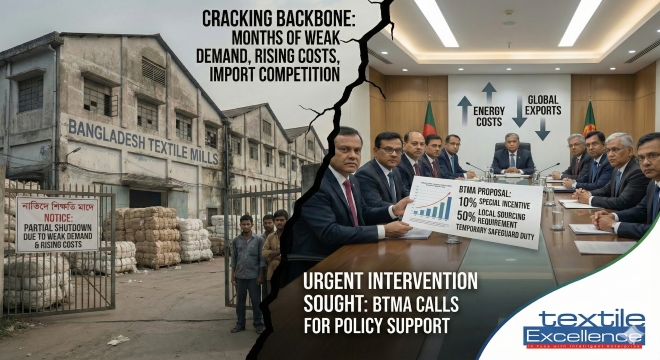
Bangladesh’s Textile Backbone Is Cracking
Bangladesh’s textile millers have sought urgent government
intervention, warning that the industry is edging towards a collapse after
months of weakening demand, rising costs and intensifying import competition.
The Bangladesh Textile Mills Association (BTMA) said the
sector, built over three decades as a vital backward linkage to the country’s
export-driven garment industry, is facing its most severe stress in years. More
than US$ 23 billion has been invested across spinning, weaving and processing,
pushing capacity utilisation above 100% for cotton knit yarn and around 80% for
woven yarn. However, business conditions have deteriorated steadily over the
past year, with a sharp downturn in the last three months.
BTMA estimates that at least 58 spinning and dyeing units
have fully or partially shut down. Several mills have tried to survive by
leasing out facilities, but many are now operating at significantly reduced
levels.
In response, industry representatives have stepped up
engagement with policymakers, holding discussions this month with the National
Board of Revenue and the finance and commerce ministries. BTMA president
Showkat Aziz Russell has written to multiple government bodies outlining the
scale of the crisis and calling for immediate corrective measures.
In a submission to the Ministry of Commerce, BTMA proposed a
five-year special incentive of 10% on domestic yarn sales, up from the current
1.5%. It also sought a requirement that at least 50% of yarn used in
export-oriented garment production be sourced locally, along with a temporary
safeguard duty on imported cotton yarn.
Industry sources said local mills are being squeezed by the
gradual withdrawal of incentives, rising input and energy costs, and stronger
policy support extended by India to its yarn producers. Millers also flagged
the leakage of duty-free yarn and fabric, imported under bonded warehouse
schemes, into the domestic market, alongside illicit imports, which have eroded
demand for local output.
The pressure has been compounded by a slowdown in global
garment exports over the past four months, forcing many mills to sell below
cost. With around 2 million jobs at stake across more than 1,800 textile units,
BTMA warned that fresh investment is unlikely without swift and targeted
government support.
The Bangladesh Textile Mills Association (BTMA) said the sector, built over three decades as a vital backward linkage to the country’s export-driven garment industry, is facing its most severe stress in years. More than US$ 23 billion has been invested across spinning, weaving and processing, pushing capacity utilisation above 100% for cotton knit yarn and around 80% for woven yarn. However, business conditions have deteriorated steadily over the past year, with a sharp downturn in the last three months.
Subscribe To Textile Excellence Print Edition
If you wish to Subscribe to Textile Excellence Print Edition, kindly fill in the below form and we shall get back to you with details.
Newsletter
Subscribe To Textile Excellence Mailing List


- December 09, 2022
'There Is Very High Acceptance For India

- December 09, 2022
'Advanced Machines & Service, Customer C

- October 09, 2023
First-time In The World: Rieter’s Auto

- July 28, 2026
Arvind Eyes Leadership In India's Premiu

- June 01, 2020
Karl Mayer Enables Automated Production

- June 05, 2023
Ultimax - All New Revolutionary Rapier W

- June 09, 2025
DyStar Becomes A Wholly Owned Subsidiary

- July 28, 2026