
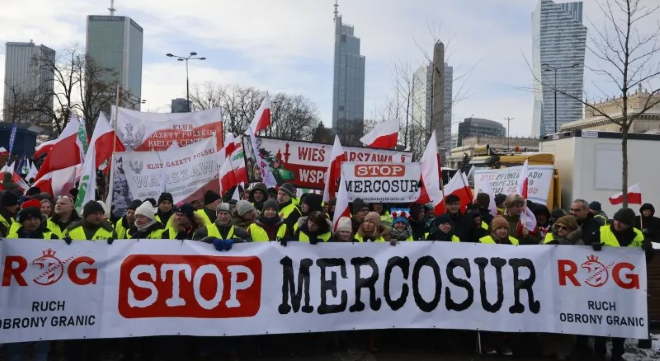
Mass Protests Sweep Europe Over EU-Mercosur Trade Deal As Farmers Fear Economic Fallout
Thousands of farmers across the European Union took to the
streets this weekend in one of the largest agricultural protests seen in years,
voicing fierce opposition to the EU’s newly approved free-trade agreement with
the Mercosur block of South American nations. Farmers in Ireland and France
mobilised tractor convoys, blockades and rallies to spotlight concerns that the
accord will expose domestic agriculture to unfair competition and undercut
local livelihoods.
In Athlone, central Ireland, tens of thousands of farmers
and supporters gathered on January 10, driving tractors along major roads and
rallying at Technological University of the Shannon under banners reading “Stop
EU-Mercosur” and slogans accusing EU leaders of abandoning agriculture.
Ireland’s Government had voted against the deal, saying it lacked sufficient
safeguards to protect stringent food safety and environmental standards.
Protesters fear the pact could open local markets to an additional 99,000 tonnes
of lower-cost beef from Mercosur nations such as Brazil and Argentina,
threatening the competitiveness of Irish beef and dairy producers in a sector
that remains a major employer in rural regions.
Simultaneous demonstrations occurred in France, where
farmers drove tractors into central Paris, blockading routes near the Eiffel
Tower and Arc de Triomphe to pressure national and EU leaders. French President
Emmanuel Macron has indicated that France will oppose the deal, echoing similar
concerns about cheap imports and inconsistent regulatory standards.
Opposition to the trade pact is not limited to Ireland and
France. Farmers in Poland, Belgium and Hungary have also staged protests,
warning that Mercosur imports could disrupt long-standing agricultural
practices and weaken food security. Critics argue that the pact, which would
create one of the world’s largest free-trade areas encompassing markets of
nearly 800 million people, prioritises industrial exports such as machinery,
chemicals and pharmaceuticals at the perceived expense of farming communities.
EU policymakers argue the agreement offers significant
economic gains, including expanded export opportunities for European
manufactured goods and reciprocal market access. Yet, the farming bloc remains
deeply divided, and the trade deal still requires approval by the European
Parliament before it can take effect. Lobby groups such as the Irish Farmers’
Association have vowed to intensify efforts to build opposition in the
legislature and push for stronger protections or renegotiation of contentious
provisions.
The unfolding protests mark a significant flash point in
European trade politics, underscoring the complex balancing act between
liberalised commerce and the protection of strategic domestic industries. With
parliamentary ratification pending, the outcome of the Mercosur deal will test
the EU’s capacity to reconcile global trade ambitions with farmer livelihoods
and food standards that many Europeans hold dear.
Opposition to the trade pact is not limited to Ireland and France. Farmers in Poland, Belgium and Hungary have also staged protests, warning that Mercosur imports could disrupt long-standing agricultural practices and weaken food security. Critics argue that the pact, which would create one of the world’s largest free-trade areas encompassing markets of nearly 800 million people, prioritises industrial exports such as machinery, chemicals and pharmaceuticals at the perceived expense of farming communities.
Subscribe To Textile Excellence Print Edition
If you wish to Subscribe to Textile Excellence Print Edition, kindly fill in the below form and we shall get back to you with details.
Newsletter
Subscribe To Textile Excellence Mailing List


- December 09, 2022
'There Is Very High Acceptance For India

- December 09, 2022
'Advanced Machines & Service, Customer C

- October 09, 2023
First-time In The World: Rieter’s Auto

- July 28, 2026
Arvind Eyes Leadership In India's Premiu

- June 01, 2020
Karl Mayer Enables Automated Production

- June 05, 2023
Ultimax - All New Revolutionary Rapier W
- June 09, 2025
DyStar Becomes A Wholly Owned Subsidiary

- July 28, 2026