
Why China’s AI-Controlled Textile Factories Threaten Labour-Led Export Models
In
the heart of western China, an extraordinary factory is garnering a lot of
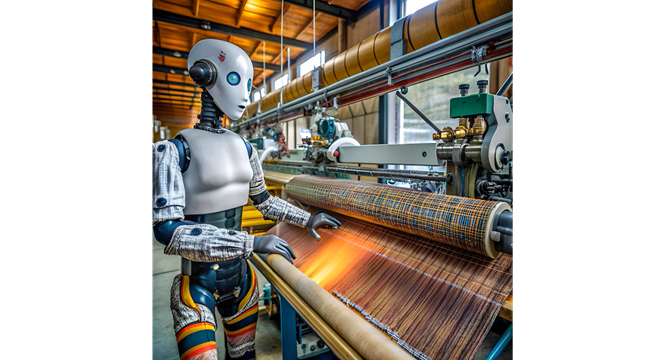
attention. Here, textile production takes place without crowds of workers.
Artificial intelligence and industrial robots are reshaping the contours of a
historic sector with new energy.
A
massive factory that never sleeps
In
the Xinjiang region, this textile factory is striking first and foremost for
its sheer scale. Nearly 5,000 looms operate continuously, 24/7. No human
operators are directly present on the production lines. Instead, robust,
durable, and perfectly synchronized machines ensure every step of the process.
This organization relies on a close alliance between artificial intelligence,
industrial robots, and smart sensors. The result is a seamless system capable
of maintaining a sustained pace without any loss of quality.
When
machines self-adjust in real time
One
of this factory's major strengths lies in its ability to adapt instantly.
Sensors continuously analyse yarn tension, weaving speed, fabric texture, and
energy consumption. Algorithms then adjust each parameter with remarkable
precision. This fine-tuned management allows for faster production while
maintaining consistent quality, without overproduction or waste. Predictive
maintenance also plays a key role: the machines detect signs of wear before a
problem occurs.
China's
"smart factories" strategy
This
factory is not an isolated case. It is part of a broader strategy pursued by
China: investing massively in automation to strengthen its industrial
competitiveness. In this model, a few technicians are sufficient to supervise
the entire operation from a control room. Human work is transformed. It is no
longer a matter of constant physical effort, but rather a role of management,
analysis, and decision-making.
Towards
a transformation of industrial professions
Rather
than a complete disappearance of human labour, many analysts speak of a
profound transformation. Some jobs are declining, but others are emerging:
maintenance specialists, automation engineers, programmers, intelligent systems
supervisors. Work is becoming less repetitive, less physically demanding, and
more focused on technological mastery.
Global
fascination and initial concerns
Internationally,
this factory has garnered both admiration and questions. On the one hand, it
promises shorter lead times, mass production, and formidable efficiency in
global markets. On the other, it raises concerns about the future of
employment, particularly for low-skilled jobs. Countries whose economies rely
on textiles and have an abundant workforce could find themselves facing stiff
competition. Faced with automated factories capable of producing without breaks
or fatigue, traditional models are showing their limitations.
In
summary, this Chinese textile factory represents a major shift in the balance
of global production. It places automation and artificial intelligence at the
heart of industrial strategies, while simultaneously reigniting the debate on
the future of work. Between technological power and social questions, this
model ushers in a new era.
Internationally, this factory has garnered both admiration and questions. On the one hand, it promises shorter lead times, mass production, and formidable efficiency in global markets. On the other, it raises concerns about the future of employment, particularly for low-skilled jobs. Countries whose economies rely on textiles and have an abundant workforce could find themselves facing stiff competition. Faced with automated factories capable of producing without breaks or fatigue, traditional models are showing their limitations.
Subscribe To Textile Excellence Print Edition
If you wish to Subscribe to Textile Excellence Print Edition, kindly fill in the below form and we shall get back to you with details.
Newsletter
Subscribe To Textile Excellence Mailing List


- December 09, 2022
'There Is Very High Acceptance For India

- December 09, 2022
'Advanced Machines & Service, Customer C

- October 09, 2023
First-time In The World: Rieter’s Auto

- July 28, 2026
Arvind Eyes Leadership In India's Premiu

- June 01, 2020
Karl Mayer Enables Automated Production

- June 05, 2023
Ultimax - All New Revolutionary Rapier W

- June 09, 2025
DyStar Becomes A Wholly Owned Subsidiary

- July 28, 2026