
Mussel Shells Are suitable And sustainable For sandblasting Jeans
The Materials and Technologies (GMT) research group has
found a new, sustainable material for sandblasting denim. They found that the
grit obtained from grinding mussel shells has better abrasive qualities than
other materials used in the textile industry. It is more environmentally
friendly because a waste product is turned into a raw material.
A major multinational in the textile manufacturing sector
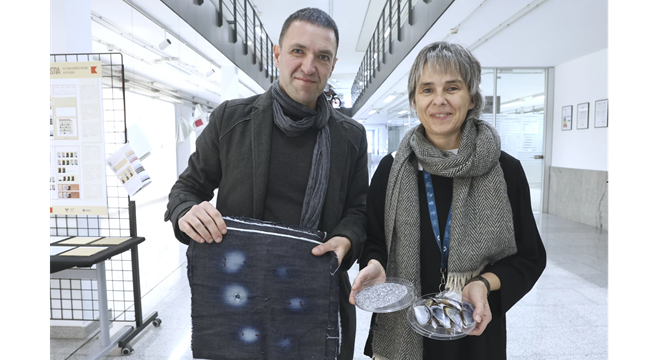
was looking for a sustainable technique for abrading denim, and the Materials and Technologies (GMT) research group of the University
of the Basque Country (EHU) came up with a solution in collaboration with the
Massachusetts Institute of Technology (MIT). “We concluded that the grit
comprising ground mussel shells was an effective abrasive and sustainable
material. It offers the chance to replace other industrial processes currently
used to abrade denim, and which have a greater environmental impact or are more
toxic,” said the researchers Cristina Peña and Juan Luis Osa.
Traditionally, denim was abraded by blasting the fabric with
silica sand at high pressure. But the workers who used this technique developed
silicosis as a result of the inappropriate use of safety measures and
protection. As silicosis is a disease with a high mortality rate, the abrasive
technique based on sandblasting fell into disrepute and was abandoned by the
textile industry. So alternative methods began to be used. Oxidising chemical
treatments or thermal laser treatments, for example. However, these were found
to be potentially more toxic and did not achieve such good abrasive results.
“Bearing in mind that there is no reason why the
sandblasting technique should harm the workers as long as they are properly
protected, the brand that produced the clothing wanted to revisit the
technique, but by using a more sustainable material; in other words, more
sustainable than the garnet (quartz-free silicate mineral) normally used as an
abrasive,” explained Peña. Initially, they conducted the first tests using the
buttons of garments destined for the landfill, but that option was not viable.
So they decided to look for a renewable material, and at the suggestion of the
very textile company that commissioned the work, they started testing with
mussel shells. Specifically, the shells discarded by the food industry. “Taking
advantage of the fact that I live very near a bar called La Mejillonera [The
Mussel Bed] in Donostia, we did some tests using the mussel shells they usually
throw away. This is the process: the shells are washed, sterilised using a
thermal treatment, ground in a mill, sifted, and finally, the grit produced is
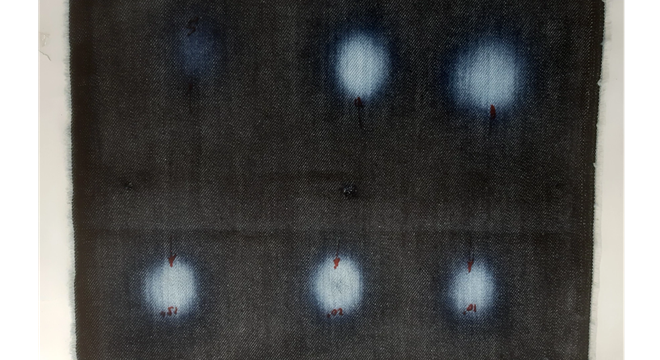
projected under pressure at the denim using a compressed air gun. We saw that
by doing so, the grit responded very well in wearing away the denim. Better
than the garnet usually used in this sandblasting process,” said Osa.
They concluded that the mussel shell grit was less brittle
than the silicate mineral, and therefore performed better. “It is less likely
to break during the blasting than the garnet. And that is a positive feature.
Indeed, less mussel shell grit than the garnet is needed to abrade the same
number of jeans. The fact is, during the sandblasting process, after the
garment has been blasted with the grit, the grit used is collected so that it
can be reused. Collected and reused over and over again. But with each use the
grit gradually becomes smaller and from time-to-time new grit has to be added. So,
what we saw was that the grit made up of mussel shells lasts longer than the
garnet and therefore less material is used to achieve the same abrasion,”
explained the researchers.
They also confirmed that the finish achieved by blasting the
fabric with mussel shells is of good quality. In other words, it is capable of
creating the colours that fashion designers and consumers love so much and,
unlike other chemical treatments, leaves the fabric smooth to the touch.
From a waste product to a raw material
The sustainability of the abrasive material discovered is
another strong point in the EHU research: “It has a lower impact on the
environment than traditional and chemical abrasives. For example, garnet is not
renewable whereas shells are. The first is a mineral that has to be extracted
from nature, whereas the other ones are a sub-product. As a result of mussel
consumption, 1.5 million tonnes of shells are produced per year worldwide, and,
as far as we know, to date they are not used for anything,” said Peña.
To take advantage of the mussel shells that end up on
landfills, the scientific community is working to find new uses, but the EHU
researchers have been among the first to find an effective solution. “It was a
major piece of work and it took us time to achieve these results, but we are
delighted with the achievement. We have verified a specific application to
abrade denim, but in addition to that, the results have revealed that mussel
shell grit has many other applications; it could be a suitable abrasive material
and could be useful in other industries, such as the cleaning of mechanical
parts or ships. What is more, it does not require any special equipment. We did
our tests on machines routinely used in sandblasting processes and they went
well," explained Osa.
The EHU researchers stressed that the research has given the
circular economy a boost: “It is a good starting point to begin to carry out
the processes currently done in industry differently. It is not just to have a
more sustainable process, but also to harness the waste we create. It shows
that we need to have a broad perspective on the use of raw materials, and
beyond the raw materials that have always been used, it’s worth looking at what
alternatives there are, to see what waste we generate and to explore what we
could do with it.”
A major multinational in the textile manufacturing sector was looking for a sustainable technique for abrading denim, and the Materials and Technologies (GMT) research group of the University of the Basque Country (EHU) came up with a solution in collaboration with the Massachusetts Institute of Technology (MIT). “We concluded that the grit comprising ground mussel shells was an effective abrasive and sustainable material. It offers the chance to replace other industrial processes currently used to abrade denim, and which have a greater environmental impact or are more toxic,” said the researchers Cristina Peña and Juan Luis Osa.
Subscribe To Textile Excellence Print Edition
If you wish to Subscribe to Textile Excellence Print Edition, kindly fill in the below form and we shall get back to you with details.
Newsletter
Subscribe To Textile Excellence Mailing List


- December 09, 2022
'There Is Very High Acceptance For India

- December 09, 2022
'Advanced Machines & Service, Customer C

- October 09, 2023
First-time In The World: Rieter’s Auto

- July 28, 2026
Arvind Eyes Leadership In India's Premiu

- June 01, 2020
Karl Mayer Enables Automated Production

- June 05, 2023
Ultimax - All New Revolutionary Rapier W

- June 09, 2025
DyStar Becomes A Wholly Owned Subsidiary

- July 28, 2026