
Forget 3D Printing: Cornell Is 3D Knitting With Its New Machine
If you find 3D printers to be just a little too coldly
futuristic, this contraption might be more to your liking. Scientists from
Cornell University have created a machine that knits solid 3D objects out of
nice old-timey conventional yarn.
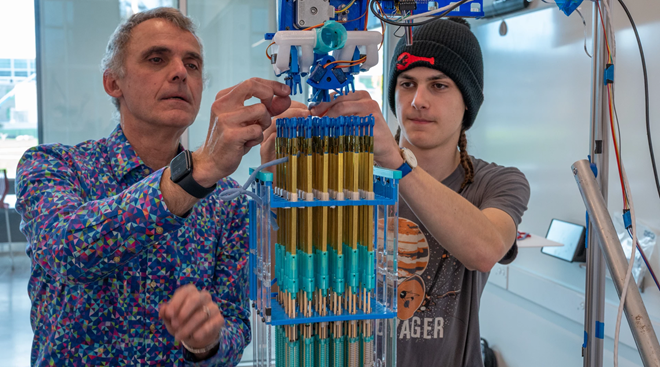
The prototype device is made mainly of 3D-printed
components, and incorporates a bed of knitting needles arranged in a 6 x 6
block. A motorised knitting head dispenses yarn to any of those needles in
sequence, as determined by a program on a computer that's controlling it.
Each of the needles in turn consists of a 3D-printed
symmetrical double hook connected to a brass support tube. Because the front
and rear sections of the hook move independently, it's possible for the device
to either knit or purl, depending on which section of the hook picks up the
first loop of yarn.
The machine is still relatively slow at this point, and
prone to errors such as dropping loops; plus so far it's limited to creating
simple objects such as wrist warmers, pyramids and boxes. That said, its
functionality should improve considerably once the technology is scaled up,
which would partially involve adding more needles to the knitting block.
Possible future applications of the device include the
production of three-dimensional scaffolding-like structures used to support the
growth of artificial ligaments or veins. And by knitting such structures
instead of printing them, it will be possible to precisely control their
thickness and stiffness.
"We establish that not only can it be done, but because
of the way we attach the stitch, it will give us access to a lot of flexibility
about how we control the material," says the lead scientist, Prof.
François Guimbretière. "The expressiveness is very similar to a 3D
printer."
A paper on the study was presented in September at the ACM
Symposium on User Interface Software and Technology in Busan, Korea.
And no, this isn't the first time we've heard about
3D-knitted objects.
Carnegie Mellon University, which collaborated with Cornell
on its device, has previously developed software that transforms existing
knitting machines into 3D printers, built a dedicated solid-knitting machine,
and created robo-knit furniture that transforms from flat to three-dimensional
shapes with one pull.
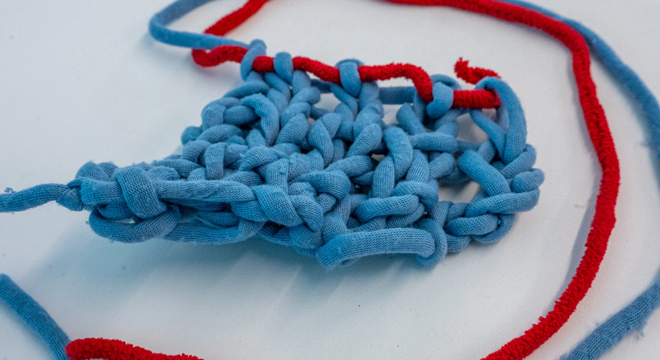
Possible future applications of the device include the production of three-dimensional scaffolding-like structures used to support the growth of artificial ligaments or veins. And by knitting such structures instead of printing them, it will be possible to precisely control their thickness and stiffness.
Subscribe To Textile Excellence Print Edition
If you wish to Subscribe to Textile Excellence Print Edition, kindly fill in the below form and we shall get back to you with details.
Newsletter
Subscribe To Textile Excellence Mailing List


- December 09, 2022
'There Is Very High Acceptance For India

- December 09, 2022
'Advanced Machines & Service, Customer C

- October 09, 2023
First-time In The World: Rieter’s Auto

- July 28, 2026
Arvind Eyes Leadership In India's Premiu

- June 01, 2020
Karl Mayer Enables Automated Production

- June 05, 2023
Ultimax - All New Revolutionary Rapier W

- June 09, 2025
DyStar Becomes A Wholly Owned Subsidiary

- July 28, 2026