
How Best To Recycle Europe’s Fast Fashion Waste? Grow Mushrooms On It, Say Researchers
Most clothing and home textile waste currently still goes
unsorted, whilst fashion is driving significant increases in unwanted goods. EU
Member States must separate textile waste under the Waste Framework Directive,
but problems remain despite this legislation. Options include carrying out
extensive sorting and separation, or recycling mixed textiles into new
products. However, there is a lack of commercially viable technologies for use
in mixed textile recycling.
A review of 27 research papers has identified the following
products as offering the most potential for re-using this waste:
-
Fungi-based (mycelium) composite for thermal
insulation: This can be used e.g. to increase home energy efficiency as a green
building material, or to improve thermal performance in industrial processes
and mechanical systems.
-
Bio-oil and terephthalic acid (TPA): These
substances are used in chemical production to create plastics, resins,
composites, and paints, with TPA being a precursor to polyethylene
terephthalate (PET; a polyester widely used in clothing, packaging, and manufacturing).
-
Textile-reinforced composite for use in
construction: For example, to retrofit existing buildings, or used in place of
traditional steel-reinforced concrete blocks as a stiffer, more lightweight,
more durable building material;
-
Cotton and nylon fibres, spandex monomers
(molecules for spandex production) and bis(2-hydroxyethyl) terephthalate (BHET;
a compound that can produce polymers for numerous applications such as resins,
foams, and bioplastics). These fibres could also be recycled back into
textiles, closing the recycling loop.
The researchers calculated how close each use would be to an
ideal solution, using four criteria - environmental, economic, technical,
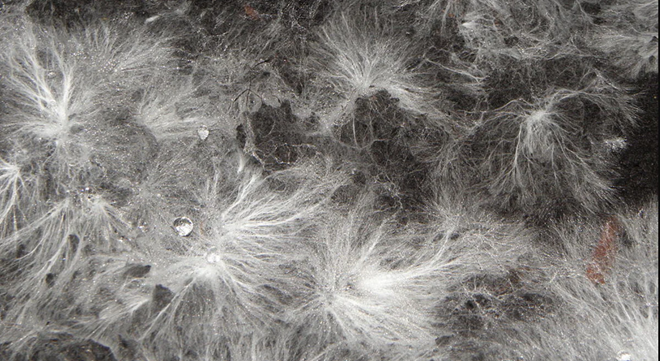
social - and rated each option. They found fungal-based insulation material had
the greatest future development potential. This can be achieved by growing
Pleurotus pulmonarius, a type of oyster mushroom, on a mixture of
agro-industrial waste and recycled ground textiles.
This option came out on top because the process to produce
the material is well-researched and simple, it has both a high economic
viability and market potential, and, as it can be produced from a wide range of
wastes and by-products, it has considerable possible environmental advantages.
Insulation grown on a mixed-textile substrate using mycelium offers a potential
solution as part of the Strategy for a Sustainable Built Environment, which
promotes the use of novel, low-carbon and circular materials. However, the
researchers found the composite material analysed in the work to have notably
poorer (higher) thermal conductivity than existing alternatives such as
polystyrene, and so this should be an area of focus for future research to
optimise the product and explore its applications.
They found the second-best option to be textile-reinforced
composite, followed by BHET, spandex, cotton and nylon, and finally bio-oil and
TPA. The latter two products were rated highly for technical readiness and
market competitiveness, but lower for environmental impact (due to the high
cradle-to-gate Global Warming Potential (GWP) of the processes required to make
them, which is up to 3 times that of producing crude oil). The
textile-reinforced composite showed good technical performance and reasonable environmental
and social impacts, according to the analysis, but poor economic performance.
With separate textile waste collection expanding across
Europe, this research helps policymakers and industry understand where to focus
investment. While mycelium-based solutions look promising, further testing and
pilot projects are still needed before large-scale adoption.
The researchers calculated how close each use would be to an ideal solution, using four criteria - environmental, economic, technical, social - and rated each option. They found fungal-based insulation material had the greatest future development potential. This can be achieved by growing Pleurotus pulmonarius, a type of oyster mushroom, on a mixture of agro-industrial waste and recycled ground textiles.
Subscribe To Textile Excellence Print Edition
If you wish to Subscribe to Textile Excellence Print Edition, kindly fill in the below form and we shall get back to you with details.
Newsletter
Subscribe To Textile Excellence Mailing List


- December 09, 2022
'There Is Very High Acceptance For India

- December 09, 2022
'Advanced Machines & Service, Customer C

- October 09, 2023
First-time In The World: Rieter’s Auto

- July 28, 2026
Arvind Eyes Leadership In India's Premiu
- June 01, 2020
Karl Mayer Enables Automated Production

- June 05, 2023
Ultimax - All New Revolutionary Rapier W
- June 09, 2025
DyStar Becomes A Wholly Owned Subsidiary

- July 28, 2026