
From Tariffs To Trade Blocs: Why BRICS Now Matters More Than Ever
BRICS
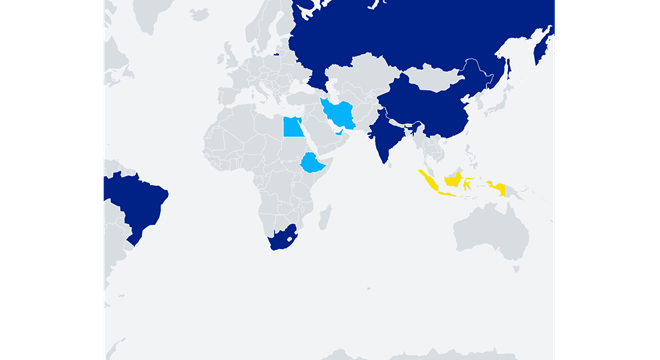
- now a 10-nation bloc comprising Brazil, Russia, India, China, South Africa,
Egypt, Ethiopia, Indonesia, Iran, and the UAE - is emerging as a consequential
trade axis for India’s textile and apparel industry. This is no longer
peripheral exposure. Today, BRICS markets account for nearly 12.5% of India’s
total textile and apparel exports, a share that is strategically significant.
India’s
textile and apparel exports to BRICS surged 21.4% to ₹36,535 crore in FY24,
before moderating by around 5% to ₹34,647 crore in FY25. The pullback reflects
demand volatility, not a structural retreat. Within the bloc, the UAE, China,
Brazil, and Egypt have become India’s most important destination markets for
textiles and clothing.
At
the same time, India’s textile and apparel imports from BRICS rose 6.9% to
₹36,854 crore in FY25, reinforcing the bloc’s dual role as both a market and a
sourcing base. China, Indonesia, Brazil, and Egypt remain key suppliers,
particularly in yarns, fabrics, and intermediate inputs.
What
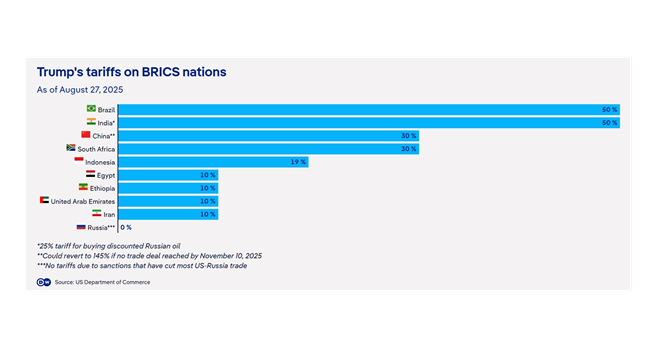
is accelerating BRICS’ relevance is geopolitics. Washington’s tariff aggression
has unintentionally strengthened the bloc, creating a shared incentive among
BRICS members to reduce exposure to the U.S., even where political agendas
diverge.
The
response is already visible. BRICS countries are expanding bilateral trade in
national currencies, steadily reducing reliance on the U.S. dollar. In
parallel, BRICS central banks have sharply increased gold purchases, a clear
signal that de-dollarisation is moving from rhetoric to policy.
Nine
ASEAN countries move toward BRICS currency adoption
In
2026, nine ASEAN countries - Brunei, Cambodia, Laos, Malaysia, Myanmar, the
Philippines, Singapore, Thailand, and Vietnam - reached a joint understanding
to accept a future BRICS currency, even before its formal launch. Growing
unease over dollar dominance, sanctions exposure, and U.S. policy
unpredictability is driving this alignment.
With
Indonesia now a full BRICS member, nearly 19 countries could adopt the BRICS
currency for trade. Including 13 BRICS partner countries, the push toward
de-dollarisation reflects a broader realignment, one that is quietly but
steadily shifting financial influence eastward.
RBI
pushes digital de-dollarisation
India
is positioning itself at the centre of this shift. The Reserve Bank of India
has urged the government to place a proposal to link BRICS central bank digital
currencies (CBDCs) on the agenda of the 2026 BRICS summit, to be hosted by
India. The plan aims to connect CBDC systems to ease cross-border trade and
tourism while reducing dollar dependence, marking the first formal attempt to
create a shared BRICS CBDC framework.
While
no BRICS nation has fully rolled out a CBDC, all core members are running
pilots. India’s e-rupee, launched in December 2022, reportedly has 7 million
retail users, supported by offline payments, programmable subsidies, and
fintech wallet integration. China, meanwhile, has pledged to expand the digital
yuan globally and is reportedly allowing commercial banks to pay interest on
digital-yuan holdings.
Why
BRICS is moving away from dollar-based trade
BRICS
economies are increasingly exposed to U.S. monetary policy and sanctions.
Federal Reserve rate hikes and Washington’s tariff decisions transmit shocks
across emerging markets. Russia’s post-Ukraine isolation and Iran’s
long-standing exclusion from dollar systems demonstrated how swiftly access to
SWIFT and dollar liquidity can be weaponised. Reducing dollar dependence has
become a question of economic sovereignty.
Dollar-intermediated
trade also imposes real costs. Multiple currency conversions add 3–5% per
transaction and amplify exchange-rate risk. Direct settlement delivers scale
benefits: China–Russia trade has already cut transaction costs by 2–3%, a
material saving on nearly US$190 billion in annual trade.
Beyond
cost, local-currency trade reduces exposure to dollar volatility and stabilises
pricing. Early evidence from China-Russia transactions shows contract price
volatility falling by nearly 25% versus dollar-denominated deals. With friction
reduced, intra-BRICS trade, currently about US$ 500 billion, has the potential
to scale far faster than under dollar-routed systems.
How
BRICS local-currency trade works
BRICS
is not rushing toward a single currency. Instead, it is advancing
de-dollarisation through bilateral currency swap agreements, allowing trade to
be settled directly in local currencies. These swaps establish pre-agreed
exchange rates and central-bank credit lines, removing the dollar from
transactions. China has led this effort; its swap arrangement with Brazil now
covers nearly 30% of bilateral trade.
On
the infrastructure side, China’s CIPS and Russia’s SPFS provide alternatives to
SWIFT. The New Development Bank (NDB) underpins the system by offering
liquidity and settlement support, helping members bypass Western-led
institutions such as the IMF and World Bank.
Constraints
and caution
Local-currency
trade within BRICS faces hard structural limits. As one analyst put it bluntly,
“These are disparate economies—there’s a long way to go before they can be
married.” China’s economic dominance creates asymmetries in liquidity and
pricing power. Russia remains resource-centric, India more diversified, while
newer members add further complexity. Designing fair exchange mechanisms across
such uneven profiles is inherently difficult.
Institutional
barriers compound the challenge. Financial systems built around the dollar
operate on incompatible standards, regulatory regimes, and settlement
timelines. Aligning payment protocols, risk frameworks, and compliance rules
requires sustained technical coordination, especially for smaller economies.
BRICS
policymakers are acutely aware of the Eurozone’s cautionary tale. As one
observer noted, attempts to bind structurally mismatched economies without
fiscal integration or shock absorbers were “flawed from the start.” The lesson
is clear: avoid premature monetary union.
Instead,
BRICS is pursuing a building-blocks strategy. Local-currency trade is the
pragmatic starting point, preserving policy autonomy while testing
interoperability. As one commentator put it, “Until those foundations exist,
debating a BRICS currency is premature.”
The
New Development Bank and the BRICS financial playbook
The
New Development Bank anchors BRICS’ financial strategy. Launched in 2015 with
US$ 100 billion in capital, it was designed not just to fund infrastructure,
but to build an alternative financial ecosystem. Beyond lending, the NDB
supports local capital markets, payment systems, trade finance, and currency
settlement.
Alongside
the US$ 100 billion BRICS Contingent Reserve Arrangement, it provides liquidity
without IMF-style conditionalities, giving members strategic autonomy. While
the dollar still dominates, BRICS local-currency trade represents the first
serious post-Bretton Woods effort to construct parallel financial channels. As
one analyst observed, “Trump’s response shows how seriously Washington views
BRICS de-dollarisation.”
BRICS economies are increasingly exposed to U.S. monetary policy and sanctions. Federal Reserve rate hikes and Washington’s tariff decisions transmit shocks across emerging markets. Russia’s post-Ukraine isolation and Iran’s long-standing exclusion from dollar systems demonstrated how swiftly access to SWIFT and dollar liquidity can be weaponised. Reducing dollar dependence has become a question of economic sovereignty.
Subscribe To Textile Excellence Print Edition
If you wish to Subscribe to Textile Excellence Print Edition, kindly fill in the below form and we shall get back to you with details.
Newsletter
Subscribe To Textile Excellence Mailing List


- December 09, 2022
'There Is Very High Acceptance For India

- December 09, 2022
'Advanced Machines & Service, Customer C

- October 09, 2023
First-time In The World: Rieter’s Auto

- July 28, 2026
Arvind Eyes Leadership In India's Premiu

- June 01, 2020
Karl Mayer Enables Automated Production

- June 05, 2023
Ultimax - All New Revolutionary Rapier W

- June 09, 2025
DyStar Becomes A Wholly Owned Subsidiary

- July 28, 2026