
India’s Growth Story Signals Opportunity For Textiles—But Execution Will Matter
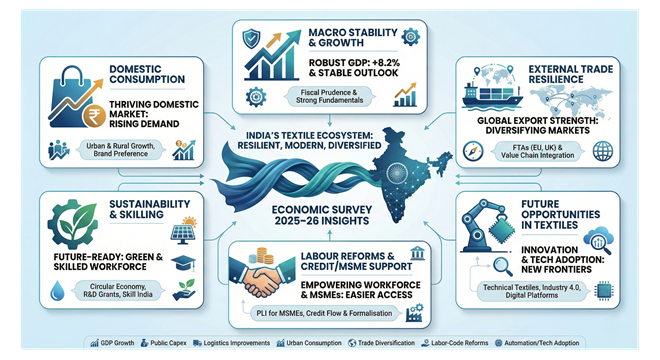
The Economic Survey 2025–26 paints a picture of resilience amid global uncertainty, with India expected to sustain growth of 6.8–7.2% in FY27 despite rising geopolitical fragmentation, trade protectionism and cost pressures worldwide. For the textile and apparel sector, deeply embedded in global value chains, this macro stability offers both reassurance and a clear call to action.
Macro
stability underpins manufacturing confidence
The
Survey underscores strong macro fundamentals, anchored by disciplined fiscal
management, steady private consumption and a sustained push on capital
expenditure. Effective public capex has risen from a pre-pandemic average of
2.7% per cent of GDP to around 4%, improving logistics, infrastructure and
industrial connectivity.
This
translates into lower transit times, improved port and rail efficiency, and a
gradual reduction in logistics costs, long a competitive handicap for Indian
exporters. Manufacturing gross value added (GVA) growth has shown renewed
momentum, with real manufacturing GVA accelerating through FY25 and FY26.
Consumption-led
growth
Private
consumption continues to account for over 60% of nominal GDP, providing a
stable base for demand-driven industries such as apparel and home textiles.
Rising
urban employment, over 61.9% of urban jobs are now in services - is supporting
discretionary spending, especially in branded apparel, athleisure and home
furnishings.
For
textile manufacturers supplying the domestic market, this consumption
resilience offers a hedge against export volatility. The message is clear:
balancing export ambitions with sharper domestic-market strategies is no longer
optional.
External
trade: Resilience amid rising uncertainty
On
the external front, the Survey notes that global trade policy uncertainty is
intensifying, with restrictive measures outpacing trade facilitation worldwide.
Merchandise exports have remained resilient in FY26 (April–December 2025), even
as imports rose, reflecting steady domestic demand and investment activity.
For
textiles and apparel - sectors vulnerable to tariff changes, non-tariff
barriers and compliance regimes - this environment reinforces the need to
diversify markets and products. India’s recent Free Trade Agreements and
Comprehensive Economic Partnership Agreements provide potential tailwinds, but
capturing value will depend on speed, compliance readiness and scale.
Employment
reforms reshape the labour landscape
The
Survey highlights a major structural shift with the consolidation of 29 labour
laws into four labour codes, aimed at balancing worker protection with
flexibility. Formalisation, fixed-term employment recognition and simplified
compliance could be game-changers here.
Industry
estimates suggest that effective implementation of these reforms could create
up to 77 lakh jobs across sectors.
For
apparel and made-ups, where seasonal demand and export cycles dominate,
flexible yet formal employment frameworks could significantly improve
productivity and compliance outcomes, provided states move swiftly on
implementation.
Credit,
MSMEs and the textile backbone
Access
to credit continues to improve, with bank lending to micro and small
enterprises maintaining a strong upward trend. Given that India’s textile
ecosystem is heavily MSME-driven, this credit momentum is critical.
However,
rising compliance standards, sustainability mandates and traceability
requirements mean that credit availability must be matched with technical
upgradation and skill development to prevent smaller firms from being squeezed
out of global supply chains.
Sustainability,
skills and the next leap
While
the Survey focuses more broadly on industry, its emphasis on productivity,
skilling and technology adoption is highly relevant for textiles. As medium-
and high-technology activities account for a growing share of manufacturing
value added, textiles must accelerate investments in automation, technical
textiles, recycling and energy-efficient processes.
Equally
important is skill alignment. The Survey’s focus on “getting skilling right”
highlights the urgency of industry-led training models, particularly in apparel
manufacturing, where quality, speed and compliance increasingly determine
competitiveness.
The
road ahead
The
Economic Survey 2025–26 offers cautious optimism for Indian economy. Stable
growth, infrastructure investment, labour reforms and improving credit
conditions form a supportive backdrop. Yet, global trade headwinds,
sustainability pressures and execution gaps remain real challenges.
For
the industry, the opportunity lies in moving decisively - scaling up,
modernising operations, and aligning with evolving global and domestic demand.
In a world where resilience is as valuable as cost competitiveness, India’s
textile sector has the macro tailwinds it needs. The next leap will depend on
how effectively the value chain converts policy intent into on-ground
performance.
The Economic Survey 2025–26 offers cautious optimism for Indian economy. Stable growth, infrastructure investment, labour reforms and improving credit conditions form a supportive backdrop. Yet, global trade headwinds, sustainability pressures and execution gaps remain real challenges.
Subscribe To Textile Excellence Print Edition
If you wish to Subscribe to Textile Excellence Print Edition, kindly fill in the below form and we shall get back to you with details.
Newsletter
Subscribe To Textile Excellence Mailing List


- December 09, 2022
'There Is Very High Acceptance For India

- December 09, 2022
'Advanced Machines & Service, Customer C

- October 09, 2023
First-time In The World: Rieter’s Auto

- July 28, 2026
Arvind Eyes Leadership In India's Premiu

- June 01, 2020
Karl Mayer Enables Automated Production

- June 05, 2023
Ultimax - All New Revolutionary Rapier W
- June 09, 2025
DyStar Becomes A Wholly Owned Subsidiary

- July 28, 2026