
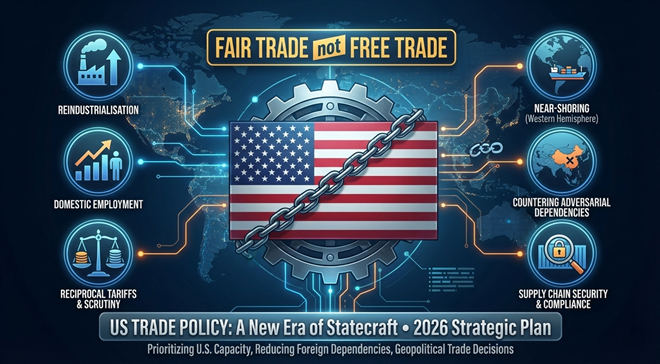
U.S. 5-Year Plan Rejects Free Trade For Fair Trade
The U.S. State
Department’s newly released five-year strategic plan marks a clear shift: trade
policy is now explicitly framed as a tool of statecraft. Commercial diplomacy,
supply-chain security, and enforcement are no longer peripheral, they sit at
the core of U.S. foreign policy. For global manufacturers and exporters, this
signals a more interventionist, security-driven trade environment.
The plan rejects the
idea of “free trade” in favour of what Washington calls “fair trade,” openly
prioritising U.S. reindustrialisation, domestic employment, and productivity.
Expect wider use of reciprocal tariffs, trade remedy investigations, and aggressive
scrutiny of tariff evasion and transshipment. Companies with complex,
multi-country supply chains, especially those touching China or other
“adversarial jurisdictions” should brace for deeper examination of sourcing,
ownership structures, and trade flows.
Reindustrialisation
sits at the heart of the strategy. The State Department will work with Commerce
and the USTR to identify critical sectors - from advanced manufacturing and
material sciences to logistics and data infrastructure - and actively reduce foreign
dependencies. Foreign investment will be encouraged only where it builds U.S.
capacity, not where it accelerates deindustrialisation.
Regionally, the plan
prioritises near-shoring in the Western Hemisphere, reinforcing supply chains
in friendly countries while blocking adversaries from controlling strategic
infrastructure. In the Indo-Pacific, the focus is on countering China-centric dependencies
through bilateral trade deals and secure trade lanes. Europe, despite sharp
rhetoric, faces pressure to reindustrialise, deregulate, and align more closely
with U.S. strategic interests.
For exporters and
sourcing hubs worldwide, the message is blunt: trade decisions are now
geopolitical decisions. Compliance, transparency, and alignment with U.S.
strategic priorities are becoming prerequisites for market access, not optional
safeguards.
The plan rejects the idea of “free trade” in favour of what Washington calls “fair trade,” openly prioritising U.S. reindustrialisation, domestic employment, and productivity. Expect wider use of reciprocal tariffs, trade remedy investigations, and aggressive scrutiny of tariff evasion and transshipment. Companies with complex, multi-country supply chains, especially those touching China or other “adversarial jurisdictions” should brace for deeper examination of sourcing, ownership structures, and trade flows.
Subscribe To Textile Excellence Print Edition
If you wish to Subscribe to Textile Excellence Print Edition, kindly fill in the below form and we shall get back to you with details.
Newsletter
Subscribe To Textile Excellence Mailing List


- December 09, 2022
'There Is Very High Acceptance For India

- December 09, 2022
'Advanced Machines & Service, Customer C

- October 09, 2023
First-time In The World: Rieter’s Auto

- July 28, 2026
Arvind Eyes Leadership In India's Premiu

- June 01, 2020
Karl Mayer Enables Automated Production

- June 05, 2023
Ultimax - All New Revolutionary Rapier W

- June 09, 2025
DyStar Becomes A Wholly Owned Subsidiary

- July 28, 2026