
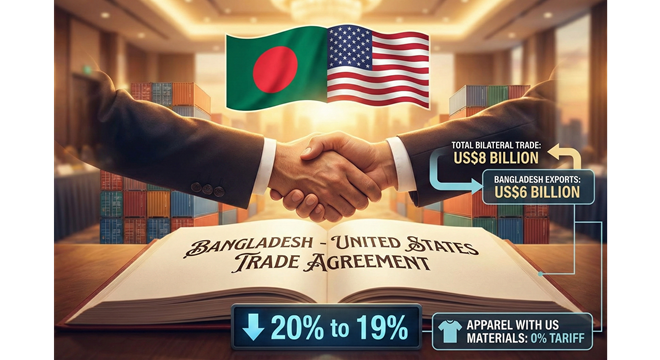
Bangladesh Secures Tariff Relief In New Us Trade Deal, Duty Free Access For Garments Using American Fibres
Bangladesh has secured a modest but strategic tariff
reduction in its trade with the United States, bringing the reciprocal duty on
its exports down from 20% to 19%. The agreement also offers a major incentive.
Garments made using US origin cotton or synthetic fibres will now enter the
American market without any reciprocal tariff.
The United States remains Bangladesh’s largest apparel
destination. Bilateral trade between the two countries stands near US$ 8
billion, of which Bangladeshi exports contribute around US$ 6 billion. Apparel
accounts for more than 80% of those shipments, making tariff competitiveness
critical for the country’s export growth.
Recent trade data shows intense competition among key
suppliers to the US. China’s textile and apparel exports to the US stood near
US$ 18.1 billion in 2025 despite a steep 47.5% tariff. Vietnam shipped around
US$ 14.6 billion at a 20% tariff. Bangladesh exported about US$ 7.5 billion at
20% duty earlier, while India recorded roughly US$ 9.6 billion amid higher
tariff pressures.
The new arrangement gives Bangladesh a strong strategic
advantage. Zero tariff access on garments made from US fibres can significantly
reduce landed costs, improve price competitiveness, and attract larger sourcing
orders from American brands. The provision is expected to shift raw material
sourcing patterns and deepen trade ties between US fibre producers and
Bangladeshi manufacturers.
CITI Chairman Shri Ashwin Chandran said the industry body is
closely tracking the development and awaiting clarity on the mechanism that
will allow certain Bangladeshi textile and apparel products to enter the US at
zero reciprocal tariff. He noted that the move creates a fresh challenge for
Indian exporters, as the tariff gap between India and Bangladesh has narrowed
from 2% to 1% in a sector that operates on tight margins. Chandran also
cautioned that the agreement could affect India’s cotton yarn exports to
Bangladesh, as the new arrangement may encourage greater use of US origin
fibres. He added that any additional advantage for Bangladesh could intensify
competition for Indian suppliers in the US market.

CITI Chairman Shri Ashwin Chandran said the industry body is closely tracking the development and awaiting clarity on the mechanism that will allow certain Bangladeshi textile and apparel products to enter the US at zero reciprocal tariff. He noted that the move creates a fresh challenge for Indian exporters, as the tariff gap between India and Bangladesh has narrowed from 2% to 1% in a sector that operates on tight margins. Chandran also cautioned that the agreement could affect India’s cotton yarn exports to Bangladesh, as the new arrangement may encourage greater use of US origin fibres.
Subscribe To Textile Excellence Print Edition
If you wish to Subscribe to Textile Excellence Print Edition, kindly fill in the below form and we shall get back to you with details.
Newsletter
Subscribe To Textile Excellence Mailing List


- December 09, 2022
'There Is Very High Acceptance For India

- December 09, 2022
'Advanced Machines & Service, Customer C

- October 09, 2023
First-time In The World: Rieter’s Auto

- July 28, 2026
Arvind Eyes Leadership In India's Premiu

- June 01, 2020
Karl Mayer Enables Automated Production

- June 05, 2023
Ultimax - All New Revolutionary Rapier W
- June 09, 2025
DyStar Becomes A Wholly Owned Subsidiary

- July 28, 2026