
Brazil Cotton Exports Hit Record, Global Trade Shifts
Record Brazilian exports
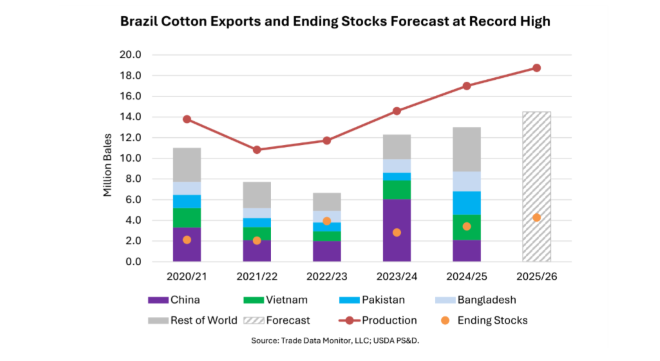
Brazil’s cotton exports are forecast at 14.5 million bales
for the 2025/26 season (August 2025–July 2026), up 1.5 million bales from last
year. This marks a record level for the third consecutive year.
Production growth - both in harvested area and yield -
drives this surge. Domestic consumption has remained stable, so ending stocks
are climbing, projected at 4.3 million bales. Prices in Brazil have softened
over the past three years, tracking global trends.
Key export markets
China, Bangladesh, Turkey, and India are major buyers.
Vietnam, once the top destination, has cut imports from Brazil, favouring US
cotton. China has reclaimed the lead in year-to-date shipments, though volumes
are half of 2023/24 levels when it was replenishing reserves.
December 2025 saw record monthly exports. The industry is
also diversifying ports: 10% of cotton shipped from alternatives to Santos,
compared to a 5-year average of 4%.
Looking ahead: 2026/27
Brazil’s 2026/27 crop is expected to fall slightly. Higher
input costs and lower cotton prices may reduce yields and harvested area. But
elevated stocks from previous years may keep exports stable.
Global production and trade
Global cotton production is projected at 119.9 million
bales, up 425,000 bales, mainly from a larger crop in China. Global consumption
is slightly down to 118.7 million bales. Overall, production grows while
consumption is flat.
Global trade is steady at 43.7 million bales. Lower exports
from the US and Argentina are offset by Australia. Reduced imports by Pakistan,
Turkey, and some Southeast Asian countries are balanced by higher imports by
China and India.
Global ending stocks rise to 75.1 million bales, mainly due
to higher stocks in China, India, and the US. The US season-average farm price
is projected down 1 cent to 60 cents per pound.
Major trade movements
Imports (1,000 480-lb bales)
China: 5,600 (up 200)
India: 3,200 (up 200)
Pakistan: 5,700 (down 200)
Turkey: 4,500 (down 100)
Exports (1,000 480-lb bales)
Argentina: 525 (down 75)
Australia: 5,500 (up 200)
United States: 12,000 (down 200)
Implications for buyers and exporters
Brazil’s growing exports offer a reliable supply for global
buyers. Rising stocks and soft prices may ease short-term cost pressures.
Exporters must manage logistics and ports efficiently. Diversifying ports, as
seen in 2025/26, helps avoid congestion and ensures timely shipments.
For buyers in India, Bangladesh, and China, Brazil offers
competitive options. But global trade shifts, like increased US exports to
Vietnam, require careful sourcing strategies.
In conclusion
Brazil is now a dominant global cotton exporter. Strong
production, growing exports, and diversified logistics underpin this rise.
Global buyers can expect ample supply and competitive
prices. Yet, market shifts demand vigilance. Monitoring production, stocks, and
international demand will be key for sourcing and pricing decisions.
Brazil’s 2026/27 crop is expected to fall slightly. Higher input costs and lower cotton prices may reduce yields and harvested area. But elevated stocks from previous years may keep exports stable. Brazil’s growing exports offer a reliable supply for global buyers. Rising stocks and soft prices may ease short-term cost pressures. Exporters must manage logistics and ports efficiently. Diversifying ports, as seen in 2025/26, helps avoid congestion and ensures timely shipments.
Subscribe To Textile Excellence Print Edition
If you wish to Subscribe to Textile Excellence Print Edition, kindly fill in the below form and we shall get back to you with details.
Newsletter
Subscribe To Textile Excellence Mailing List


- December 09, 2022
'There Is Very High Acceptance For India

- December 09, 2022
'Advanced Machines & Service, Customer C

- October 09, 2023
First-time In The World: Rieter’s Auto

- July 28, 2026
Arvind Eyes Leadership In India's Premiu

- June 01, 2020
Karl Mayer Enables Automated Production

- June 05, 2023
Ultimax - All New Revolutionary Rapier W

- June 09, 2025
DyStar Becomes A Wholly Owned Subsidiary

- July 28, 2026