
US House Lawmakers Again Introduce Legislation For Low-Value Package Entry
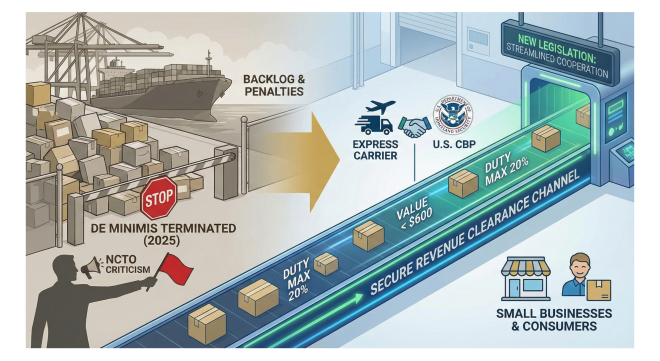
Newly introduced legislation aims to provide a new channel
for low-value shipments to enter the United States duty free, mimicking
elements of the de minimis provision that was terminated for commercial
shipments last year.
Congresswoman Carol Miller (R-W.V.) and Congressman Don
Beyer (D-Va.) authored the Secure Revenue Clearance Channel Act, which they
said will address a "growing backlog" of imports at America's ports
of entry by facilitating streamlined cooperation between express carriers and
U.S. Customs and Border Protection (CBP).
According to the lawmakers, the bill would allow shipments
valued at US$ 600 or less to move more quickly through the importation and
customs process. Under the proposed legislation, importers that rely on select
express shippers would be responsible for tariffs worth a maximum of 20% of the
value of the shipment in question. These parcels would be exempted from the
customs reporting requirements that larger shipments face.
"Shipments have recently faced significant backlogs at
our ports of entry. This bill creates a critical mechanism to help small
businesses, manufacturers, and hardworking Americans by allowing express
shippers to move goods more efficiently through the system, while also cutting
unnecessary penalties and fees that slow commerce and raise costs," Rep.
Miller said.
"I am committed to supporting our supply chains while
ensuring shipments enter our country securely and responsibly, with strong
safeguards in place to keep dangerous and illicit products far from our
communities," she added.
Beyer spoke to the impact that the termination of de minimis
has had on the American economy.
"In recent months, American consumers and small
businesses have suffered as their goods, particularly lower cost but still
time-sensitive items, have been held up waiting to be cleared by Customs. The
expedited shipping channel this bill creates would help resolve this growing
problem while also maintaining a high level of security at our ports of entry
to keep out drugs, counterfeits, and other illicit products," he said.
The Trump administration ended the longstanding rule-which
allowed small shipments worth $800 or less to enter the country duty free-under
the International Emergency Economic Powers Act (IEEPA), the same law used to
impose double-digit tariffs on more than 90 U.S. trading partners.
Critics of de minimis also pointed to the deluge of
cheaply-made, China-originating products from e-commerce juggernauts like
Shein, Temu and AliExpress using what they deemed a "loophole" in
trade policy. De minimis parcels are subject to much less stringent processing
by CBP, and many US brands believe they have been undermined by offshore
players. In 2024, 1.4 billion packages entered the US using de minimis, and
experts estimate that at least half, if not more, originated in China.
CBP said in December that it had collected US$ 1 billion in
tariff revenue on low-value packages since the exemption was rolled back on
August 29, 2025.
Calling the proposal "damaging," National Council
of Textile Organizations (NCTO) CEO and president Kim Glas said its passage
"would provide a workaround to President Trump's executive order closing
the dangerous de minimis loophole," which Congress passed legislation to
codify.
"This legislative proposal would replicate the
underlying problem with de minimis and it would require less information than
normal entries-making it impossible to enforce and rewarding these packages
skirting normal duty collections and costs," Glas said. "With the end
of de minimis, low-value shipments must come in under a system that is fair,
transparent, and enforceable. CBP is equipped to handle this change and has the
systems in place. Now, all small package shipments regardless of delivery
method have the necessary inspection, information, and duty collection."
According to the lawmakers, the bill would allow shipments valued at US$ 600 or less to move more quickly through the importation and customs process. Under the proposed legislation, importers that rely on select express shippers would be responsible for tariffs worth a maximum of 20% of the value of the shipment in question. These parcels would be exempted from the customs reporting requirements that larger shipments face.
Subscribe To Textile Excellence Print Edition
If you wish to Subscribe to Textile Excellence Print Edition, kindly fill in the below form and we shall get back to you with details.
Newsletter
Subscribe To Textile Excellence Mailing List


- December 09, 2022
'There Is Very High Acceptance For India

- December 09, 2022
'Advanced Machines & Service, Customer C

- October 09, 2023
First-time In The World: Rieter’s Auto

- July 28, 2026
Arvind Eyes Leadership In India's Premiu

- June 01, 2020
Karl Mayer Enables Automated Production

- June 05, 2023
Ultimax - All New Revolutionary Rapier W
- June 09, 2025
DyStar Becomes A Wholly Owned Subsidiary

- July 28, 2026