
The Zero-Duty Illusion: US Trade Pact Limits Bangladesh's Gains
Bangladesh’s newly signed reciprocal tariff arrangement with
the United States has triggered intense debate across South Asia’s textile
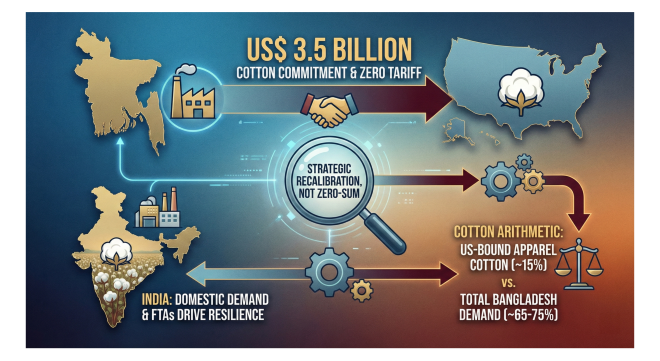
ecosystem. At the centre of the discussion is a reported US$ 3.5 billion cotton
purchase commitment and zero reciprocal tariff access for garments made from
US-origin cotton and man-made fibres.
But does the cotton arithmetic justify the scale of the
commitment? And does this shift pose a threat to India’s cotton and textile
sector?
A closer look at the numbers provides clarity.
How much cotton is actually used for US apparel exports?
In 2024, Bangladesh exported approximately US$ 7.2 billion
worth of apparel to the United States, about 18–19% of its total garment
exports. Assuming that 80% of those exports are cotton-based garments, the
cotton apparel value equals US$ 5.76 billion
In typical FOB garment costing structures, raw cotton fibre
accounts for roughly 10–12% of export value, depending on product mix (basic
knits vs denim-heavy categories).
Using this range:
- At 10% fibre cost share → US$576 million worth of raw cotton
- At 12% fibre cost share → US$691 million worth of raw cotton
Assuming an average US cotton export price of approximately
US$ 2.50 per kg, this translates into 230,000 to 275,000 metric tonnes of
cotton annually.
Even using a higher 15% fibre share assumption, cotton usage
would reach only around 345,000 tonnes.
Now compare this with Bangladesh’s total annual cotton
consumption.
Bangladesh’s cotton requirement
Bangladesh consumes approximately 85 lakh bales (8.5 million
bales) per year - equivalent to roughly 1.7 to 1.9 million metric tonnes.
Nearly all of this is imported, as domestic production is negligible.
Historically, sourcing has been diversified across:
- Brazil
- India
- West African origins
- United States (in varying shares)
The key takeaway:
Cotton used for US-bound apparel likely represents around
15% of Bangladesh’s total cotton consumption.
The US$ 3.5 billion cotton commitment: A scale mismatch
If US$3.5 billion worth of cotton were purchased at roughly
US$2.50/kg, the volume would equal 1.2 to 1.4 million metric tonnes. That is
nearly 65–75% of Bangladesh’s annual cotton requirement.
This clearly exceeds the cotton required solely for US-bound
garments.
Therefore, one of three realities must apply:
- The US$ 3.5 billion purchase is spread across multiple years;
- Bangladesh will incorporate US cotton into garments exported
to other markets;
- Mills will significantly rebalance fibre blending strategies.
Operationally, Bangladesh cannot rely on a single origin due
to staple length variations, blend optimisation needs, freight economics, and
price arbitrage cycles. Diversification remains structurally necessary.
The agreement therefore appears less about servicing
US-bound garments alone and more about deepening upstream supply-chain
alignment with the United States.
What does this mean for India?
Concerns have surfaced that Bangladesh’s tilt toward US
cotton may displace Indian exports. However, supply-side realities suggest
otherwise.
Bangladesh imports about 85 lakh bales annually, and India
currently exports roughly 12 lakh bales to Bangladesh.
Meanwhile, India produces around 370 lakh bales per year.
However, strong domestic spinning demand, export commitments across yarn and
fabrics, and textile value chain expansion require India to import nearly 50
lakh bales annually.
This is a crucial structural fact: India is not surplus in
cotton.
Domestic consumption remains strong enough that India often
supplements supply through imports to stabilise quality and availability.
Are Indian cotton farmers at risk?
The evidence suggests limited downside risk.
India’s textile ecosystem is entering an expansionary phase,
supported by:
- A concluded FTA with the United Kingdom and the European
Union
- Ongoing discussions toward a broader India–US trade framework
- Various other trade deals
These developments are expected to stimulate spinning,
weaving, processing, and garmenting capacity, driving higher domestic cotton consumption.
Given limited scope for rapid acreage expansion or
productivity breakthroughs, India may actually increase cotton imports over
time.
In this context, fears of structural demand collapse for
Indian cotton appear overstated.
Zero-duty access: Not Bangladesh -exclusive
Another overlooked point is that zero-duty access linked to
US-origin fibre is not necessarily unique to Bangladesh.
Under reciprocal tariff frameworks introduced during the
administration of Donald Trump, countries incorporating a minimum threshold of
US-origin raw materials in finished goods may qualify for preferential access,
subject to negotiated terms.
Indian textile bodies have raised similar mechanisms in
bilateral discussions. Given India’s integrated value chain and scale
advantages, any structural edge granted to Bangladesh may not remain
unilateral.
Strategic conclusion
The Bangladesh-US arrangement undoubtedly incentivises
increased US cotton usage. However, the arithmetic reveals that cotton required
for US-bound apparel is only a fraction of Bangladesh’s total fibre demand.
For Bangladesh, the deal represents a strategic sourcing
recalibration rather than total dependence.
For India, the evolving trade landscape appears more
opportunity than threat. Domestic demand strength, ongoing FTAs, and value
chain expansion suggest resilience in cotton consumption dynamics.
This is not a zero-sum cotton contest. It is a broader
realignment of textile supply chains in a geopolitically sensitive trade
environment where scale, diversification, and policy agility will determine
long-term advantage.
The Bangladesh-US arrangement undoubtedly incentivises increased US cotton usage. However, the arithmetic reveals that cotton required for US-bound apparel is only a fraction of Bangladesh’s total fibre demand. For Bangladesh, the deal represents a strategic sourcing recalibration rather than total dependence. For India, the evolving trade landscape appears more opportunity than threat. Domestic demand strength, ongoing FTAs, and value chain expansion suggest resilience in cotton consumption dynamics.
Subscribe To Textile Excellence Print Edition
If you wish to Subscribe to Textile Excellence Print Edition, kindly fill in the below form and we shall get back to you with details.
Newsletter
Subscribe To Textile Excellence Mailing List


- December 09, 2022
'There Is Very High Acceptance For India

- December 09, 2022
'Advanced Machines & Service, Customer C

- October 09, 2023
First-time In The World: Rieter’s Auto

- July 28, 2026
Arvind Eyes Leadership In India's Premiu

- June 01, 2020
Karl Mayer Enables Automated Production

- June 05, 2023
Ultimax - All New Revolutionary Rapier W
- June 09, 2025
DyStar Becomes A Wholly Owned Subsidiary

- July 28, 2026