
India’s Cotton Crossroads: Record Imports, Farm Stress And A Shifting Textile Balance
India’s cotton economy is going through a structural shift.
In 2024–25 (October–September), the country recorded cotton imports of 4.13
million bales worth ₹11,989 crore, a five-year high and nearly three times the
previous year’s level. The data, shared in Parliament by Union Textiles
Minister Giriraj Singh, confirms a decisive change in sourcing patterns for the
world’s second-largest cotton producer.
The largest supplier was the United States, which exported
856,000 bales to India. Brazil followed closely with 854,000 bales, and
Australia supplied 849,000 bales. For a country traditionally seen as
cotton-surplus, this scale of imports marks a notable transition.
Why imports rose so sharply
Three forces converged to drive the surge.
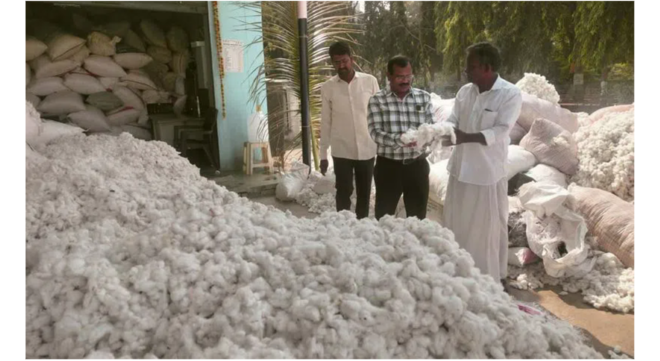
First, domestic output faced pressure. Crop stress in parts
of Maharashtra and other producing regions affected yields and arrivals. In
Wardha district, arrivals reportedly fell 35–40% year-on-year, reflecting
weather-related challenges and lower per-acre productivity. For mills dependent
on steady raw material flows, reduced local arrivals meant looking overseas.
Second, landed prices of imported cotton were often lower
than domestic quotes. Competitive global pricing made imports commercially
attractive, especially for export-oriented spinning mills operating on thin
margins.
Third, policy intervention played a role. The government
waived the 11% import duty on cotton between August 19 and December 31, 2025,
to ease raw material shortages. Although the duty was reinstated in January
2026, the temporary relief significantly improved import economics during the
peak buying window.
The result was a sharp rise in shipments just as domestic
production was under strain.
The political debate: Farmer distress vs industry need
The import spike triggered a strong debate in the Lok Sabha.
MP G Kumar Naik flagged concerns that imports from Brazil had risen over 1,000%
in two years, while shipments from the United States had grown about 200%. He
argued that cheaper foreign cotton was depressing farmgate prices and
increasing uncertainty for growers.
The government responded by reiterating its commitment to
Minimum Support Price (MSP) protection. The MSP for medium-staple cotton for
2025–26 was set between ₹7,710 and ₹8,110 per quintal, based on recommendations
from the Commission for Agricultural Costs and Prices.
But MSP assurance alone does not prevent market volatility.
Open market prices in several mandis have hovered close to support levels,
particularly as additional supply entered through imports and institutional
sales.
CCI steps in: Procurement expands across states
To stabilise the situation, the Cotton Corporation of India
(CCI) scaled up procurement operations.
Nationally, CCI has procured around 90 lakh bales under MSP
operations in the 2025–26 season. In Karnataka, procurement rose from 5.22 lakh
bales in 2024–25 to 6.82 lakh bales so far in 2025–26, with the number of
centres increasing from 26 to 37. In Telangana, procurement reached 29.5 lakh
bales worth ₹11,800 crore, covering 8.60 lakh farmer transactions across 122
centres.
The expansion of procurement centres, based on objective
norms such as minimum cotton acreage, presence of APMCs and ginning facilities,
indicates a clear attempt to deepen MSP outreach and reduce farmer distress.
However, CCI’s role does not end at procurement. It also
releases cotton into the market through transparent e-auction platforms. In
early 2026, increased CCI sales, combined with softer global benchmarks,
contributed to renewed price pressure in domestic markets.
Global weakness adds to price pressure
International cotton markets have softened amid ample supply
and moderate demand. Since Indian cotton competes globally, lower benchmark
prices limit the room for domestic price increases.
The combined effect of CCI stock releases and subdued global
rates has kept spot cotton prices stable to weak in several trading centres.
For farmers, this creates discomfort. For mills, it offers partial relief.
The cotton economy is therefore experiencing a classic
squeeze: support at the bottom through MSP, and pressure at the top through
global competition.
Yarn markets show signs of recovery
While raw cotton markets remain cautious, the downstream
segment tells a more optimistic story.
According to trade reports, cotton yarn prices in North
India, particularly in Ludhiana, Panipat and Delhi, have strengthened on the
back of export enquiries. Buyers from Bangladesh, China and parts of Southeast
Asia have returned to the market after months of subdued activity.
Spinners report increased enquiries for 30s and 40s counts,
and export-oriented mills are prioritising confirmed orders. With yarn
availability tightening slightly and cotton prices relatively stable, mills
have managed to push through selective price increases, helping restore
margins.
This recovery in yarn markets suggests that demand is not
collapsing; rather, it is adjusting. Export-linked segments appear to be
stabilising even as raw material markets recalibrate.
The structural gap: Production vs consumption
At the heart of the current dynamics lies a widening
structural gap. India remains one of the world’s largest textile and garment
producers, and export ambitions remain strong. But domestic cotton production
has struggled to consistently match rising fibre requirements.
When crop output falls or arrivals slow, imports quickly
fill the gap. When imports rise, domestic prices soften. When prices soften,
MSP procurement expands. When procurement expands, fiscal and inventory
management pressures increase.
This circular cycle underscores the complexity of balancing
farmer welfare and industrial competitiveness.
The road ahead
The cotton sector now stands at a delicate intersection.
For farmers, the priority is stable and remunerative
pricing. Rising input costs from seeds to fertilisers and labour, make MSP
operations critical. Expanded procurement in states like Karnataka and
Telangana signals intent, but long-term sustainability will depend on
productivity improvements and climate resilience.
For mills, competitive fibre access is essential. Export
markets remain sensitive to price changes, currency movements and evolving
tariff policies. Reliable and affordable raw cotton - whether domestic or
imported - determines India’s ability to protect global market share.
For policymakers, the challenge is strategic calibration.
Temporary duty waivers may ease short-term supply constraints, but they can
also disrupt farm economics. Procurement expansion stabilises farmers but
increases fiscal exposure. Market interventions must therefore balance
immediate pressures with structural reform.
The import spike triggered a strong debate in the Lok Sabha. MP G Kumar Naik flagged concerns that imports from Brazil had risen over 1,000% in two years, while shipments from the United States had grown about 200%. He argued that cheaper foreign cotton was depressing farmgate prices and increasing uncertainty for growers. The government responded by reiterating its commitment to Minimum Support Price (MSP) protection. The MSP for medium-staple cotton for 2025–26 was set between ₹7,710 and ₹8,110 per quintal, based on recommendations from the Commission for Agricultural Costs and Prices.
Subscribe To Textile Excellence Print Edition
If you wish to Subscribe to Textile Excellence Print Edition, kindly fill in the below form and we shall get back to you with details.
Newsletter
Subscribe To Textile Excellence Mailing List


- December 09, 2022
'There Is Very High Acceptance For India

- December 09, 2022
'Advanced Machines & Service, Customer C

- October 09, 2023
First-time In The World: Rieter’s Auto

- July 28, 2026
Arvind Eyes Leadership In India's Premiu

- June 01, 2020
Karl Mayer Enables Automated Production

- June 05, 2023
Ultimax - All New Revolutionary Rapier W

- June 09, 2025
DyStar Becomes A Wholly Owned Subsidiary

- July 28, 2026