
A Space Leap For Indian Technical Textiles
On
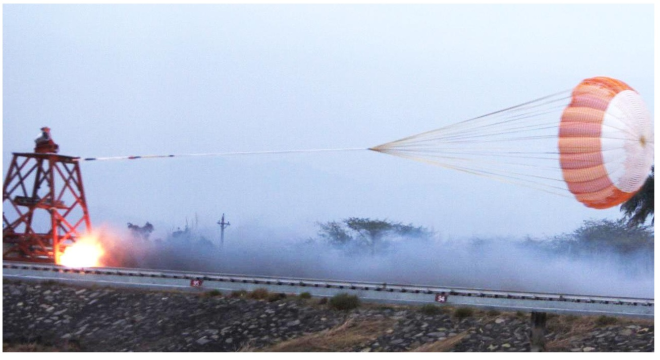
February 18, 2026, the Defence Research and Development Organisation
successfully completed the qualification-level load test of the Gaganyaan
drogue parachute at the Rail Track Rocket Sled facility of the Terminal
Ballistics Research Laboratory in Chandigarh. The parachute was tested at loads
higher than it will face in actual flight conditions. It cleared the test.
That
result carries enormous significance. A drogue parachute is a life-critical
system. It stabilises and slows the crew module during re-entry before the main
parachutes deploy. It opens at extremely high speeds. The opening shock loads
can reach several tonnes within milliseconds. The margin for error is ZERO.
What
makes this achievement even more important is the material science behind it.
The
drogue parachute uses a high-strength ribbon construction. Instead of a solid
canopy, it is built with spaced nylon ribbons designed to reduce opening shock
and maintain stability in turbulent airflow. The fabric is made from
high-tenacity polyamide yarns. In critical load-bearing areas, aramid fibres
such as Kevlar and similar high-performance materials are used for superior
tensile strength and heat resistance. Suspension lines are made from aramid or
UHMWPE fibres such as Dyneema or Spectra, selected for their exceptional
strength-to-weight ratio and low elongation. Heavy reinforcement tapes
distribute stress evenly across the canopy. Every stitch is engineered for
controlled energy absorption.
These
are not conventional textiles. They are advanced technical textiles operating
at the highest level of performance.
The
encouraging reality is that India today has the capability to manufacture many
of these high-performance materials and systems. We can design, weave and
fabricate high-strength parachute fabrics domestically.
DRDO’s
Aerial Delivery Research and Development Establishment has built deep expertise
in aerial textile systems. Indian manufacturers produce high-tenacity nylon
fabrics, specialised webbings and coated aerospace textiles. Parachute
assemblies are made in India. Processing, precision stitching, load testing and
full system integration are all being carried out within the country.
At
the same time, certain specialised raw fibres, such as advanced para-aramids
and ultra-high molecular weight polyethylene, are still partly imported. The
ecosystem is strong in fabric engineering and system integration. However,
upstream fibre manufacturing is an area where scale and investment must grow.
For
the textile industry, this is a clear signal. Aerospace-grade nylon. Indigenous
aramid production. High-performance fibre spinning. Advanced coating and
finishing. Automated precision stitching. These are no longer niche
opportunities. They are strategic sectors.
India’s
technical textile industry is often described in terms of future potential.
This test turns that potential into proof.
This
is where the Make in India opportunity becomes decisive.
India
has already moved from being a major importer of defence platforms to becoming
a manufacturer and exporter across domains. India can engineer textiles that
perform in space. That credibility strengthens our position in defence exports,
aerospace collaboration and global high-performance textile markets.
India’s
Defence Minister Rajnath Singh has reiterated the government’s commitment to
expanding indigenous defence production under Aatmanirbhar Bharat. The
Gaganyaan drogue parachute test shows that high-performance technical textiles
are now firmly part of that national capability.
DRDO’s Aerial Delivery Research and Development Establishment has built deep expertise in aerial textile systems. Indian manufacturers produce high-tenacity nylon fabrics, specialised webbings and coated aerospace textiles. Parachute assemblies are made in India. Processing, precision stitching, load testing and full system integration are all being carried out within the country.
Subscribe To Textile Excellence Print Edition
If you wish to Subscribe to Textile Excellence Print Edition, kindly fill in the below form and we shall get back to you with details.
Newsletter
Subscribe To Textile Excellence Mailing List


- December 09, 2022
'There Is Very High Acceptance For India

- December 09, 2022
'Advanced Machines & Service, Customer C

- October 09, 2023
First-time In The World: Rieter’s Auto

- July 28, 2026
Arvind Eyes Leadership In India's Premiu

- June 01, 2020
Karl Mayer Enables Automated Production

- June 05, 2023
Ultimax - All New Revolutionary Rapier W

- June 09, 2025
DyStar Becomes A Wholly Owned Subsidiary

- July 28, 2026