
Textile Wasterwater Recycling Works, Says Viridis Research
Vancouver-based
Viridis Research has delivered a major breakthrough for the global textile
industry.
In
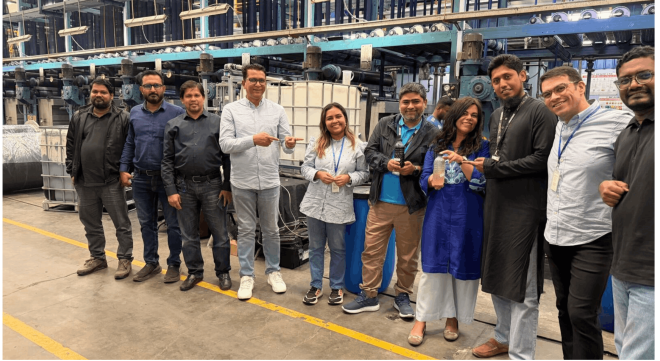
Dhaka, Bangladesh, the company completed a full-scale industrial pilot with
H&M Group and three textile mill partners. The objective was clear: prove
that textile wastewater can be treated and reused under real factory
conditions. The result: it works.
Viridis
validated its electrochemical oxidation technology inside operating mills. This
was not a laboratory test. The system treated wastewater directly from dye
baths, equalisation tanks, treatment plants and reverse osmosis reject streams.
These are some of the toughest waste flows in textile processing.
The
numbers are decisive. The system removed between 99.56% and 99.94% of colour
from dye baths. Organic contamination was reduced to target thresholds. Treated
water was clean enough to be fed back into new dye cycles. Valuable chemicals
were recovered. The loop was closed.
The
technology fully mineralises dyes, surfactants and auxiliary chemicals into
gas. It does not shift pollution from one stream to another. It eliminates it.
That allows treated water to re-enter production safely and reliably.
For
an industry known as one of the most water-intensive in the world, this is a
structural shift. On full deployment, the system has the potential to sharply
reduce freshwater intake and cut effluent discharge at scale.
Dr.
Macarena Cataldo, CEO and Founder of Viridis, said the mission was simple:
prove that water reuse in textile manufacturing is possible in real operating
environments. The pilot confirmed it.
Sharif
Hoque, Water Impact Lead at H&M Group, called the results credible
innovation in real factory conditions, with the potential to reduce freshwater
consumption while maintaining supplier performance.
The
achievement also reflects the strength of British Columbia’s cleantech
ecosystem. Early research was advanced through Simon Fraser University’s 4D
LABS. Commercialisation strategy was refined via the MaRS Discovery District
Women in Cleantech Accelerator. Further development was supported by the
University of British Columbia HATCH Venture Builder and VentureLAB’s Hardware
Catalyst Initiative. Research access, venture support and hardware scaling
infrastructure helped move the company from concept to industrial validation.
For
Vancouver’s growing water-tech sector, the message is powerful. Climate
technologies developed locally can prove themselves in the world’s most
demanding manufacturing environments.
Viridis
is now exploring broader deployment across textile supply chains as it moves
toward commercial scale.
For
textile manufacturing, this is more than a pilot. It is proof that closed-loop
water systems are no longer theoretical. They are industrially viable.
The achievement also reflects the strength of British Columbia’s cleantech ecosystem. Early research was advanced through Simon Fraser University’s 4D LABS. Commercialisation strategy was refined via the MaRS Discovery District Women in Cleantech Accelerator. Further development was supported by the University of British Columbia HATCH Venture Builder and VentureLAB’s Hardware Catalyst Initiative. Research access, venture support and hardware scaling infrastructure helped move the company from concept to industrial validation.
Subscribe To Textile Excellence Print Edition
If you wish to Subscribe to Textile Excellence Print Edition, kindly fill in the below form and we shall get back to you with details.
Newsletter
Subscribe To Textile Excellence Mailing List


- December 09, 2022
'There Is Very High Acceptance For India

- December 09, 2022
'Advanced Machines & Service, Customer C

- October 09, 2023
First-time In The World: Rieter’s Auto

- July 28, 2026
Arvind Eyes Leadership In India's Premiu

- June 01, 2020
Karl Mayer Enables Automated Production

- June 05, 2023
Ultimax - All New Revolutionary Rapier W
- June 09, 2025
DyStar Becomes A Wholly Owned Subsidiary

- July 28, 2026