
India’s Cotton Push Gets A Green Backbone
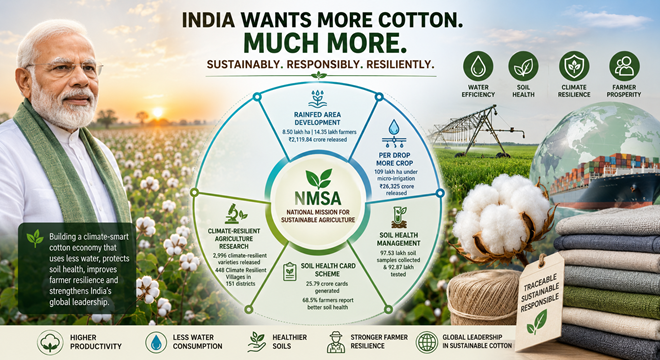
India wants more cotton. Much more. And wants to do so sustainably. India does not want higher cotton output at the cost of soil, water and long-term farm sustainability. That is where the National Mission for Sustainable Agriculture (NMSA) comes in. Indian Prime Minister Narendra Modi in his appeal to the nation last week stressed on following sustainable farming techniques using natural fertilizers, pesticides and other inputs. Originally launched in 2014-15 under the National Action Plan on Climate Change, the programme could become the backbone of India’s new cotton strategy – focussing on water efficiency, soil health, climate resilience and sustainable farming practices. This matters because cotton sits at the centre of one of agriculture’s toughest challenges. India’s cotton productivity has remained below global benchmarks for years despite the country being one of the world’s largest producers. The crop faces frequent pest attacks severely impacting farm incomes. The government now wants to change that. Nearly 60% of India’s net sown area is rainfed. These farms contribute about 40% of the country’s food production. Large parts of India’s cotton belt also depend heavily on rainfall and groundwater. That makes climate resilience critical. Main Pillars Of The National Mission for Sustainable Agriculture (NMSA) • Rainfed Area Development (RAD) Focus: Promotes Integrated Farming Systems (IFS) combining crops, horticulture, livestock and fisheries to improve farmer resilience and incomes in rainfed areas. Spend: Rs 2,119.84 crore released since 2014-15. Coverage: 8.50 lakh hectares and 14.35 lakh farmers covered. FY26 Allocation: Rs 343.86 crore allocated; over 96,000 farmers trained. • Per Drop More Crop (PDMC) Focus: Expands micro-irrigation through drip and sprinkler systems to improve water-use efficiency and reduce wastage. Spend: Rs 26,325 crore released as central assistance since 2015-16. Coverage: About 109 lakh hectares brought under micro-irrigation. Future Target: Additional 100 lakh hectares to be covered between 2025-26 and 2029-30. • Soil Health Management (SHM) Focus: Promotes balanced nutrient use, organic farming, residue management and long-term soil fertility improvement. Key Achievement: 97.53 lakh soil samples collected and 92.87 lakh tested in 2025-26. • Soil Health Card (SHC) Scheme Focus: Provides crop-specific nutrient recommendations to farmers for scientific fertilizer use. Coverage: 25.79 crore Soil Health Cards generated since 2015. Impact: 68.5% of surveyed farmers reported significant improvement in soil health, according to a 2025 NITI Aayog evaluation. • Climate-Resilient Agriculture Research (NICRA & ICAR) Focus: Development of climate-resilient crop varieties and adaptive farming technologies to tackle droughts, floods and heat stress. Key Achievement: 2,996 climate-resilient crop varieties released between 2014 and 2025. Coverage: Vulnerability assessments conducted across 651 districts; 310 identified as highly climate-vulnerable. Climate Resilient Villages: 448 villages established across 151 districts in 28 states and UTs. Global brands want traceable, sustainably produced fibre with lower environmental impact. The larger ambition is to hopefully build a climate-smart cotton economy, one that uses less water, protects soil health, improves farmer resilience and strengthens India’s position in global textile markets.
Global brands want traceable, sustainably produced fibre with lower environmental impact. The larger ambition is to hopefully build a climate-smart cotton economy, one that uses less water, protects soil health, improves farmer resilience and strengthens India’s position in global textile markets.
Subscribe To Textile Excellence Print Edition
If you wish to Subscribe to Textile Excellence Print Edition, kindly fill in the below form and we shall get back to you with details.
Newsletter
Subscribe To Textile Excellence Mailing List


- December 09, 2022
'There Is Very High Acceptance For India

- December 09, 2022
'Advanced Machines & Service, Customer C

- October 09, 2023
First-time In The World: Rieter’s Auto

- July 28, 2026
Arvind Eyes Leadership In India's Premiu

- June 01, 2020
Karl Mayer Enables Automated Production

- June 05, 2023
Ultimax - All New Revolutionary Rapier W
- June 09, 2025
DyStar Becomes A Wholly Owned Subsidiary

- July 28, 2026