
Middle East Redesigns Its Trade Architecture For An Uncertain World
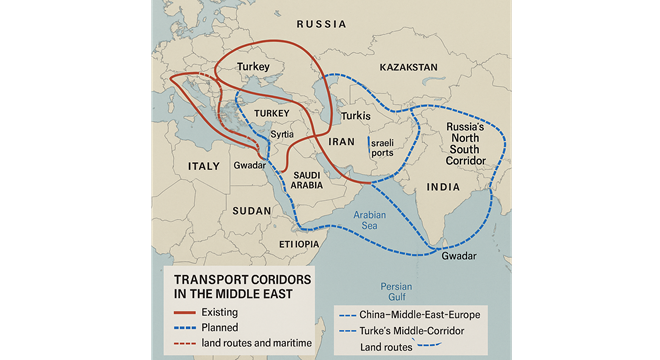
As conflict and shipping disruptions continue to shake the Strait of Hormuz and Red Sea routes, Middle Eastern countries are rapidly redrawing the region’s trade map. Governments led by Saudi Arabia, United Arab Emirates and Turkey are now pushing a series of rail, port and pipeline projects aimed at reducing dependence on vulnerable maritime chokepoints. The focus is shifting from crisis response to long-term trade resilience. The new strategy is centred on building alternative logistics corridors linking the Indian Ocean to the Mediterranean Sea. Cargo would move through ports outside the Persian Gulf, travel overland through rail and road networks, and then connect to Red Sea or Mediterranean shipping routes. Several parts of this new architecture are already moving from proposal stage to execution. Key projects taking shape UAE-Saudi Sea-Land Corridor: Saudi-Jordan Rail Freight Link: Neom Cargo Corridor: Hejaz Railway Revival: Jordan Railway Expansion: GCC Railway Integration: Regional Pipeline Network: Turkey-Iraq Oil Corridor: Qatar-Turkey Gas Proposal: Ports are becoming another major battleground in the region’s logistics transformation. Analysts say the Middle East is no longer treating disruptions in Hormuz and the Red Sea as temporary events. Instead, governments are building parallel trade systems designed to keep energy and cargo flows moving even during prolonged instability. The region is redesigning its trade architecture for a far more uncertain world.
Gulf states have launched sea-land bridges connecting the UAE’s Arabian Sea ports of Fujairah and Khor Fakkan with Saudi Arabia’s Red Sea port of Jeddah, as well as the Gulf ports of Dammam and Jubail.
Rail cargo services linking Saudi Arabia and Jordan have already started, creating an alternative route for regional freight movement.
Saudi Arabia’s new port city of Neom has launched a cargo service linking Gulf countries and Iraq to the Suez Canal through the Gulf of Aqaba.
Turkey, Jordan and Syria are reviving the historic Hejaz Railway connecting Istanbul to the Arabian Peninsula through Amman and Damascus. Saudi Arabia and the UAE are also backing parts of the project.
The UAE recently agreed to finance a railway connecting Jordan’s Aqaba port to phosphate mining regions, seen as the first phase of a broader regional rail corridor.
Gulf countries are accelerating railway connectivity linking Saudi Arabia with the UAE, Qatar, Oman, Kuwait and Bahrain. One key missing link remains the Saudi-UAE rail connection.
GCC leaders have approved plans for a regional network carrying oil, gas, desalinated water and electricity across member countries.
Turkey is pushing to expand the existing Ceyhan-Kirkuk oil pipeline further south to Basra near the Gulf.
Turkey is also backing proposals for gas pipelines linking Qatar, Iraq and Turkey under the larger Iraq Development Road initiative.
Ports are becoming another major battleground in the region’s logistics transformation. Analysts say the Middle East is no longer treating disruptions in Hormuz and the Red Sea as temporary events. Instead, governments are building parallel trade systems designed to keep energy and cargo flows moving even during prolonged instability. The region is redesigning its trade architecture for a far more uncertain world.
Subscribe To Textile Excellence Print Edition
If you wish to Subscribe to Textile Excellence Print Edition, kindly fill in the below form and we shall get back to you with details.
Newsletter
Subscribe To Textile Excellence Mailing List


- December 09, 2022
'There Is Very High Acceptance For India

- December 09, 2022
'Advanced Machines & Service, Customer C

- October 09, 2023
First-time In The World: Rieter’s Auto

- July 28, 2026
Arvind Eyes Leadership In India's Premiu

- June 01, 2020
Karl Mayer Enables Automated Production

- June 05, 2023
Ultimax - All New Revolutionary Rapier W

- June 09, 2025
DyStar Becomes A Wholly Owned Subsidiary

- July 28, 2026