
India Keeps Building as Global Textile Demand Wobbles — And That Is the Point
India's textile industry is
sending a rather unusual signal.
Exports are growing, but
not spectacularly. Global demand remains uncertain. Freight costs are under
pressure. Western buyers are cautious. Yet investment continues. New machinery
is being ordered. Textile parks are attracting companies. MMF and technical textile
projects are moving forward. The obvious question is: Why invest when the
export market is under pressure?
India's textile and apparel
exports, including handicrafts, reached ₹3,25,339 crore in 2025–26, up 1.8%
from ₹3,19,573 crore in 2024–25.
The growth was modest, but
importantly, exports increased across more than 100 destinations during the
year.
So this is not a collapse
story. It is a resilience story. And the country's strategy is increasingly
about building capacity before the next major wave of global sourcing arrives.
Seven mega parks, one big bet
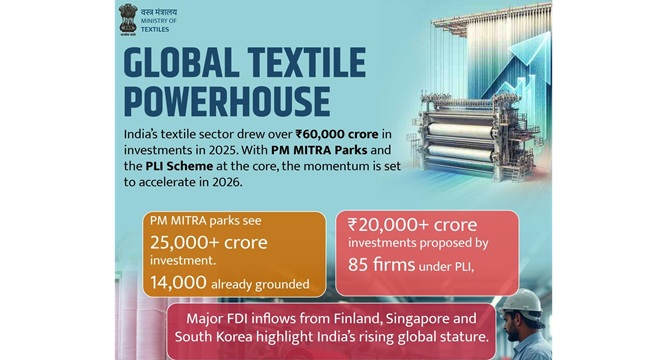
The PM MITRA programme is
at the centre of that strategy.
India has approved seven PM
MITRA parks in Tamil Nadu, Telangana, Gujarat, Karnataka, Madhya Pradesh, Uttar
Pradesh and Maharashtra.
As of March 2026, total
investment interest across the seven parks had reached ₹63,177 crore.
The idea is simple but
powerful. Put more of the textile value chain in one place : fibre, spinning,
weaving, processing, garmenting, fashion.
That reduces fragmentation
and logistics costs while making large-scale manufacturing easier. The original
PM MITRA framework envisages roughly 1 lakh direct and 2 lakh indirect jobs per
park.
This is not just an export
scheme.
It is an attempt to rebuild
India's textile manufacturing architecture.
The domestic market gives
India breathing room
This is where India's story
differs sharply from Bangladesh. India has a huge domestic textile and apparel
market alongside its export industry.
That means companies can
build capacity for multiple markets instead of relying entirely on Western
orders. It also gives manufacturers an opportunity to scale production, improve
machinery utilisation and build brands at home while continuing to pursue
exports.
The government is targeting
an overall textile market of ₹33 lakh crore by FY2030–31, roughly double the
current size, according to Union Textiles Minister Giriraj Singh.
The target includes both
domestic and export markets.
That distinction is
crucial. India is not saying: “We will export our way to growth.” It is saying:
“We will build the industry at home and use that scale to compete globally.”
Machinery investment is changing
India's machinery purchases
also reveal where the industry is heading. ITMF's 2024 data shows Asia and
Oceania absorbed about 90% of global short-staple spindle shipments.
India remained among the
world's major investors in spinning equipment, while it was also one of the
leading destinations for large circular knitting machines, behind China. But
the next investment cycle is not simply about adding more conventional spinning
capacity. It is about efficiency and diversification. Modern spinning equipment
can improve productivity and reduce energy use. Automated weaving and knitting
can reduce labour dependence. MMF machinery can help India participate more
strongly in synthetic-heavy global fashion. Technical textile machinery opens
markets beyond conventional apparel. And modern processing equipment can reduce
water, energy and chemical consumption.
The MMF challenge
India's historic strength
is cotton. Its next big challenge is becoming equally strong in man-made
fibres. The global fashion industry uses enormous volumes of polyester, nylon,
viscose and other synthetic fibres, particularly in sportswear, activewear and
performance apparel. India's policy framework is increasingly aimed at closing
that gap.
The PLI scheme for textiles
focuses specifically on MMF apparel, MMF fabrics and technical textiles, while
the National Technical Textiles Mission is pushing higher-value industrial
applications. That could become critical as global sourcing shifts.
The winning supplier may
not simply be the country producing the cheapest cotton T-shirt. It may be the
country capable of supplying cotton, MMF, technical textiles, home textiles and
garments from a modern integrated ecosystem.
PM MITRA's real test
There is an even bigger
reason the parks matter. Global logistics costs can rise and fall. But India's
domestic logistics inefficiencies are structural. If spinning is in one state,
weaving in another, processing somewhere else and garmenting somewhere else
again, every additional movement adds cost and time. An integrated park attacks
that problem at source. And it gives international brands something else they
increasingly want: scale, traceability, modern infrastructure and
sustainability compliance in one location. That is why the current export
slowdown does not make PM MITRA less relevant. It may make it more relevant.
India has a window to
build. Upgrade. Integrate. Automate. Diversify.
Then wait for global
sourcing demand to strengthen again. The question is no longer whether India
can produce more textiles. It is whether India can produce them faster, smarter
and at globally competitive cost.
That is the investment race
now underway.
India has a window to build. Upgrade. Integrate. Automate. Diversify. Then wait for global sourcing demand to strengthen again. The question is no longer whether India can produce more textiles. It is whether India can produce them faster, smarter and at globally competitive cost. That is the investment race now underway.
Subscribe To Textile Excellence Print Edition
If you wish to Subscribe to Textile Excellence Print Edition, kindly fill in the below form and we shall get back to you with details.
Newsletter
Subscribe To Textile Excellence Mailing List


- December 09, 2022
'There Is Very High Acceptance For India

- December 09, 2022
'Advanced Machines & Service, Customer C

- October 09, 2023
First-time In The World: Rieter’s Auto

- July 28, 2026
Arvind Eyes Leadership In India's Premiu

- June 01, 2020
Karl Mayer Enables Automated Production

- June 05, 2023
Ultimax - All New Revolutionary Rapier W
- June 09, 2025
DyStar Becomes A Wholly Owned Subsidiary

- July 28, 2026