
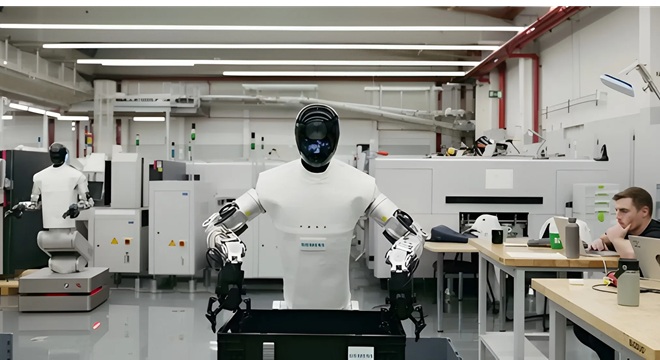
2,000 Humanoids Are Ready To Step Into Textile Factories
The
textile industry is taking another big step into automation, with humanoid
robots moving from futuristic demos to real industrial floors. China-based
industrial sewing machine maker Jack Technology is teaming up with Siemens to
bring AI, digital engineering and humanoid robotics into apparel manufacturing.
And
the ambition is huge: 2,000 humanoid robots have been ordered for apparel
production, in what is being described as one of the first major deployments of
humanoid robots in the textile sector.
The
goal? At least 30% higher manufacturing efficiency while helping factories
tackle rising labour costs, shorter lead times and growing demand for
customised products.
Robots
that fit into the factory
The
big attraction of humanoid robots is simple: they are designed to work in
environments already built for people.
Instead
of redesigning an entire production line, these robots can move around existing
workstations, handle materials and perform repetitive tasks alongside human
workers. That flexibility could be a major advantage for textile and garment
factories looking for more automation without completely rebuilding their
production floors.
A
Siemens plant in Erlangen, Germany, recently offered a glimpse of what is
possible.
British
robotics company Neura Robotics deployed its wheeled humanoid robot HMND 01 for
a two-week trial. Powered by NVIDIA’s physical AI technology, the robot
autonomously picked up crates, placed them on a conveyor and moved them to a
designated handoff point for human workers.
The
numbers were impressive. HMND 01 moved 60 crates an hour, handled two different
crate sizes and operated for more than eight hours a day. Its autonomous
grasping and placement achieved a success rate of over 90%.
For
textile factories, that points to a very practical opportunity: let robots take
care of repetitive material movement while people focus on tasks requiring
judgement, skill and flexibility.
More
than humanoids
Humanoid
robots are only one piece of the automation puzzle. Four-legged robots are also
entering industrial environments, particularly for inspection and maintenance
in difficult or hazardous areas.
Robotic
systems such as ANYbotics’ ANYmal can collect inspection data from hundreds of
points and help create detailed 3D models of industrial facilities. For textile
manufacturers, the bigger lesson is that robots are becoming increasingly
capable of moving, sensing, inspecting and making decisions within real factory
environments.
But
robots cannot work in isolation.
The
real transformation comes when they are connected to machines, production
systems, autonomous vehicles and human workers. Siemens is building this
digital backbone with digital twins, AI-enabled sensing, robot and PLC
interfaces, fleet management and industrial communication systems.
That
could turn the factory of tomorrow into something very different: not a place
where robots replace people, but a smarter, faster production ecosystem where
humans and machines work side by side—and the robots take care of the
repetitive stuff.
The real transformation comes when they are connected to machines, production systems, autonomous vehicles and human workers. Siemens is building this digital backbone with digital twins, AI-enabled sensing, robot and PLC interfaces, fleet management and industrial communication systems. That could turn the factory of tomorrow into something very different: not a place where robots replace people, but a smarter, faster production ecosystem where humans and machines work side by side—and the robots take care of the repetitive stuff.
Subscribe To Textile Excellence Print Edition
If you wish to Subscribe to Textile Excellence Print Edition, kindly fill in the below form and we shall get back to you with details.
Newsletter
Subscribe To Textile Excellence Mailing List


- December 09, 2022
'There Is Very High Acceptance For India

- December 09, 2022
'Advanced Machines & Service, Customer C

- October 09, 2023
First-time In The World: Rieter’s Auto

- July 28, 2026
Arvind Eyes Leadership In India's Premiu

- June 01, 2020
Karl Mayer Enables Automated Production

- June 05, 2023
Ultimax - All New Revolutionary Rapier W

- June 09, 2025
DyStar Becomes A Wholly Owned Subsidiary

- July 28, 2026