
The Supply Chain Filter: US Puts 60 Economies Under New Forced-Labour Tariffs
On
24 July, the US imposed new 10% or 12.5% tariffs on imports from 60 economies
under Section 301 of the Trade Act of 1974. The reason? Forced labour. The US
says these economies have failed to effectively prohibit imports made with
forced labour.
Together,
the 60 economies account for 99.4% of US imports.
The
list includes major textile and apparel suppliers such as India, Bangladesh,
China, Vietnam, Indonesia, Malaysia, Thailand and Cambodia, along with the EU,
Japan and South Korea.
But
there is a catch: not everyone gets the same tariff.
The
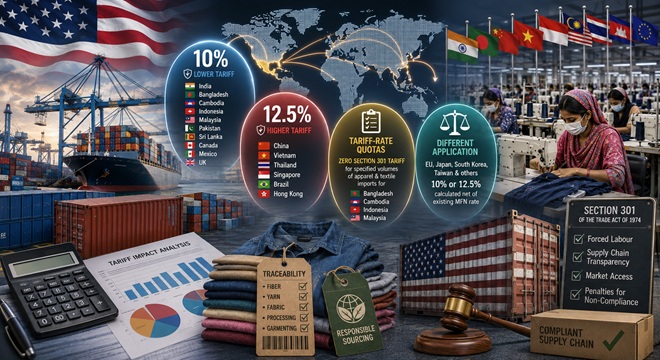
basic Section 301 rate is 12.5%. Economies that already prohibit forced-labour
imports, have committed to doing so through trade agreements, or have partial
regimes covering certain goods qualify for 10%.
India,
Bangladesh, Cambodia, Indonesia, Malaysia, Pakistan, Sri Lanka, Canada, Mexico
and the UK fall into this group.
China,
Vietnam, Thailand, Singapore, Brazil and Hong Kong face 12.5%, subject to
product-specific provisions and exemptions.
For
the EU, Japan, South Korea, Taiwan and some other economies, the Section 301
duty is applied differently. The 10% or 12.5% rate is effectively calculated
net of the existing MFN rate, depending on the product.
There
are also exemptions for products where tariffs could create domestic shortages,
cause wider economic disruption, or where comparable products cannot be
produced domestically or sourced elsewhere at reasonable prices.
Bangladesh
gets an interesting advantage
For
textiles, Bangladesh is a particularly important case.
The
US plans to establish tariff-rate quotas for Bangladesh, Cambodia, Indonesia
and Malaysia by 1 September 2026. The mechanism will run for three years and is
designed to encourage sourcing inputs from suppliers considered less likely to
involve forced labour.
Most
importantly, specified volumes of apparel and textile imports can enter the US
with zero Section 301 tariff, provided they meet the qualifying conditions.
That
could become a significant sourcing advantage. A Bangladeshi garment may
therefore face a very different effective tariff depending on whether it falls
within the quota.
Traceability
is becoming a competitive tool, not just a compliance exercise.
India
gets 10%, but the pressure remains
India's
10% rate looks better than the 12.5% facing China and Vietnam. But India's
exporters still have plenty to worry about.
Indian
textile and apparel exports to the US are worth almost US$ 11 billion annually,
making the market critical. Industry bodies have warned that the new duty could
hurt India's competitiveness, particularly as Bangladesh, Cambodia, Indonesia
and Malaysia gain access to the new quota mechanism.
The
sourcing question is changing from “Who makes it cheapest?” to “Who can stay
competitive after tariffs, prove traceability and deliver on time?”
China
starts from a tougher base
China
faces the 12.5% forced-labour-related rate, but that is only one part of its
tariff burden. USTR said in February 2026 that existing Section 301 tariffs on
Chinese products ranged from 7.5% to 100%, depending on the product.
So
Chinese exporters cannot treat 12.5% as their total US tariff exposure. The
final landed cost depends on product classification and other applicable
duties.
And
that helps explain China's push towards automation, higher-value textiles,
domestic consumption and diversified export markets.
The
new tariff reality
For
textile exporters, the US tariff equation can now involve MFN duties, Section
301 and 232 duties, trade agreements, temporary surcharges, quotas, exemptions,
origin rules and input requirements.
A
garment can be competitive at the factory gate, and suddenly lose its edge at
the US border.
The
US is no longer simply taxing products. It is increasingly shaping where they
are made, where their inputs come from and how global supply chains are
organised.
For textile exporters, the US tariff equation can now involve MFN duties, Section 301 and 232 duties, trade agreements, temporary surcharges, quotas, exemptions, origin rules and input requirements. A garment can be competitive at the factory gate, and suddenly lose its edge at the US border. The US is no longer simply taxing products. It is increasingly shaping where they are made, where their inputs come from and how global supply chains are organised.
Subscribe To Textile Excellence Print Edition
If you wish to Subscribe to Textile Excellence Print Edition, kindly fill in the below form and we shall get back to you with details.
Newsletter
Subscribe To Textile Excellence Mailing List


- December 09, 2022
'There Is Very High Acceptance For India

- December 09, 2022
'Advanced Machines & Service, Customer C

- October 09, 2023
First-time In The World: Rieter’s Auto

- July 28, 2026
Arvind Eyes Leadership In India's Premiu

- June 01, 2020
Karl Mayer Enables Automated Production

- June 05, 2023
Ultimax - All New Revolutionary Rapier W

- June 09, 2025
DyStar Becomes A Wholly Owned Subsidiary

- July 28, 2026