
Can India Warehouse Its Way Around Near-Shoring?
India
has come up with an intriguing answer to one of its biggest problems in the US
market: distance.
The
Parliamentary Standing Committee on Commerce, in its latest report on India-US
trade relations, has recommended that the government work with industry bodies
to establish government-subsidised textile warehousing hubs at major US
shipping entry points.
The
thinking is simple. Put Indian goods closer to American buyers. Hold
ready-to-sell inventory in the US. Speed up delivery. Reduce dependence on
intermediaries. Combine the warehouses with faster customs and green-channel
facilities in India.
It
sounds like a logistics idea. It could become something much bigger.
But
there is a catch. A warehouse can solve distance. It cannot, by itself, solve
demand, pricing, finance, product mix or market access.
And
those questions need answers before India starts pouring money into warehouses.
The
$10 million question
First,
what does one warehouse actually cost?
Consider
a hypothetical 100,000 sq ft US textile distribution centre. Current US
construction benchmarks put warehouse construction broadly in the US$ 85-US$ 200
per sq ft range, depending on location, specification and complexity. That puts
the building itself at roughly US$ 8.5 million - US$ 20 million for 100,000 sq
ft.
And
that is before land, financing, racking, forklifts, warehouse-management
systems, security, IT, customs infrastructure and other fit-out costs.
Leasing
is cheaper upfront, but it is hardly cheap.
Recent
US warehouse rental benchmarks put average rents around US$ 9 per sq ft, with
additional NNN expenses often adding another US$2-US$4 per sq ft.
So
a 100,000 sq ft facility could mean roughly US$ 900,000 a year in base rent,
potentially rising to US$1.1-1.3 million or more once common operating charges
are included.
Then
come labour, equipment, insurance, handling, customs compliance, software,
utilities and last-mile distribution. And there is an even bigger number hiding
behind all of this.
The
inventory.
If
that warehouse contains US$ 10 million worth of Indian textiles, someone has to
finance US$ 10 million of merchandise sitting thousands of kilometres from the
factory.
That
could easily be more financially significant than the warehouse itself.
Who
pays?
This
is the first big hole in the proposal.
The
government can subsidise the warehouse.
But
who finances the stock?
The
exporter?
The
buyer?
A
bank?
A
logistics company?
An
industry consortium?
And
what happens when the goods don't sell?
For
a large Indian textile company, carrying inventory in America may be
manageable.
For
an MSME exporter operating on thin margins and already struggling for working
capital, it could be a completely different story.
The
policy therefore cannot stop at subsidising warehouse space.
India
would need to think about inventory finance, warehouse receipts, credit
insurance, customs arrangements, insurance and inventory-risk sharing.
Otherwise,
the country could end up subsidising buildings while exporters remain unable to
fill them.
And
then comes the uncomfortable question: pricing
The
warehouse could make Indian exporters faster.
But
could it make them weaker?
Imagine
several Indian companies stocking similar basic garments in the same US hub. The
American buyer knows the goods are already there. He also knows the exporter
has already paid to manufacture, ship and store them. That changes the
bargaining game.
The
buyer can push: “You already have the goods in America. Give me your best
price.” The exporter, meanwhile, has inventory to turn. The longer it sits, the
more expensive it becomes.
So
the warehouse could improve delivery power while reducing pricing power.
That
is not necessarily a reason to reject the idea. It is a reason to be very
careful about what goes into the warehouse.
Basic,
repeat-order products could make sense: towels, bedsheets, T-shirts, uniforms,
workwear, institutional textiles and other standardised SKUs with predictable
demand.
Fashion-sensitive,
seasonal or highly customised merchandise is a different proposition.
Nobody
wants a warehouse full of last season's fashion.
India
already has a few lessons
Interestingly,
Indian companies have already been testing versions of this strategy.
Take
Welspun. Welspun USA was established in 2000 with sales, design and marketing
operations in New York and a distribution centre in Ohio. The company has built
a substantial US-facing supply chain rather than treating America simply as an
export destination.
Its
Grove City, Ohio operation is particularly revealing.
Welspun
already had a distribution centre there. In 2024, it announced a $12.5 million
investment to retrofit the existing distribution centre with manufacturing
capability, adding production of home textiles including towels, rugs and
bedding. The move was explicitly designed to strengthen its North American
presence and bring production closer to customers.
That
is a significant lesson.
Welspun
isn't merely asking: “How do we ship from India to America faster?”
It
is asking: “What should we actually produce and hold in America?”
And
there is another layer to the company's US strategy.
Welspun
has also been building consumer and brand-side capabilities. In 2024, Welspun
USA set up and acquired Christy Home Inc., with the company focused on trading
Christy-branded home textiles in the US.
That
is different from simply renting a warehouse. It combines brand, distribution,
inventory and market access.
Indo
Count offers another useful case study.
Rather
than simply establishing a giant warehouse and filling it with Indian-made
goods, the company has been buying its way deeper into the North American
supply chain.
In
2024, its US subsidiary Indo Count Global acquired an 81% stake in Fluvitex
USA, a Columbus, Ohio-based pillow and quilt manufacturer. The company had
capacity for around 5 million pillows and 1.5 million quilts, with its location
giving it distribution advantages across the US and Canada.
Barely
a month later, Indo Count acquired 100% of Modern Home Textiles in Phoenix,
Arizona. The facility had capacity to produce about 8 million pillows a year.
Indo Count described the two acquisitions as a step towards building an
integrated utility-bedding business for North America, with facilities on both
the Midwest and West Coast.
That
is a very different model from “send more containers to America”.
It
is: Manufacture + distribution + local presence + market knowledge.
And
Indo Count has gone further still.
The
company acquired the US home-fashion brand Wamsutta, giving it access to a
recognised American brand and a premium consumer position rather than relying
entirely on an Indian manufacturing identity.
This
is an important lesson for policymakers. Indian companies are not necessarily
solving the US challenge by building warehouses. Some are buying distribution,
manufacturing and brands.
China
has gone much further
Now
look at Alibaba.
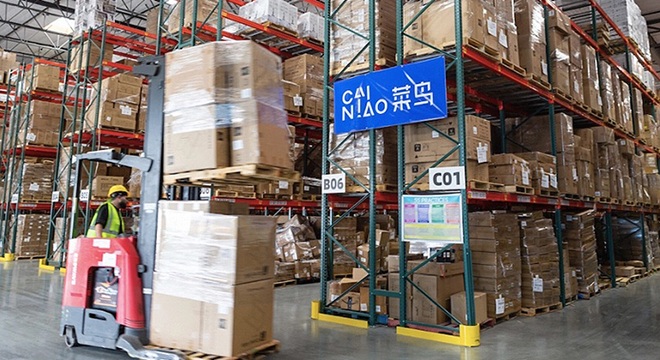
Cainiao,
Alibaba's logistics arm, has been building an overseas logistics network that
goes far beyond storage.
Alibaba
announced plans to expand Cainiao's overseas warehouse network from 30
warehouses covering about 1 million sq m to more than 2 million sq m. The
objective was to allow Chinese SMEs to pre-stock goods overseas and fulfil a
large proportion of cross-border orders within 72 hours in targeted markets.
By
2025, Cainiao said it had a network of more than 40 overseas warehouses across
Europe, the US, Southeast Asia and Australia. Its proposition is not simply “we
have storage space”. It combines warehousing with transportation, customs
clearance and digital logistics.
That
distinction matters.
China
has built an export fulfilment ecosystem. India is discussing warehouses. The
gap is important.
The
warehouse is only one piece
There
is another reason to think bigger.
The
US already has sophisticated logistics infrastructure, including Foreign-Trade
Zones and bonded warehouses that can allow eligible imported merchandise to
remain under customs control and defer duty payment until the goods enter US
customs territory for domestic consumption.
So
India may not even need to build every warehouse itself.
Why
not partner with existing US logistics operators?
Why
not create an India-dedicated network inside existing 3PLs, bonded facilities
and Foreign-Trade Zones?
Why
spend millions building a new 100,000 sq ft facility if Indian exporters can
access an existing facility at a fraction of the capital cost?
The
government's money could instead be used to solve the more difficult problems:
inventory finance, market intelligence, customs facilitation, digital order
management, export credit and buyer connections.
And
what about the American buyer?
This
is another point that deserves scrutiny.
A
US retailer gets a lot from Indian stock being held locally:
- faster replenishment
- shorter lead times
- lower supply-chain uncertainty
- smaller and more frequent orders
- easier returns
- potentially lower inventory
requirements on the buyer's side.
All
valuable.
But
who captures that value?
If
the American buyer gets all the benefits while the Indian exporter carries the
inventory and financing risk, India may simply be subsidising a better supply
chain for the buyer.
The
policy has to ensure that at least part of the productivity gain comes back
through better prices, larger orders or longer-term commitments.
Otherwise,
speed could become another cost imposed on the exporter.
So,
should India build the warehouses?
Yes,
but selectively and intelligently.
The
Committee's idea deserves serious attention. India does need to become closer
to its customers.
But
the real objective should not be: “Indian goods sitting in American
warehouses.”
It
should be: “Indian exporters becoming easier, faster and smarter suppliers to
America.”
That
requires much more.
It
means identifying products with predictable US demand.
It
means financing inventory intelligently.
It
means linking warehouses to FTZs, bonded facilities and professional 3PLs.
It
means digital inventory visibility.
It
means faster customs.
It
means reliable last-mile fulfilment.
It
means understanding what American buyers actually want before manufacturing
thousands of pieces.
And
it means tackling the bigger competitiveness questions: tariffs, product mix,
MMF capacity, technical textiles, scale, quality, compliance, sustainability,
design, branding and buyer relationships.
The
warehouse can solve one problem: distance.
It
cannot solve all the others.
That
may be the biggest lesson from Welspun, Indo Count and Cainiao. They did not
build logistics networks simply to store products. They built them to get
closer to the customer, control more of the value chain and respond faster to
demand. That is the real opportunity for India.
Don't
just put “Made in India” inside an American warehouse.
Build
the supply chain that makes “Made in India” harder to ignore.
The Parliamentary Standing Committee on Commerce, in its latest report on India-US trade relations, has recommended that the government work with industry bodies to establish government-subsidised textile warehousing hubs at major US shipping entry points. The thinking is simple. Put Indian goods closer to American buyers. Hold ready-to-sell inventory in the US. Speed up delivery. Reduce dependence on intermediaries. Combine the warehouses with faster customs and green-channel facilities in India. It sounds like a logistics idea. It could become something much bigger.
Subscribe To Textile Excellence Print Edition
If you wish to Subscribe to Textile Excellence Print Edition, kindly fill in the below form and we shall get back to you with details.
Newsletter
Subscribe To Textile Excellence Mailing List


- December 09, 2022
'There Is Very High Acceptance For India

- December 09, 2022
'Advanced Machines & Service, Customer C

- October 09, 2023
First-time In The World: Rieter’s Auto

- July 28, 2026
Arvind Eyes Leadership In India's Premiu

- June 01, 2020
Karl Mayer Enables Automated Production

- June 05, 2023
Ultimax - All New Revolutionary Rapier W
- June 09, 2025
DyStar Becomes A Wholly Owned Subsidiary

- July 28, 2026