
.png)
Union Textiles Minister Applauds ReFiber And Textile Recovery Facility Digital Circularity Initiative
India is accelerating its transition toward a structured
circular economy across the textile manufacturing landscape. Union Minister of
Textiles Giriraj Singh officially commended a landmark partnership between
post-consumer textile recovery enterprise ReFiber and the Textile Recovery
Facility located in Belapur Navi Mumbai. The strategic collaboration formalizes
a Letter of Intent signed on August 25 2026 to pioneer digital collection
mechanisms for discarded garments. This milestone agreement establishes transparent
pathways directing discarded apparel into verified repurposing upcycling and
recycling channels. Senior government officials along with prominent industry
leaders gathered in Mumbai to witness this critical first-mile supply chain
intervention.
Institutional Convergence in Navi Mumbai
The formal signing ceremony occurred alongside the
inauguration of the Mati thrift store under the broader Punarsutra initiative
focused on crafting circular change. The Textiles Committee is actively
executing this project across the Navi Mumbai Municipal Corporation
jurisdiction in close partnership with the SBI Foundation IDH India and Tisser
Artisan Trust. This ambitious civic program covers a substantial urban
population of approximately 16 lakh residents. Project coordinators anticipate
generating thousands of sustainable green livelihood opportunities across local
communities. Municipal authorities are converting voluminous urban waste into high-quality
value-added raw materials.
Navi Mumbai Municipal Corporation Commissioner Dr Kailas
Shinde highlighted the indispensable role played by civic administrations in
establishing viable municipal recovery networks. Director of the Textiles
Committee Dr Tapan Kumar Rout emphasized that strong institutional
collaboration provides the backbone for modernizing municipal waste recovery
systems. Tisser Artisan Trust Founder Dr Megha Phansalkar reaffirmed long-term
support to expand accessible collection hubs across metropolitan centres.
Technological Architecture and Digital Tracking
Operational logistics across the post-consumer garment
sector have historically suffered from severe fragmentation and unrecorded
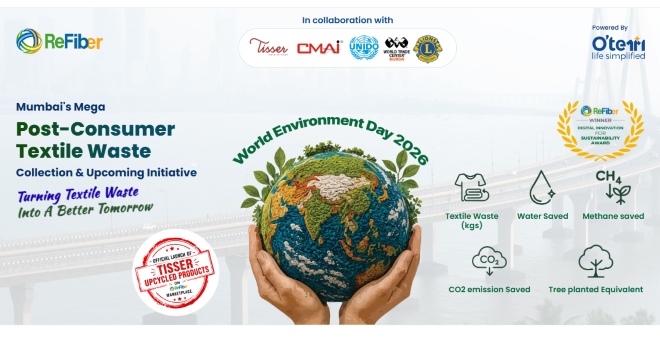
disposal routes. ReFiber originally launched its technology-driven recovery
network on World Environment Day on June 5 2026 to solve these structural
inefficiencies. Chief Operating Officer Manoj Wanvari signed the agreement on
behalf of the technology platform. The system integrates scheduled doorstep
pickups digital verification algorithms and end to end batch tracking.
Collection workflows direct sorted apparel into dedicated
reuse upcycling or mechanical recycling streams rather than permitting items to
enter municipal landfills. The company also introduced its proprietary Upcycle
Marketplace to connect artisans and manufacturers with recovered secondary
textiles directly. This closed loop digital marketplace enables recovered fibres
to return smoothly into commercial product cycles.
Ministerial Leadership and Policy Mandates
Government leadership views this technological integration
as an essential prerequisite for nationwide environmental compliance. Union
Minister Giriraj Singh commended the bilateral agreement as a vital milestone
reinforcing national sustainability targets. Singh noted, "The exchange of
the Letter of Intent between TRF, Navi Mumbai and ReFiber for the digital
collection of used clothes is a commendable initiative and an important step
towards strengthening India’s Circular Textile Economy. I appreciate this
collaborative effort to bring greater organisation and technology into the
collection and recovery of post-consumer textiles."
Maharashtra Government Textile Commissioner Ms Vrunda
Manohar Desai underlined the operational necessity of building accountable
collection systems. Desai stated, "India’s transition towards a circular
textile economy requires stronger systems for the collection and recovery of
post-consumer textiles. ReFiber’s technology-led approach is a commendable step
towards making textile collection more organised, accessible and traceable.
Such collaborations are important in creating a more connected ecosystem where
used textiles can be channelled towards reuse, upcycling and recycling, rather
than being lost from the circular economy."
Scaling Upcycled Production and Economic Impact
Industry analysts project the global circular textile
economy will unlock over US$500 billion in market value over the coming decade.
ReFiber Chairman Shrikant Bhangdiya expressed gratitude toward the Ministry of
Textiles and municipal leaders for prioritizing organized post-consumer
collection networks. Bhangdiya affirmed that establishing true circularity
demands total oversight over the journey of every garment from the exact point
of consumer disposal onwards. ReFiber plans to scale this digitized collection
infrastructure into major metropolitan hubs nationwide.
The Mati thrift store situated inside the Belapur facility
creates an immediate consumer facing channel for inspected pre owned apparel.
Integrating physical storefronts alongside digital collection dashboards
addresses critical recovery bottlenecks simultaneously. Textile mills and
garment exporters can utilize these traceable secondary feedstocks to satisfy
rigorous international sustainability thresholds. Global apparel brands
currently require suppliers to demonstrate verifiable recycled fibre
integration to maintain export compliance across major Western retail markets.
Domestic spinning mills and recycling units will gain consistent access to pre-sorted textile fractions through this organized digital framework. Indian manufacturing clusters can lead global circularity benchmarks while simultaneously generating substantial local employment. The initiative demonstrates how public institutions, civic corporations and Innovative technology startups can collectively modernize traditional textile recovery frameworks into highly productive industrial assets.
Re-Fiber
is a technology-enabled circular economy platform designed to manage
post-consumer textile waste (PCTW) at scale, starting from households and
ending with verified recycling outcomes. You may contact Re-Fiber for further
details.
Government leadership views this technological integration as an essential prerequisite for nationwide environmental compliance. Union Minister Giriraj Singh commended the bilateral agreement as a vital milestone reinforcing national sustainability targets. Singh noted,
Subscribe To Textile Excellence Print Edition
If you wish to Subscribe to Textile Excellence Print Edition, kindly fill in the below form and we shall get back to you with details.
Newsletter
Subscribe To Textile Excellence Mailing List


- December 09, 2022
'There Is Very High Acceptance For India

- December 09, 2022
'Advanced Machines & Service, Customer C

- October 09, 2023
First-time In The World: Rieter’s Auto

- July 28, 2026
Arvind Eyes Leadership In India's Premiu

- June 01, 2020
Karl Mayer Enables Automated Production

- June 05, 2023
Ultimax - All New Revolutionary Rapier W

- June 09, 2025
DyStar Becomes A Wholly Owned Subsidiary

- July 28, 2026