
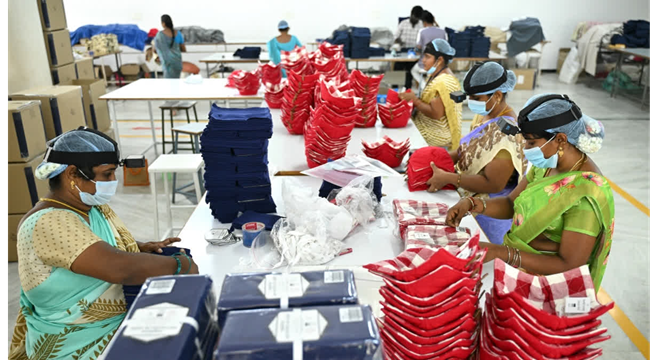
Indian Garment Workers Are Teaching Robots To Stitch
From garment workers
filming their stitching techniques to barbers recording their hand movements, a
new gig economy is emerging around training physical AI. It pays workers today,
but raises some uncomfortable questions about tomorrow.
A garment worker stitches
fabric every day. A barber handles a razor with practised precision. Nothing
unusual there. Except that some of them are now doing their jobs with a camera
strapped to their heads - not to make social media videos, but to teach robots
how to do the same work.
Welcome to a new and rather
unexpected corner of India's gig economy: recording human activity to train
artificial intelligence.
The demand comes from
companies developing physical AI - systems designed to control robots
and perform tasks in the real world. Unlike conventional AI, which learns from
text, images and digital information, these systems need to understand how
human hands move, how much force to apply and how people interact with objects.
And where better to collect
such information than from people who have spent years mastering practical
skills?
After a decade in the
textile industry, stitching and cutting fabric have become second nature to
garment worker Mohammed Arman. Now, he records these familiar movements for AI
training. He sees it as a practical way to earn a little more without taking on
an entirely different job.
A new market for human
movements
The footage is collected by
companies such as Bengaluru-based Rashdan Technologies and supplied to
technology firms and research organisations. The tasks are not limited to
textile work. Data collectors are being sought for activities ranging from
embroidery and pottery to agriculture, household chores and small-business
operations.
Rashdan Technologies pays
around $5–10 for eight to ten hours of recorded work, depending on the
assignment. The company says it takes steps to protect workers' identities,
including recording hands rather than faces and blurring faces where necessary.
The demand is growing as
robotics developers seek real-world data to train machines. A robot cannot
learn to stitch a garment, grip a tool or handle delicate material simply by
reading instructions. It needs examples of how people perform these tasks, including
the movements, coordination and physical judgement involved.
That is why ordinary
workplaces are becoming valuable training grounds. The knowledge held in a
worker's hands, often acquired through years of repetition, is being converted
into data that machines can learn from.
Humyn Labs, another company
in this space, collects and processes human-generated data across countries in
Latin America and Southeast Asia. It filters large volumes of footage,
identifies useful material, labels it and prepares it for clients. The company
says it has 96,000 data collectors across countries.
This points to a much
larger opportunity than simply wearing a camera. The value lies in turning raw
recordings into reliable, structured training data. As competition increases,
India could move beyond supplying footage and develop capabilities in data processing,
validation and quality standards.
The uncomfortable question
There is, however, a bigger
issue lurking behind this new source of income. Are workers being paid to train
the very machines that could eventually replace them?
It is too early to predict
how quickly physical AI will change employment. Robots may take over some
tasks, assist workers with others or create entirely new jobs. The outcome will
vary across industries and applications.
But the possibility cannot
be brushed aside. A worker may see the camera as an easy way to earn extra
money today, without necessarily knowing how the recorded movements could be
used years later. Once the data has been collected and incorporated into training
systems, the worker may have little control over its future use.
Consent, privacy,
compensation and ownership of the data therefore need serious attention. The
recording process may begin with a camera focused only on hands, but some
companies are already asking for multiple cameras to capture more of the body
and surrounding environment. That raises fresh questions about how much of a
person's work and workplace should be recorded.
For India's textile and
garment workforce, the development is particularly interesting. The country has
a vast pool of skilled workers whose practical knowledge could become an asset
in the emerging robotics economy. But remaining merely a source of low-cost
human footage would be a missed opportunity.
The bigger prize lies in
building the capabilities to process, organise and validate that data, and
eventually participate in setting the standards for how it is used.
For now, workers are
earning a few extra dollars by showing machines how to do what humans do best.
The real test will be whether this new economy creates better opportunities for
those workers, or simply makes their skills easier for machines to copy.
The bigger prize lies in building the capabilities to process, organise and validate that data, and eventually participate in setting the standards for how it is used. For now, workers are earning a few extra dollars by showing machines how to do what humans do best. The real test will be whether this new economy creates better opportunities for those workers, or simply makes their skills easier for machines to copy.
Subscribe To Textile Excellence Print Edition
If you wish to Subscribe to Textile Excellence Print Edition, kindly fill in the below form and we shall get back to you with details.
Newsletter
Subscribe To Textile Excellence Mailing List


- December 09, 2022
'There Is Very High Acceptance For India

- December 09, 2022
'Advanced Machines & Service, Customer C

- October 09, 2023
First-time In The World: Rieter’s Auto

- July 28, 2026
Arvind Eyes Leadership In India's Premiu

- June 01, 2020
Karl Mayer Enables Automated Production

- June 05, 2023
Ultimax - All New Revolutionary Rapier W

- June 09, 2025
DyStar Becomes A Wholly Owned Subsidiary

- July 28, 2026