
How Indian Textiles Turned Disruption Into Opportunity
As
the new year opens, India’s textile and apparel sector enters 2026 with rare
confidence. The past year was not just about turmoils of geopolitics and
tariffs, it was not just about schemes and statistics, 2025 marked a structural
shift. Infrastructure moved from plans to ground. Incentives translated into
production. Farmers, factories and fashion schools were all pulled into a
single forward-looking narrative: scale, speed and global relevance.
The
Ministry of Textiles’ 2025 year-end review reads less like a government
scorecard and more like a blueprint for the next decade. From mega textile
parks to fibre reforms, from GST rationalisation to export resilience, the
direction is clear - India wants to be a predictable, competitive and
future-ready textile powerhouse.
PM
MITRA: From vision to construction mode
The
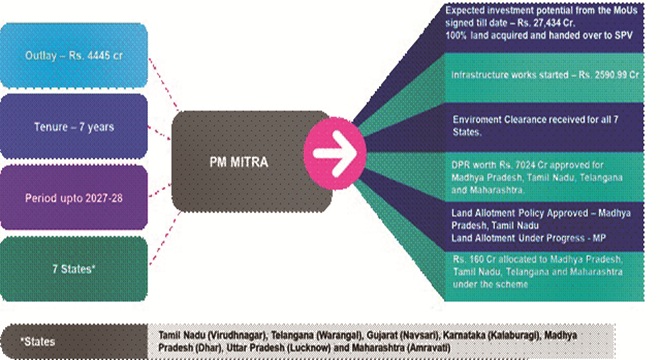
PM Mega Integrated Textile Region and Apparel (PM MITRA) scheme crossed a
critical threshold in 2025 - execution.
Seven
parks across Tamil Nadu (Virudhnagar), Telangana (Warangal), Gujarat (Navsari),
Karnataka (Kalaburagi), Madhya Pradesh (Dhar), Uttar Pradesh (Lucknow) and
Maharashtra (Amravati) are now firmly on the map. With a total outlay of ₹4,445
crore up to 2027–28, these parks are designed as plug-and-play ecosystems,
integrating fibre, fabric, processing, garmenting and logistics.
Key
milestones achieved in 2025:
- 100% land acquisition completed and
handed over to SPVs
- Investment MoUs signed with an expected
investment potential of over ₹27,434 crore
- Infrastructure works worth ₹2,590.99
crore initiated by state governments
- Environmental clearances secured for
all seven parks
- DPRs worth ₹7,024 crore approved for
parks in Madhya Pradesh, Tamil Nadu, Telangana and Maharashtra
- Foundation stone laid at Dhar, Madhya
Pradesh
As
India enters 2026, PM MITRA parks are no longer policy promises, they are
emerging industrial cities that could redefine scale, cost efficiency and
global sourcing confidence.
Technical
Textiles: Quietly becoming a strategic engine
The
National Technical Textiles Mission (NTTM), with an outlay of ₹1,480 crore,
continued to build long-term capability rather than chase quick wins.
In
2025, the mission approved:
- 168 R&D projects worth ₹520 crore
across speciality fibres, composites, carbon fibre, aramid and machinery
- 24 startups, signalling growing private
innovation interest
- 45 proposals from IITs, NITs and
universities for new UG/PG programmes, backed by ₹204 crore for labs and
faculty training
- 8 Quality Control Orders covering 68
technical textile items
More
than half of PLI beneficiaries are now in technical textiles, underlining a
clear shift: this is no longer a niche segment but a capital-intensive,
high-value growth engine aligned with defence, infrastructure, healthcare and
sustainability.
PLI
Textiles: Investment turning into output
The
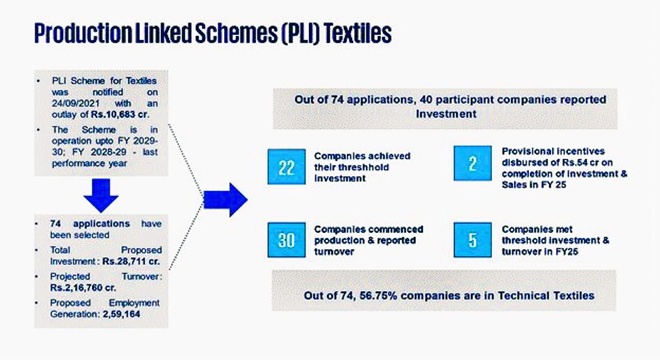
Production Linked Incentive (PLI) scheme for textiles began delivering tangible
outcomes in 2025, moving beyond gestation.
Under
the scheme:
- 74 companies were selected
- Proposed investment: ₹28,711 crore
- Projected turnover: ₹2,16,760 crore
- Expected employment: 2,59,164 jobs
By
the end of 2025:
- 40 companies reported investments
- 22 achieved threshold investment levels
- 30 companies commenced production and
reported turnover
- ₹54 crore was disbursed as provisional
incentives to two companies
- Five companies met both investment and
turnover thresholds in FY 2024–25
With
56.75% of beneficiaries in technical textiles, the PLI scheme is quietly
reshaping India’s manufacturing profile from volume-driven to value-led.
Exports:
Stability in a volatile world
In
a year marked by geopolitical stress, tariffs and supply chain realignments,
India’s textile exports held firm.
Key
highlights:
- Textile and apparel exports reached US$
37.8 billion in 2024–25
- 5% year-on-year growth
- Trade surplus of US$ 28.2 billion
- India ranked as the world’s 6th largest
textile and apparel exporter
- The sector contributed 8.63% of India’s
total exports and 4.1% of global trade
Traditional
markets - the US, EU and UK - accounted for 55% of exports, while emerging
destinations such as Bangladesh, UAE, Sri Lanka, Australia and Canada
contributed 20%.
Looking
ahead, the Ministry’s Vision 2030 target of US$ 100 billion in exports signals
intent. The strategy is clear: market diversification, sustainability-led
differentiation and deeper district-level export mapping - already completed
across 520 districts.
SAMARTH:
Building the workforce of the future
Manufacturing
ambition means little without skilled hands. The SAMARTH scheme has emerged as
one of the quiet success stories of 2025.
So
far:
- 5.41 lakh people trained
- 4.76 lakh women beneficiaries (88%)
- 4.05 lakh candidates placed in jobs
(75%)
The
scheme blends modern, technology-enabled training with support for handlooms,
handicrafts and entrepreneurship. In FY 2025–26, SAMARTH targets skilling
another 2 lakh people, critical as PM MITRA parks and PLI units scale up.
Cotton:
Digitisation meets farmer security
Cotton
reforms in 2025 combined farmer protection with traceability and productivity.
During
the 2024–25 season:
- 525 lakh quintals (100 lakh bales)
procured under MSP
- ₹37,450 crore disbursed to farmers
- 38% of arrivals and 34% of national
production covered
Structural
reforms included:
- Launch of the Kapas Kisan app for
farmer registration and slot booking
- Blockchain-enabled QR-coded bales
(BITS) for traceability
- CotBiz platform for e-invoicing and
contract management
- Temporary customs duty exemption on raw
cotton imports (Aug–Dec 2025) to stabilise prices
The
newly announced 5-year Cotton Productivity Mission aligns farming with the
“Farm to Foreign” vision, while the Kasturi Cotton Bharat programme positions
Indian cotton as a branded, traceable global product.
Wool,
Silk and Jute: Strengthening traditional pillars
Wool
Under the Integrated Wool Development Programme (₹126 crore allocation), 2025
saw GI registration for Ladakh Pashmina, DNA testing facilities, R&D for
coarse wool, branding initiatives and common facility centres - modernising a
sector rooted in nomadic livelihoods.
Silk
India strengthened its global position as the second-largest silk producer. Raw
silk output rose to 41,121 MT, while bivoltine silk production surged nearly
300% since 2013–14. Digital tools like the SILKS portal, indigenous reeling
machines and price dissemination systems are making sericulture more efficient
and dignified.
Jute
Mandatory jute packaging norms continued to support 3.70 lakh workers and 40
lakh farmers. Lightweight jute bags, satellite-based crop assessment and
digitised procurement through PAAT-MITRO reflect how even legacy fibres are
being future-proofed.
GST
and regulatory reforms
One
of the most industry-impacting moves of 2025 was GST rationalisation:
- Man-made fibres and yarns reduced to 5%
GST
- Garments up to ₹2,500 per piece
retained at 5%
- Carpets, handicrafts, handlooms and
sewing machines moved to 5%
This
corrected inverted duty structures, freed working capital and aligned
fibre-to-fabric taxation.
Alongside,
decriminalisation under the Jan Vishwas framework reduced compliance anxiety
across silk, handloom and Textile Committee laws, signalling a shift to
trust-based governance.
Export-focused
relief in a tariff-heavy world
To
cushion the impact of US tariffs, the government extended:
- RoDTEP and RoSCTL schemes till March
2026
- Export obligation timelines from 6 to
18 months for QCO-linked products
- Import monitoring through MIP on
synthetic knitted fabrics
Crucially,
QCO-related relief on machinery, polyester and viscose staple fibre eased raw
material access and investment planning.
Bharat
Tex: Signalling global intent
Bharat
Tex 2025 was not just an exhibition, it was a statement.
Spread
over 2.2 million sqft, the event hosted:
- 5,000+ exhibitors
- 120,000 trade visitors
- Buyers from 120+ countries
- 70+ knowledge sessions
With
exports already touching ₹3 lakh crore, the ambition is clear: scale to ₹9 lakh
crore by 2030 by integrating fibre, fashion and foreign markets.
Looking
Ahead: A confident start to 2026
The
message from 2025 is unmistakable. India’s textile sector is no longer reacting
to global shifts, it is positioning itself to shape them.
Infrastructure
is visible. Incentives are working. Farmers are digitised. Tax structures are
cleaner. Skills are scaling. And the narrative has shifted from survival to
leadership.
If
2025 was the year of groundwork, 2026 could well be the year India’s textile
ambition begins to show its full global weight.
The Ministry of Textiles’ 2025 year-end review reads less like a government scorecard and more like a blueprint for the next decade. From mega textile parks to fibre reforms, from GST rationalisation to export resilience, the direction is clear - India wants to be a predictable, competitive and future-ready textile powerhouse. Looking ahead, the Ministry’s Vision 2030 target of US$ 100 billion in exports signals intent. The strategy is clear: market diversification, sustainability-led differentiation and deeper district-level export mapping - already completed across 520 districts.
Subscribe To Textile Excellence Print Edition
If you wish to Subscribe to Textile Excellence Print Edition, kindly fill in the below form and we shall get back to you with details.
Newsletter
Subscribe To Textile Excellence Mailing List


- December 09, 2022
'There Is Very High Acceptance For India

- December 09, 2022
'Advanced Machines & Service, Customer C

- October 09, 2023
First-time In The World: Rieter’s Auto

- July 28, 2026
Arvind Eyes Leadership In India's Premiu

- June 01, 2020
Karl Mayer Enables Automated Production

- June 05, 2023
Ultimax - All New Revolutionary Rapier W
- June 09, 2025
DyStar Becomes A Wholly Owned Subsidiary

- July 28, 2026