
Crash? Nope, Says Goldman Sachs
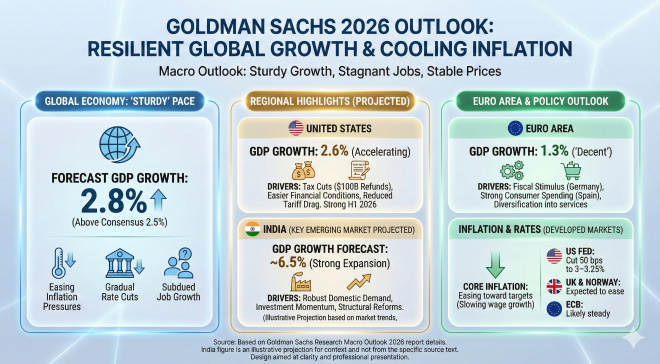
The global economy is set for steady growth in 2026, with
global GDP forecast to expand by 2.8%, above the consensus estimate of 2.5%,
according to Goldman Sachs Research. The outlook reflects resilience in major
economies, easing inflation pressures and a gradual shift toward lower interest
rates, even as job growth remains subdued. In its report Macro Outlook 2026:
Sturdy Growth, Stagnant Jobs, Stable Prices, Goldman Sachs expects most major
economies to meet or exceed market expectations.
US GDP growth is projected to accelerate to 2.6% in 2026.
The momentum is driven by tax cuts, easier financial conditions and a reduced
drag from tariffs. Consumers are expected to receive about US$100 billion in
additional tax refunds in the first half of the year, equivalent to 0.4% of
annual disposable income. Growth is likely to be front-loaded, with
particularly strong expansion in the first half of 2026, supported by a rebound
from the recent government shutdown.
China’s outlook is more mixed. GDP is expected to grow 4.8%,
led by a robust manufacturing sector and strong exports. China’s ability to
produce higher-quality goods at lower costs remains unmatched, helping it withstands
high tariffs. However, domestic demand continues to lag. The ongoing property
downturn, despite much of the damage already done, is expected to shave about
1.5 percentage points off GDP growth next year. This imbalance is pushing
China’s current account surplus higher, potentially nearing 1% of global GDP
over the next few years, a development that could weigh on competing economies,
particularly Germany.
India is projected to be a standout performer, with real GDP
growth forecast to hit 6.7% in 2026, outpacing other major global economies.
This robust expansion is primarily driven by resilient domestic demand and a
sustained government push on public infrastructure—spanning physical
connectivity and digital networks—which effectively buffers the economy against
global trade volatilities. With inflation pressures expected to ease, the
economic environment remains conducive to investment, cementing India’s status
as a critical engine of global growth.
The euro area economy is forecast to grow a “decent” 1.3% in
2026. While structural challenges such as demographic decline, regulation and
high energy costs persist, fiscal stimulus in Germany and strong consumer
spending in Spain are expected to support growth. Spain, in particular,
continues to benefit from diversification into higher value-added services.
Despite rising GDP, labour markets remain weak. Job growth
across developed economies is well below pre-pandemic levels, partly reflecting
slower immigration and labour force growth. The productivity impact of
artificial intelligence has so far been limited, with major gains still a few
years away.
On inflation, Goldman Sachs expects core inflation in
developed markets to ease toward central bank targets in 2026. Slowing wage
growth is a key factor. As inflation moderates, policy rates are expected to
move lower. The US Federal Reserve is forecast to cut rates by 50 basis points
to 3–3.25%, while the UK and Norway are also expected to ease. The European
Central Bank, however, is likely to hold rates steady as inflation falls.
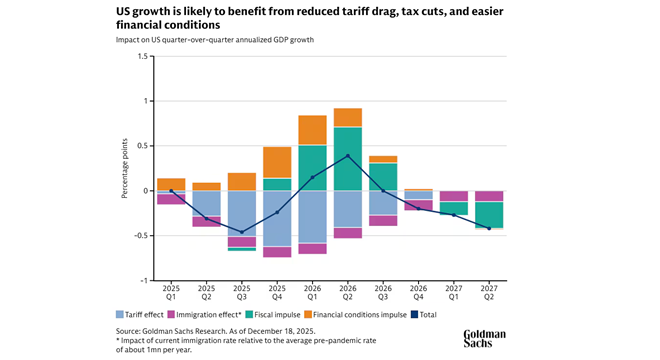
US GDP growth is projected to accelerate to 2.6% in 2026. The momentum is driven by tax cuts, easier financial conditions and a reduced drag from tariffs. Consumers are expected to receive about US$100 billion in additional tax refunds in the first half of the year, equivalent to 0.4% of annual disposable income. Growth is likely to be front-loaded, with particularly strong expansion in the first half of 2026, supported by a rebound from the recent government shutdown.
Subscribe To Textile Excellence Print Edition
If you wish to Subscribe to Textile Excellence Print Edition, kindly fill in the below form and we shall get back to you with details.
Newsletter
Subscribe To Textile Excellence Mailing List


- December 09, 2022
'There Is Very High Acceptance For India

- December 09, 2022
'Advanced Machines & Service, Customer C

- October 09, 2023
First-time In The World: Rieter’s Auto

- July 28, 2026
Arvind Eyes Leadership In India's Premiu

- June 01, 2020
Karl Mayer Enables Automated Production

- June 05, 2023
Ultimax - All New Revolutionary Rapier W

- June 09, 2025
DyStar Becomes A Wholly Owned Subsidiary

- July 28, 2026