
India’s Textile Market Surges To ₹15 Lakh Crore
India’s textile story is no
longer just about exports. It is increasingly being driven from within. The
latest National Household Survey 2024 on Textiles and Clothing, released by
Union Textiles Minister Giriraj Singh, puts a sharp spotlight on this shift.
The numbers are striking.
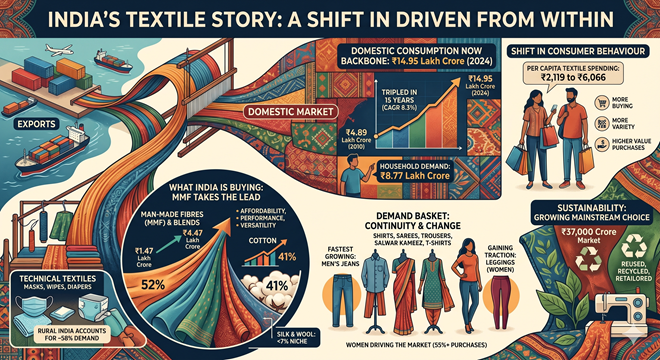
India’s textile market has nearly tripled over the past 15 years, expanding
from ₹4.89 lakh crore in 2010 to ₹14.95 lakh crore in 2024, clocking a steady
CAGR of 8.3%. At the heart of this surge is domestic consumption, particularly
households, which now account for ₹8.77 lakh crore of demand, effectively the
backbone of the sector.
Equally significant is the
rise in individual consumption. Per capita textile spending has almost tripled,
from ₹2,119 to ₹6,066, signalling not just population growth, but a clear shift
in consumer behaviour, more buying, more variety, and higher value purchases.
But the real disruption
lies in what India is buying.
For decades, cotton
dominated the Indian textile narrative. That dominance is now being challenged.
Man-made fibres (MMF) and blended textiles have taken the lead, accounting for
over 52% of the market, while cotton follows at 41%. This is not a marginal
shift, it reflects a deeper transformation in consumer preference towards
affordability, performance, and versatility.
In absolute terms, MMF
demand has surged from ₹1.47 lakh crore to ₹4.47 lakh crore, while cotton,
though still strong, is growing in a more competitive landscape. Silk and wool
remain niche, together contributing less than 7% of the market.
The demand basket itself
tells a story of both continuity and change. Staples like shirts, sarees,
trousers, salwar kameez, and T-shirts continue to dominate, anchoring everyday
consumption. But within this, new trends are emerging. Men’s jeans are the fastest-growing
category, while products like leggings are gaining strong traction among women.
Women, in fact, are driving
the market. They account for over 55% of textile purchases, reinforcing their
central role in shaping demand patterns across categories.
Another powerful shift is
the rise of sustainability, not as a niche, but as a growing mainstream choice.
The market for sustainable textiles has reached ₹37,000 crore, with a
significant portion coming from reused, recycled, and retailored garments. This
points to an evolving consumer mindset, where value is no longer just about
price, but also about longevity and responsibility.
At the same time, technical
textiles are quietly expanding their footprint in household consumption.
Products such as masks, sanitary napkins, wipes, diapers, and medical
disposables are seeing strong uptake, particularly in rural India, which
accounts for nearly 58% of this demand.
The implications are clear.
India’s textile industry is no longer just supply-driven, it is becoming
demand-led, diversified, and increasingly sophisticated.
For policymakers and
businesses alike, this is a wake-up call. The next phase of growth will not be
built on exports alone, but on understanding and serving the complexity of the
Indian consumer.
The numbers are striking. India’s textile market has nearly tripled over the past 15 years, expanding from ₹4.89 lakh crore in 2010 to ₹14.95 lakh crore in 2024, clocking a steady CAGR of 8.3%. At the heart of this surge is domestic consumption, particularly households, which now account for ₹8.77 lakh crore of demand, effectively the backbone of the sector.
Subscribe To Textile Excellence Print Edition
If you wish to Subscribe to Textile Excellence Print Edition, kindly fill in the below form and we shall get back to you with details.
Newsletter
Subscribe To Textile Excellence Mailing List


- December 09, 2022
'There Is Very High Acceptance For India

- December 09, 2022
'Advanced Machines & Service, Customer C

- October 09, 2023
First-time In The World: Rieter’s Auto
- July 28, 2026
Arvind Eyes Leadership In India's Premiu

- June 01, 2020
Karl Mayer Enables Automated Production

- June 05, 2023
Ultimax - All New Revolutionary Rapier W
- June 09, 2025
DyStar Becomes A Wholly Owned Subsidiary

- July 28, 2026