
Womaniya Surges Past Targets To Redefine Women’s Access To Government Markets
The Womaniya initiative has quietly emerged as one of the most significant inclusion-led success stories in India’s public procurement ecosystem. The latest numbers underline its scale and momentum. Over 2.1 lakh women-led micro and small enterprises (MSEs) are now registered on the Government e-Marketplace (GeM), collectively securing 13.7 lakh orders in FY 2025–26. In value terms, contracts worth more than ₹28,000 crore have been awarded to women entrepreneurs, marking a strong 27.6% growth over the previous year. Notably, women-led businesses now account for 5.6% of GeM’s total procurement, significantly exceeding the mandated 3% target.
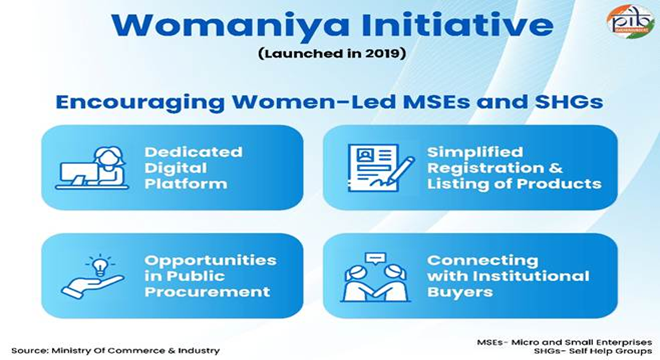
This growth reflects a structural shift in how women entrepreneurs are participating in formal markets. Launched in 2019 under the Ministry of Commerce & Industry, Womaniya was designed to address a long-standing gap - limited access for women-led enterprises to government procurement. By creating a dedicated interface within GeM, the initiative has simplified entry barriers and enabled direct engagement between women entrepreneurs and institutional buyers.
GeM itself, introduced in 2016, transformed public procurement into a fully digital, paperless and cashless system. It connects central and state ministries, public sector undertakings, local bodies and cooperatives with suppliers across India. Womaniya builds on this digital backbone by ensuring that women-led enterprises are not just present, but visible and competitive within this marketplace.
Targeted categories driving scale and visibility
A key strength of the initiative lies in its focused product segmentation. Womaniya identifies categories where women already have strong production capabilities and clusters them into curated storefronts. These include handicrafts, handloom textiles, jute and coir products, home décor, office accessories, grocery items and personal hygiene products. This structured categorisation improves product discoverability and makes it easier for government buyers to source from women-led enterprises at scale.
From barriers to seamless digital participation
Beyond access, the initiative addresses operational challenges that have historically limited participation. Digital onboarding through Udyam registration ensures formal recognition of enterprises. Standardised catalogue templates bring uniformity in product listings, allowing buyers to compare offerings with clarity. Most importantly, the entire procurement cycle - from bidding and order placement to invoicing and payment - is executed online. This reduces dependence on intermediaries and enables direct, transparent transactions.
Timely payment mechanisms are another critical enabler. For micro and small enterprises, working capital constraints can be a major barrier. Digitised workflows on GeM ensure faster order acceptance and payment cycles, improving liquidity and business continuity for women entrepreneurs.
Capacity building remains central to Womaniya’s expansion. Under the broader SWAYATT (Startups, Women & Youth Advantage Through e-Transactions) programme, targeted interventions such as onboarding drives, training workshops, vernacular sessions and buyer-seller meets are conducted across states. These initiatives are designed to equip women entrepreneurs with the knowledge and tools required to navigate digital procurement systems effectively.
Harnessing SHG scale to unlock market access
The scale of the opportunity becomes clearer when viewed alongside India’s vast Self-Help Group (SHG) network. As of February 2026, over 10.05 crore women are organised into 90.09 lakh SHGs. These grassroots institutions play a crucial role in mobilising women, pooling resources and enabling income-generating activities. Womaniya provides these groups with a direct pathway into formal markets, converting local production capabilities into sustainable enterprise participation.
At the ground level, implementation is supported by a network of district administrations, enterprise support centres and training institutions. These stakeholders conduct onboarding drives, assist with product cataloguing and build seller readiness. As government buyers increasingly source from Womaniya-listed products, demand creation is becoming more structured and predictable.
What sets Womaniya apart is the way it integrates multiple elements - digital infrastructure, policy support, capacity building and institutional demand - into a cohesive ecosystem. It is not merely a procurement initiative, but a market-building mechanism that expands supplier diversity while strengthening women-led entrepreneurship.
The initiative has evolved significantly since its launch. From a targeted inclusion effort, it has grown into one of the largest organised procurement channels for women-led enterprises in the country. Its impact is visible not only in numbers, but in the changing dynamics of market access—where women entrepreneurs are moving from the margins to becoming active participants in formal supply chains.
As the platform continues to scale, Womaniya is expected to play an even larger role in shaping India’s domestic enterprise landscape. By aligning public procurement with inclusion goals, it is creating a model where economic participation is broader, more equitable and more sustainable.
The initiative has evolved significantly since its launch. From a targeted inclusion effort, it has grown into one of the largest organised procurement channels for women-led enterprises in the country. Its impact is visible not only in numbers, but in the changing dynamics of market access—where women entrepreneurs are moving from the margins to becoming active participants in formal supply chains.
Subscribe To Textile Excellence Print Edition
If you wish to Subscribe to Textile Excellence Print Edition, kindly fill in the below form and we shall get back to you with details.
Newsletter
Subscribe To Textile Excellence Mailing List


- December 09, 2022
'There Is Very High Acceptance For India

- December 09, 2022
'Advanced Machines & Service, Customer C

- October 09, 2023
First-time In The World: Rieter’s Auto
- July 28, 2026
Arvind Eyes Leadership In India's Premiu

- June 01, 2020
Karl Mayer Enables Automated Production

- June 05, 2023
Ultimax - All New Revolutionary Rapier W
- June 09, 2025
DyStar Becomes A Wholly Owned Subsidiary
- July 28, 2026