
Australia’s Cotton Exports Rise As China And India Drive Demand
Australia’s cotton exports
are set to rise sharply despite an expected dip in production, underscoring how
global demand shifts and stock dynamics are rewriting trade flows in real time.
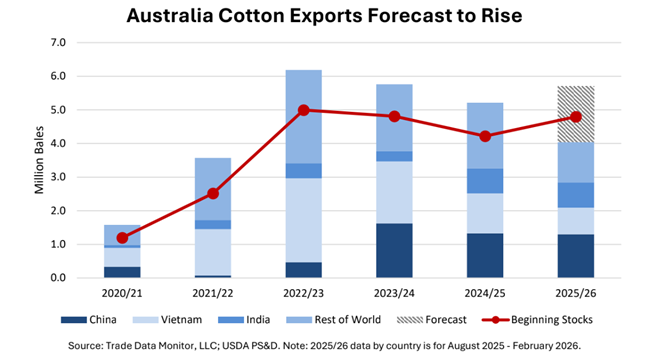
For the 2025/26 marketing year (August 2025–July 2026), exports are forecast to
climb nearly 10% to 5.7 million bales, powered by strong buying from China and
India that more than offsets weaker shipments to Vietnam.
The surprising resilience
is being driven not by a bigger crop, but by timing and inventory. A large
2024/25 harvest has left Australia with elevated beginning stocks, effectively
front-loading supply into the current export cycle. These stocks are now acting
as a buffer, allowing exports to stay strong even before the smaller 2025/26
crop enters the market.
Australia’s export rhythm
also plays a decisive role. As a Southern Hemisphere producer, harvesting
begins in April, with exports typically starting in May. Roughly 30% of the new
crop is shipped in the final quarter of the marketing year, while the rest is
carried into the next cycle. That means exports between May and July will
increasingly reflect tighter supply conditions from the new crop.
On the demand side, the
geography of trade is shifting fast. As of February, China accounts for about
one-third of Australia’s cotton exports, while Vietnam and India each absorb
roughly one-fifth. This balance has changed dramatically over the past few years.
During 2021/22 and 2022/23, political tensions pushed China away from
Australian cotton, redirecting flows toward Vietnam. That pattern has now
reversed as China returns as a dominant buyer.
India has emerged as
another key swing factor. Temporary duty removal between August and December
2025 triggered a surge in imports, with Australian shipments already surpassing
last year’s totals. Together, China and India are now reshaping Australia’s export
map.
However, this concentration
carries risk. Around 70% of Australia’s exports are now tied to just three
markets, leaving it more exposed to geopolitical and policy shocks than Brazil
or the United States, where demand is more diversified.
Globally, cotton
fundamentals remain mixed. Production is expected to rise to 121.9 million
bales, driven by China, India, and Pakistan, while consumption edges up to
119.1 million bales. Trade volumes, however, are slightly lower at 43.7 million
bales due to weaker flows from India and softer import demand in several Asian
markets.
Ending stocks are also
rising to 77 million bales, led by accumulation in China and India—signalling
that even as demand strengthens, supply is staying ahead of it. In this
shifting balance, Australia’s export surge stands out as a story of timing,
trade realignment, and market concentration risk playing out simultaneously.
Globally, cotton fundamentals remain mixed. Production is expected to rise to 121.9 million bales, driven by China, India, and Pakistan, while consumption edges up to 119.1 million bales. Trade volumes, however, are slightly lower at 43.7 million bales due to weaker flows from India and softer import demand in several Asian markets.
Subscribe To Textile Excellence Print Edition
If you wish to Subscribe to Textile Excellence Print Edition, kindly fill in the below form and we shall get back to you with details.
Newsletter
Subscribe To Textile Excellence Mailing List


- December 09, 2022
'There Is Very High Acceptance For India

- December 09, 2022
'Advanced Machines & Service, Customer C

- October 09, 2023
First-time In The World: Rieter’s Auto

- July 28, 2026
Arvind Eyes Leadership In India's Premiu

- June 01, 2020
Karl Mayer Enables Automated Production

- June 05, 2023
Ultimax - All New Revolutionary Rapier W

- June 09, 2025
DyStar Becomes A Wholly Owned Subsidiary

- July 28, 2026