
A Fragile Turnaround: ITMF Survey
The global textile industry appears to be turning a
corner, but this is more likely a fragile and possibly temporary improvement
than the start of a durable recovery. According to the 38th ITMF
Global Textile Industry Survey, conducted worldwide during the second half of
May 2026, business sentiment, order intake, order backlogs and capacity
utilization all improved versus March — yet every indicator remains weak by
historical standards, and rising costs cast doubt on how long the upturn can
last.
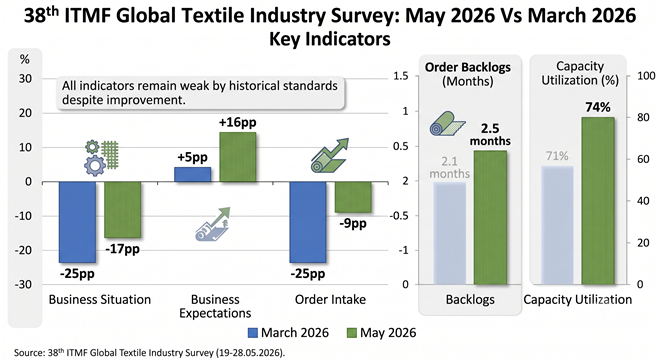
The new survey shows a business situation balance rising to −17 percentage points (pp) from −25pp in March. Business expectations climbed to +16pp (from +5pp), order intake to −9pp (from −25pp), backlogs to 2.5 months and capacity utilization to 74%. Order cancellations stayed contained and inventories lean low. The direction is encouraging, but the levels rest on a thin and fragile cushion.
The upturn was
geographically uneven. Africa led on business situation, order intake, backlog
and expectations, alongside gains in Europe and North & Central America.
The Asian production hubs lagged, with East Asia weakest on both current
conditions and the six-month outlook. Along the value chain, segments closest
to the end-consumer slightly fared best, while capital-goods and upstream
segments trailed.
Cost and demand pressures
persist: weak demand remains the major concern for 53% of participating textile
manufacturers, followed by raw-material prices (52%) and energy prices and
geopolitics (42% each). The survey links rising costs to the war in Iran, which
has pushed crude oil to around USD 100 and lifted gasoline prices by roughly
50% since March, feeding inflation and squeezing margins. Whether the May
reading holds will depend largely on energy prices and the resolution of
ongoing conflicts.
Cost and demand pressures persist: weak demand remains the major concern for 53% of participating textile manufacturers, followed by raw-material prices (52%) and energy prices and geopolitics (42% each). The survey links rising costs to the war in Iran, which has pushed crude oil to around USD 100 and lifted gasoline prices by roughly 50% since March, feeding inflation and squeezing margins. Whether the May reading holds will depend largely on energy prices and the resolution of ongoing conflicts.
Subscribe To Textile Excellence Print Edition
If you wish to Subscribe to Textile Excellence Print Edition, kindly fill in the below form and we shall get back to you with details.
Newsletter
Subscribe To Textile Excellence Mailing List


- December 09, 2022
'There Is Very High Acceptance For India

- December 09, 2022
'Advanced Machines & Service, Customer C

- October 09, 2023
First-time In The World: Rieter’s Auto

- July 28, 2026
Arvind Eyes Leadership In India's Premiu

- June 01, 2020
Karl Mayer Enables Automated Production

- June 05, 2023
Ultimax - All New Revolutionary Rapier W
- June 09, 2025
DyStar Becomes A Wholly Owned Subsidiary

- July 28, 2026