
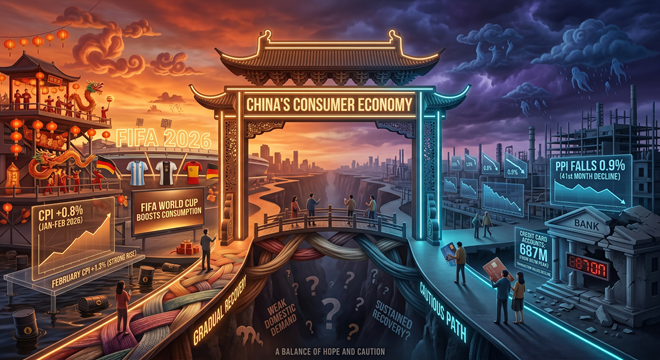
China's Consumer Story: Signs Of Life, But Caution Still Rules
China's consumer economy is sending mixed signals. There
are signs that spending is improving, helped by festivals, sporting events and
government support measures. Yet beneath the surface, households remain
cautious, raising questions about whether the recovery can be sustained.
The first encouraging sign came from inflation data.
China's consumer price index (CPI) rose 0.8% year-on-year during January and
February 2026, while February alone recorded a 1.3% increase, the strongest
monthly rise in around three years and above market expectations.
Much of the improvement was driven by the extended
Chinese New Year holiday. Higher spending on travel, dining and entertainment
pushed prices higher than usual. Core inflation, which excludes food and
energy, also increased by 1.3%, suggesting some underlying improvement in
demand.
However, economists warn against reading too much into
the figures. Higher oil prices resulting from tensions in the Middle East also
contributed to inflation. Once these temporary factors fade, China's familiar
challenges of weak domestic demand and excess supply could quickly return.
Even producer prices tell a similar story. China's
producer price index (PPI) fell 0.9% year-on-year in February, marking its 41st
consecutive month of decline. Yet the contraction narrowed from January, and
producer prices rose on a monthly basis for the fifth straight month,
indicating improving industrial conditions.
2026 FIFA World Cup boosts consumption
Meanwhile, the 2026 FIFA World Cup has provided another
boost to consumption. Chinese e-commerce platforms reported that searches
linked to the tournament lifted toy and collectible sales by more than 150%.
Demand for jerseys of teams such as Argentina, Germany and Spain has also
risen, with many of these products manufactured in China. Restaurants, cafés,
hotels and tourism operators are benefiting as consumers embrace
football-themed experiences during the nearly 40-day tournament.
China’s credit card accounts decline
Despite these bright spots, Chinese households remain
careful with their spending. Credit card data highlight this caution. The
number of credit card accounts fell to 687 million in the first quarter of
2026, down from a peak of 807 million in 2022. China's major banks also
reported an average 11% decline in credit card transaction values in 2025.
Rising bad debts have prompted banks to tighten approvals and focus on existing
customers.
For the textile and apparel industry, the message is
clear. Consumer spending in China is recovering, but only gradually. Holiday
celebrations and global sporting events can spark bursts of demand,
particularly for fashion, merchandise and lifestyle products. Yet until
consumer confidence strengthens and households feel secure enough to spend more
freely, the recovery is likely to remain uneven rather than broad-based.
Even producer prices tell a similar story. China's producer price index (PPI) fell 0.9% year-on-year in February, marking its 41st consecutive month of decline. Yet the contraction narrowed from January, and producer prices rose on a monthly basis for the fifth straight month, indicating improving industrial conditions.
Subscribe To Textile Excellence Print Edition
If you wish to Subscribe to Textile Excellence Print Edition, kindly fill in the below form and we shall get back to you with details.
Newsletter
Subscribe To Textile Excellence Mailing List


- December 09, 2022
'There Is Very High Acceptance For India

- December 09, 2022
'Advanced Machines & Service, Customer C

- October 09, 2023
First-time In The World: Rieter’s Auto

- July 28, 2026
Arvind Eyes Leadership In India's Premiu

- June 01, 2020
Karl Mayer Enables Automated Production

- June 05, 2023
Ultimax - All New Revolutionary Rapier W

- June 09, 2025
DyStar Becomes A Wholly Owned Subsidiary

- July 28, 2026