
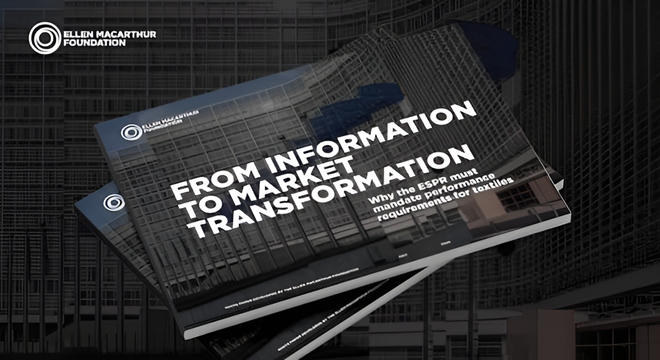
ESPR Battle Lines Drawn: Europe’s Textile Rules Could Decide The Future Of Circular Fashion
The
next phase of Europe’s textile revolution will not be decided by information
alone. It will be decided by performance.
As
the European Union moves closer to introducing the first textile-specific rules
under the Ecodesign for Sustainable Products Regulation (ESPR), industry
stakeholders are pushing for stronger mandatory requirements that could reshape
how textiles are designed, produced, sold and recycled.
The
ESPR is designed to make sustainable products the norm across the EU by
reducing environmental impacts throughout a product’s lifecycle. For textiles,
one of the most resource-intensive sectors, the regulation could become a
turning point, influencing everything from fibre choices and product durability
to recycling and market access.
However,
experts warn that transparency alone will not transform the textile industry.
They argue that Europe needs binding performance standards to ensure
circularity becomes a market reality rather than remaining limited to pilot
projects.
From
labels to real change
The
ESPR introduces product-specific requirements through Delegated Acts, which
determine the conditions products must meet before entering the EU market.
Textiles are among the first sectors expected to come under this framework.
The
European Commission’s Joint Research Centre (JRC) has identified four key
ecodesign areas for textiles: durability, recyclability, recycled content and
environmental footprint.
But
the current approach places greater emphasis on information disclosure rather
than mandatory performance benchmarks. Industry advocates believe this could
limit the regulation’s ability to drive large-scale transformation.
“Information
can encourage change, but performance requirements create change at scale,” is
the core message emerging from sustainability experts.
Without
mandatory thresholds, companies investing in durable, recyclable and circular
products could find themselves competing against lower-cost products that do
not meet equivalent standards.
Circularity
needs scale, not just innovation
The
textile industry is witnessing growing investment in recycling, repair, resale
and resource-efficient manufacturing. But scaling these solutions requires
clear market signals.
A
stronger ESPR could unlock significant opportunities across the circular
textile ecosystem, from textile
collection and sorting to recycling, repair and refurbishment, creating new
business models and employment opportunities.
For
manufacturers, the regulation could also provide greater certainty to invest in
circular product design and next-generation textile technologies.
What
the new rules must deliver
A
sustainability-focused white paper on ESPR implementation recommends stronger
requirements, including:
- Making durability and robustness
mandatory performance criteria instead of only information requirements.
- Strengthening recyclability standards,
including stricter limits on materials that hinder recycling, such as high
elastane content.
- Prioritising post-consumer
fibre-to-fibre recycled content, with targets increasing over time.
- Introducing mandatory product-level
repairability requirements in future revisions.
As
Europe moves towards a circular textile economy, the ESPR could become one of
the most influential regulations shaping global textile supply chains.
The
message for the industry is clear: the future of sustainable textiles will not
be built only on transparency. It will be built on products that are designed,
manufactured and measured for circularity from the beginning.
AMCIRC said circular manufacturing should become a strategic priority, helping reduce dependence on virgin raw materials while supporting responsible sourcing and sustainable production. The move reflects growing efforts to link trade, sustainability and supply chain security. Several textile organisations have also called on USTR to strengthen regional manufacturing and improve the proposed incentive framework. USTR launched the Section 301 investigations in March 2026 and proposed further actions in June. The agency is currently reviewing industry feedback before announcing its final decision. For global textile exporters, the development signals a growing shift, sustainability and traceability could increasingly influence market access alongside cost and quality.
Subscribe To Textile Excellence Print Edition
If you wish to Subscribe to Textile Excellence Print Edition, kindly fill in the below form and we shall get back to you with details.
Newsletter
Subscribe To Textile Excellence Mailing List


- December 09, 2022
'There Is Very High Acceptance For India

- December 09, 2022
'Advanced Machines & Service, Customer C

- October 09, 2023
First-time In The World: Rieter’s Auto

- July 28, 2026
Arvind Eyes Leadership In India's Premiu

- June 01, 2020
Karl Mayer Enables Automated Production

- June 05, 2023
Ultimax - All New Revolutionary Rapier W
- June 09, 2025
DyStar Becomes A Wholly Owned Subsidiary

- July 28, 2026