
Grasim Urges Price Stability To Rescue Textile Exports
During Bharat Tex 2026 at Bharat Mandapam in New Delhi,
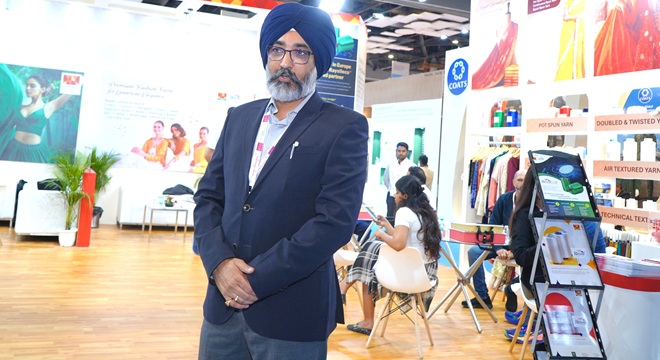
Textile Excellence caught up with ManMohan Singh, Group Executive President and
Chief Marketing Officer at Grasim Industries, Birla Cellulose. The discussion
focused on structural challenges facing Indian textile exports, the shifting
raw material landscape, and strategic roadmaps for sustainable growth. Latest
industry numbers reveal that total textile exports registered a modest growth
of 2.1% in the financial year 2025 to 2026, reaching Rs 3,16,334.9 crore.
Ready-made garments rose 2.9%, while man-made yarn and fabrics grew by 3.6%.
While new Free Trade Agreements open fresh avenues, domestic price instability
continues to bottleneck long term competitiveness.
Export Stagnation and Pricing Volatility
Historical trade data reveals double digit
export growth between 2004 and 2014, whereas growth slowed drastically to 0.3%
from 2014 to 2026. What primary factor explains this sharp deceleration?
ManMohan Singh:
Raw material price stability remains the absolute fundamental requirement for
driving sustained export growth. Earlier, when domestic market dynamics
operated within narrow boundaries, price fluctuations stayed within one or two
rupees per kilogram. Global open market conditions and currency movements now
drive extreme volatility. Domestic prices fluctuate rapidly every fortnight.
Apparel retailers operating on six-month seasonal cycles cannot manage product
price changes every fifteen days. Unstable pricing across fibres, yarns, and
fabrics forces downstream buyers toward extreme caution, ultimately crippling
export momentum.
Cost Pressures Across the Value Chain
Global geopolitical conflicts have disrupted
traditional supply chains. How are escalating input costs impacting man-made
cellulosic fibre manufacturing?
ManMohan Singh:
Input costs have escalated across four distinct operational fronts. Logistics
costs for imported raw material inputs from Canada, Sweden, and South Africa
have surged. Currency fluctuations continue to create pricing instability.
Energy costs have spiked, directly impacting energy byproducts like sulphur.
Traditionally, sulphur prices hovered around US 160 per tonne. Current
market prices stand near US$910 per tonne, representing an extraordinary
sevenfold increase. Value chain partners cannot absorb these massive cost
spikes. Fabric prices remain suppressed while yarn and fibre costs rise,
compressing margins and forcing manufacturers to reengineer fabric blends to
survive.
160 per tonne. Current
market prices stand near US$910 per tonne, representing an extraordinary
sevenfold increase. Value chain partners cannot absorb these massive cost
spikes. Fabric prices remain suppressed while yarn and fibre costs rise,
compressing margins and forcing manufacturers to reengineer fabric blends to
survive.
Cotton Deficit and Strategic Focus on
Lyocell
India became a net importer of cotton in
2025. How will this ongoing raw material deficit reshape the domestic fibre
basket?
ManMohan Singh:
Projections indicate India will face a cotton deficit of 1500 to 1600 tonnes
per day by 2030. Alternative fibres must step in to fill this structural
shortfall. Lyocell represents the ultimate replacement option because its
physical properties and hand feel closely resemble natural cotton. Grasim
initiated formal sustainability initiatives in 2014 and maintains strict
European Union environmental compliance. Our closed loop Lyocell production
technology recovers 99.7% of chemical solvents and process gases. Global
Lyocell adoption within the man-made cellulosic fibre basket stood near 10% in
2022 and is projected to reach nearly 20% by 2027. We are expanding capacity
heavily to meet emerging demand.
Productivity Gaps and Policy Imperatives
What critical policy interventions and
structural upgrades must the government implement to maximize new trade
opportunities?
ManMohan Singh:
Trade policies must actively protect domestic markets from predatory foreign
dumping when global demand weakens. Policy tools like Minimum Import Prices
should be explored to maintain pricing equilibrium. Beyond raw material policy,
processing and garmenting infrastructure require urgent modernization. Over
seven lakh garment units operate in India, primarily within micro, small, and
medium enterprises. Per person manufacturing productivity in Indian garmenting
remains 30% lower than Bangladesh and Sri Lanka. Large scale integrated
manufacturing facilities equipped with modern processing technology must be
built to elevate competitiveness and capture emerging international trade
opportunities.
The comprehensive dialogue emphasizes that policy
interventions must pivot toward scaling infrastructure and enforcing price
stability to unlock the next growth phase. Broadening processing capabilities
alongside building globally competitive garment manufacturing plants will prove
essential for Indian exporters seeking to capture high value international
markets. Combining technological modernization, strict sustainability benchmarks,
and predictable raw material pricing will determine whether India transforms
its trade prospects into sustained global leadership.
ManMohan Singh, Group Executive President and Chief Marketing Officer at Grasim Industries, Birla Cellulose said that Trade policies must actively protect domestic markets from predatory foreign dumping when global demand weakens. Policy tools like Minimum Import Prices should be explored to maintain pricing equilibrium. Beyond raw material policy, processing and garmenting infrastructure require urgent modernization. Over seven lakh garment units operate in India, primarily within micro, small, and medium enterprises.
Subscribe To Textile Excellence Print Edition
If you wish to Subscribe to Textile Excellence Print Edition, kindly fill in the below form and we shall get back to you with details.
Newsletter
Subscribe To Textile Excellence Mailing List


- December 09, 2022
'There Is Very High Acceptance For India

- December 09, 2022
'Advanced Machines & Service, Customer C

- October 09, 2023
First-time In The World: Rieter’s Auto

- July 28, 2026
Arvind Eyes Leadership In India's Premiu

- June 01, 2020
Karl Mayer Enables Automated Production

- June 05, 2023
Ultimax - All New Revolutionary Rapier W
- June 09, 2025
DyStar Becomes A Wholly Owned Subsidiary

- July 28, 2026