
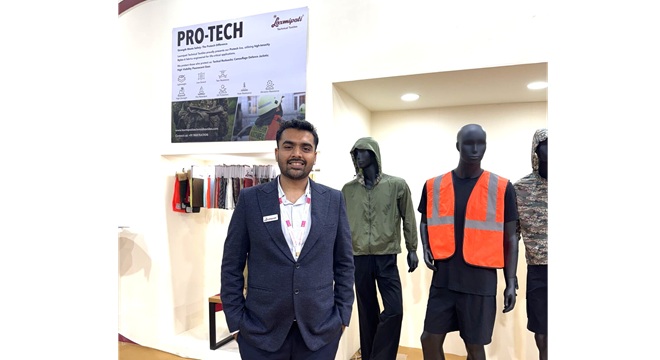
Laxmipati Technical Textiles Bets Big On Protech And Global Markets
India's technical textiles sector is entering a new
phase of transformation, driven by innovation, specialised manufacturing, and
rising demand across industrial applications. Laxmipati Technical Textiles is
positioning itself at the centre of this shift through a strategy focused on
value added products, technology driven manufacturing, and long-term export
growth, according to Executive Director Harddik Sarawagi during an exclusive interaction
with Textile Excellence.
Sarawagi believes the future of the textile industry
lies beyond conventional fabrics. Demand is increasingly moving towards
high-performance materials that deliver durability, functionality, and superior
technical performance. Laxmipati has aligned its business strategy accordingly,
expanding its presence across Protech, Sportech, and Indutech segments while
strengthening research, product development, and advanced manufacturing
capabilities.
Protective textiles have emerged as the company's
fastest growing business segment. Sarawagi said industries across construction,
infrastructure, defence, industrial safety, and manufacturing are increasingly
seeking performance-oriented materials capable of delivering greater strength
and longer service life.
"The segment that is growing the fastest for us is
Protech, or protective textiles. Demand is increasing because industries today
are looking for high-performance materials that deliver durability, safety and
long-term value," Sarawagi said.
The company manufactures an extensive portfolio of
technical fabrics using nylon 6, nylon 6.6, and high tenacity polyester yarns
catering to applications such as protective equipment, punching bags,
industrial reinforcement, high visibility products, and specialised performance
fabrics. Functional finishing technologies including water repellent, durable
water repellent, and acrylic finishes further enhance product performance
across industrial applications.
Sarawagi acknowledged that certain critical raw
materials, particularly nylon 6.6 yarns, continue to be imported due to limited
domestic availability. Imported specialised yarns increase procurement costs
and extend production timelines, highlighting the importance of developing
stronger upstream manufacturing capabilities within India.
Despite growing awareness, technical textiles continue
to face structural challenges in the domestic market. Sarawagi observed that
many buyers still expect premium performance fabrics at prices comparable to
conventional textile products, creating a significant commercial gap for
manufacturers investing in advanced technologies.
Lead times present another challenge. Technical fabrics
are largely application specific, requiring customised yarn procurement after
order confirmation. Production typically requires around 45 days, making rapid
delivery difficult without confirmed demand and long-term customer commitments.
Sarawagi stressed that stronger collaboration between
buyers and manufacturers is essential to accelerate market development.
Industry exhibitions and dedicated technical textile platforms are becoming
increasingly important in educating customers about product capabilities and
commercial benefits.
Bharat Tex 2026 represents a major opportunity in this
direction. Laxmipati plans to showcase its complete technical textile portfolio
after exhibiting knitted apparel during the previous edition. The company's
objective extends beyond immediate sales.
"Our primary focus is creating awareness about what
Laxmipati manufactures beyond apparel fabrics. Bharat Tex brings together
buyers from India and overseas, making it an ideal platform to build long term
business relationships," Sarawagi said.
Sports textiles represent another promising growth
avenue. Rising health awareness, changing lifestyles, increasing participation
in sports, and India's ambitions to host major global sporting events are
expected to accelerate demand for advanced functional fabrics. Sarawagi
believes these trends will create substantial opportunities for manufacturers
capable of delivering specialised performance textiles.
Export expansion forms the company's next strategic
priority. Rather than pursuing overseas markets aggressively at an early stage,
Laxmipati intends to first establish a strong domestic reputation before
scaling international operations.
"We are looking positively at exports. Right now,
our priority is to establish ourselves strongly in the Indian market. Once
domestic customers and traders recognise our products and capabilities,
expanding into overseas markets becomes much more sustainable," Sarawagi
explained.
The United States, Japan, and Europe have been
identified as priority export markets. Supply chain diversification, evolving
geopolitical dynamics, and India's expanding network of Free Trade Agreements
could create significant opportunities for technical textile exports. Sarawagi
believes Indian manufacturers can emerge as competitive alternatives in global
sourcing, particularly where international buyers seek diversified supply
chains.
India's technical textiles market is projected to exceed
US$ 29 billion by 2030, supported by the National Technical Textiles Mission,
infrastructure expansion, automotive manufacturing, healthcare, defence,
construction, and industrial applications. The segment is expected to become a
key pillar of India's ambition to build a US$ 350 billion textile economy by
2030.
Competitiveness, however, remains closely linked to
manufacturing scale. Sarawagi noted that China's integrated production
ecosystem enables significantly lower manufacturing costs through large scale
specialised facilities. India, in contrast, operates through fragmented
manufacturing clusters that often limit economies of scale.
He argued that higher levels of integration, larger
production volumes, and specialised manufacturing ecosystems will be essential
for Indian companies to compete globally in advanced technical textiles.
Government support has improved considerably, according
to Sarawagi. Policy direction remains positive, particularly through incentives
supporting technical textiles, renewable energy adoption, and industrial
development. Faster implementation and greater policy stability, however,
remain equally important.
"The government is taking an active role. The real
challenge lies in implementation. Reforms are moving in the right direction,
but faster execution and policy stability will be essential to strengthen
India's competitiveness in technical textiles," Sarawagi said.
Innovation, sustainability, specialised manufacturing,
and export readiness are expected to define the next phase of India's technical
textile journey. Laxmipati Technical Textiles believes these pillars will
enable both the company and the broader industry to emerge as significant
global suppliers of high-performance technical textile solutions over the
coming decade.
"The government is taking an active role. The real challenge lies in implementation. Reforms are moving in the right direction, but faster execution and policy stability will be essential to strengthen India's competitiveness in technical textiles," Executive Director Harddik Sarawagi said.
Subscribe To Textile Excellence Print Edition
If you wish to Subscribe to Textile Excellence Print Edition, kindly fill in the below form and we shall get back to you with details.
Newsletter
Subscribe To Textile Excellence Mailing List


- December 09, 2022
'There Is Very High Acceptance For India

- December 09, 2022
'Advanced Machines & Service, Customer C

- October 09, 2023
First-time In The World: Rieter’s Auto
- July 28, 2026
Arvind Eyes Leadership In India's Premiu

- June 01, 2020
Karl Mayer Enables Automated Production

- June 05, 2023
Ultimax - All New Revolutionary Rapier W
- June 09, 2025
DyStar Becomes A Wholly Owned Subsidiary
- July 28, 2026