
India’s US$ 100 Billion Textile Roadmap: The Blueprint For Global Leadership
At
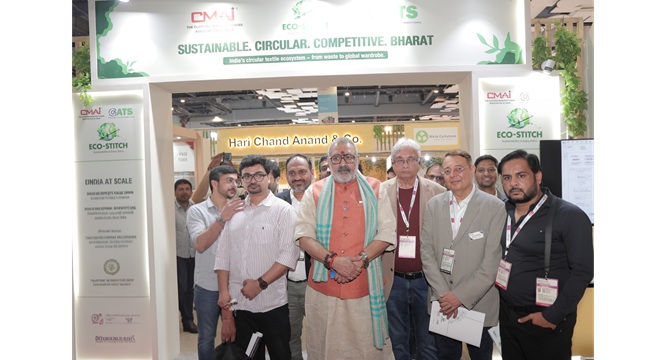
Bharat Tex 2026, Union Minister of Textiles Shri Giriraj Singh unveiled the
‘India Textiles & Apparel CXO Blueprint 2030’, a strategic roadmap prepared
by the Clothing Manufacturers Association of India (CMAI) and the Global
Alliance for Textile Sustainability (GATS). The report lays out a clear
ambition: helping India transform its textile and apparel sector into a
future-ready global powerhouse and achieve USD 100 billion in textile and
apparel exports by 2030.
Released
at the Sustainability & Circularity Impact Pavilion, the Blueprint comes at
a crucial time as global buyers increasingly demand transparency, traceability
and responsible manufacturing.
Highlighting
the importance of the report, Shri Giriraj Singh said its release during Bharat
Tex, in the presence of global buyers, was timely. He noted that the findings
would provide valuable direction to the textile ecosystem and help stakeholders
unlock new growth opportunities while strengthening India’s global
competitiveness.
The
report summarises that India’s next textile leap will not come from scale
alone. It will come from building capabilities.
India
is currently the world’s sixth-largest textile and apparel exporter,
contributing around 4.1% of global trade and supporting nearly 45 million jobs.
However, exports have remained around US$ 40 billion for nearly six years, even
as global textile trade has expanded.
The
Blueprint argues that India must move from being cost competitive to becoming
capability competitive.
With
the domestic textile and apparel market expected to reach USD 250 billion and
exports targeted at US$ 100 billion by 2030, the industry needs to accelerate
innovation, diversify products and strengthen operational excellence across the
value chain.
Santosh
Katariya, President, CMAI, said India has already earned global recognition as
a manufacturing destination, but the next phase of growth will depend on
creating greater value for customers and global brands.
“The
next chapter of our growth will depend on how successfully we build
capabilities that create greater value,” he said, adding that the Blueprint
aims to help enterprises strengthen competitiveness through innovation,
collaboration, sustainability and execution.
The
report identifies five strategic pillars that will shape India’s textile
future:
Circularity,
end-to-end traceability, resource-efficient manufacturing, product
diversification, and technology adoption through AI, automation and digital
systems.
Among
these, circularity presents a significant opportunity. According to the
Blueprint, an optimised circular textile ecosystem could unlock nearly USD 9.4
billion in value by recovering textile waste and creating new economic
opportunities.
Sustainability
is also becoming a business necessity, especially as nearly 50% of India’s
textile and apparel exports are shipped to the US and European Union, where
stricter environmental regulations are reshaping global sourcing decisions.
The
report highlights that India’s growing network of trade agreements with markets
such as the EU, UK, UAE, Oman, Australia and New Zealand can provide a major
boost—but only if companies are prepared with the right products, compliance
systems, documentation and traceability mechanisms.
Naveen
Sainani, Chairman – ESG Committee and Hon. General Secretary, CMAI, said
sustainability is no longer just an aspiration but a key driver of
competitiveness.
“The
Blueprint reflects the industry’s transition from discussion to
implementation,” he said, adding that the focus is on helping enterprises,
particularly MSMEs, combine sustainability, technology and operational
excellence to create long-term value.
Parvinder
Singh, Director, GATS, emphasised that India’s strength lies in its vast
textile ecosystem, but the next opportunity will come from connecting these
capabilities through collaboration, knowledge sharing and implementation.
The
Blueprint is designed not just for large manufacturers but also for MSMEs,
brands, policymakers and ecosystem partners. Its objective is to create a more
integrated textile ecosystem where sustainability and competitiveness move
together.
With
global sourcing undergoing a major transformation, Bharat Tex 2026 provided the
perfect stage for this roadmap. The message from the Blueprint is simple: India
has the scale, skills and ambition. The next challenge is converting that
strength into global leadership.
Parvinder Singh, Director, GATS, emphasised that India’s strength lies in its vast textile ecosystem, but the next opportunity will come from connecting these capabilities through collaboration, knowledge sharing and implementation. The Blueprint is designed not just for large manufacturers but also for MSMEs, brands, policymakers and ecosystem partners. Its objective is to create a more integrated textile ecosystem where sustainability and competitiveness move together.
Subscribe To Textile Excellence Print Edition
If you wish to Subscribe to Textile Excellence Print Edition, kindly fill in the below form and we shall get back to you with details.
Newsletter
Subscribe To Textile Excellence Mailing List


- December 09, 2022
'There Is Very High Acceptance For India

- December 09, 2022
'Advanced Machines & Service, Customer C

- October 09, 2023
First-time In The World: Rieter’s Auto

- July 28, 2026
Arvind Eyes Leadership In India's Premiu

- June 01, 2020
Karl Mayer Enables Automated Production

- June 05, 2023
Ultimax - All New Revolutionary Rapier W

- June 09, 2025
DyStar Becomes A Wholly Owned Subsidiary

- July 28, 2026