
THE CASHFLOW FIX
Small
Textile Businesses Just Got A Bigger Safety Net
For
India's small textile businesses, the biggest problem is often not getting an
order.
It
is getting paid.
A
garment unit buys fabric, pays workers, pays for electricity, trims and
transport, ships the order and then waits weeks or months for the money. That
wait can hurt more than a lack of orders.
The
new Micro, Small and Medium Enterprises Development (Amendment) Bill, 2026,
passed by Parliament this month, goes straight at that problem.
The
Big Change: Make delayed payments harder to ignore
The
amendment brings tighter timelines into the dispute-resolution process for
micro and small enterprises. Mediation must be completed within 90 days of the
first appearance. If it fails, the matter must move to arbitration within 30
days. The arbitral award is then to be made within 90 days of completion of
pleadings.
That
is a significant shift.
A
delayed-payment dispute should no longer be allowed to drift indefinitely
through the system.
There
is another powerful provision.
If
a court case challenging a decree, award or order remains pending for more than
six months, the court must direct payment of at least 50% of the awarded amount
to the micro or small enterprise supplier.
For
a small textile unit waiting for a large payment, that can mean the difference
between surviving and scrambling for another loan.
And
now, the money can move faster
The
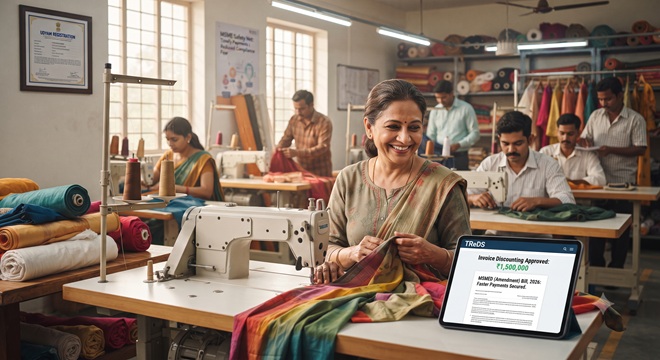
reform also gives a major push to TReDS - Trade Receivables Discounting System.
Think
of it as turning an unpaid invoice into working capital. Instead of waiting for
a buyer to pay a 60-, 90- or 120-day invoice, an MSME can get the receivable
discounted through the TReDS platform and access money earlier.
The
scale of the platform has exploded. Invoice discounting on TReDS jumped from
around ₹40,000 crore in FY2022-23 to ₹3.47 lakh crore in FY2025-26.
Now
comes the bigger push: Central Public Sector Enterprises will have to route
settlement of MSME invoices through TReDS.
For
textile suppliers selling to large public-sector buyers, that could
significantly improve cash-flow visibility. And the reform allows states to
push their own public sector enterprises towards TReDS too.
Disputes
go digital
The
Bill also brings Online Dispute Resolution into the picture.
The
government launched an ODR mechanism in 2025 to provide a low-cost digital
route for resolving delayed-payment disputes. The amended framework strengthens
that direction.
For
a small textile entrepreneur in Tiruppur, Surat, Panipat, Ludhiana or
Ichalkaranji, resolving a payment dispute should not require repeated trips to
offices and courts hundreds of kilometres away. If the dispute can travel
online, why shouldn't the solution?
The
government also plans stronger digital infrastructure and allows states to
establish multiple Micro and Small Enterprises Facilitation Councils. There are
already 161 MSEFCs across states and Union Territories.
More
councils, better infrastructure and digital systems should mean fewer disputes
stuck in the queue.
Another
quietly important change
The
amendment also changes how MSMEs are classified.
The
system will use both investment in plant and machinery/equipment and turnover.
That matters because textile companies often invest heavily in machinery as
they scale. A unit should not be pushed out of the MSME framework simply
because it has made a productive investment to become more competitive.
The
Bill also gives permanence to the Udyam Registration Portal, making
registration free, voluntary and digital. That pushes the sector further
towards formalisation.
A
registered enterprise has a better shot at accessing finance, government
schemes, digital platforms and institutional buyers.
Less
fear, more trust
The
amendment decriminalises several MSME compliance provisions. Instead of
immediately treating certain registration, information and disclosure failures
as criminal offences, the system moves towards warnings and graded civil
penalties.
Wrong
information? Warning first. Repeat violation? Penalty. Certain disclosure
failures? A graduated response instead of jumping straight to criminal
liability.
It
is a small but important message: Make compliance easier, not scarier.
A
better cash-flow system
The
reforms fix the machinery around delayed payments. They do not automatically
make every buyer pay on time. TReDS needs wider adoption. MSEFCs need adequate
staff and infrastructure. Digital dispute resolution needs to work quickly in
practice, not just on paper.
And
textile MSMEs still face familiar problems: expensive credit, volatile
raw-material prices, fragmented production, technology gaps and intense global
competition.
Growth
needs cash before it creates cash
That
is the central point.
The
2026 MSMED amendments try to make sure that an MSME's money does not remain
trapped in someone else's balance sheet for months. For India's textile sector,
that could be a very practical competitive advantage. Because sometimes the
difference between “we can't take that order” and “yes, we can” is not a new
machine. It is simply getting paid for the last one.
The 2026 MSMED amendments try to make sure that an MSME's money does not remain trapped in someone else's balance sheet for months. For India's textile sector, that could be a very practical competitive advantage. Because sometimes the difference between “we can't take that order” and “yes, we can” is not a new machine. It is simply getting paid for the last one.
Subscribe To Textile Excellence Print Edition
If you wish to Subscribe to Textile Excellence Print Edition, kindly fill in the below form and we shall get back to you with details.
Newsletter
Subscribe To Textile Excellence Mailing List


- December 09, 2022
'There Is Very High Acceptance For India

- December 09, 2022
'Advanced Machines & Service, Customer C

- October 09, 2023
First-time In The World: Rieter’s Auto

- July 28, 2026
Arvind Eyes Leadership In India's Premiu

- June 01, 2020
Karl Mayer Enables Automated Production

- June 05, 2023
Ultimax - All New Revolutionary Rapier W
- June 09, 2025
DyStar Becomes A Wholly Owned Subsidiary
- July 28, 2026