

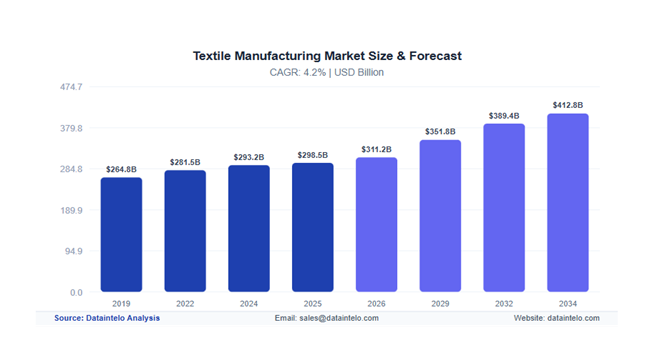
Global Textile Manufacturing Value Projected To Reach US$ 412.8 Billion By 2034
Global textile production is entering a transformative era
where competitive advantage hinges on technological adoption and strict
regulatory compliance rather than traditional low labour costs. A comprehensive
research report published by DataIntelo reveals that the international textile
manufacturing industry will expand from US$ 298.5 billion in 2025 to US$ 412.8
billion by 2034, registering a compound annual growth rate of 4.2% across
spinning, weaving, knitting, and finishing operations worldwide.
Divergence Between Traditional Apparel and Technical
Textiles
Market data indicates a widening divergence between
traditional garment manufacturing and advanced technical textiles. Traditional
apparel continues to represent the single largest application segment at US$
144.2 billion, accounting for 48.3% of total industry value in 2025. However,
traditional garment manufacturing is recording a modest annual growth rate of
2.8% due to maturing demand in western economies and rapid inventory turnover
cycles across ecommerce networks. Technical textiles engineered for automotive,
healthcare, and industrial infrastructure are expanding rapidly at a 5.8%
compound annual rate. Technical textile applications are projected to increase
their total manufacturing share from 28.1% in 2025 to 38.4% by 2034.
Automotive And Medical Applications Fuel High Growth
Demand
Automotive textiles represent the fastest growing category
within the specialized segment, advancing at an annual rate of 6.2% through
2034. Global electric vehicle production expanding toward 55 million units
annually serves as the primary catalyst for this demand. Electric vehicles
require 15% to 20% more technical textile volume than internal combustion
engine vehicles, deploying specialized fabrics for battery pack thermal
barriers, interior acoustic dampening, and lightweight structural composites.
Medical textiles encompassing surgical drapes, antimicrobial fabrics, and
advanced wound management products maintain robust momentum due to supply chain
security priorities established during global health crises.
Advanced Automation and Robotics Reshape Mill Economics
Advanced shop floor automation is reshaping operational
economics across primary processing stages. Integrated digital monitoring of
fibre tension in real time reduces defect rates by up to 35% while cutting
labour requirements by nearly 40% per machine compared to semi-automated
installations. Modern ring spinning units operate 1500 to 2000 spindles with
minimal direct manual intervention, while artificial intelligence predictive
maintenance tools enhance equipment efficiency by 20%. Innovations like the Rieter
automated piecing robot demonstrate that sophisticated robotic arms can perform
precise piecing operations inside operating spinning mills. High speed air jet
and water jet looms equipped with electronic pattern controls enable rapid
style adjustments and cost-effective small batch processing.
Domestic Machinery Challenges and Component Tariff
Disparities
Domestic machinery makers in India face structural
challenges amid these global shifts. Ketan Sanghvi, Chairman of India ITME
Society and Director of Laxmi Looms, noted, "fragmentation to be the main
challenge, as almost 3500 machinery manufacturers exist in India, out of which
majority are MSMEs and compete individually". Indian capital goods
manufacturers also encounter tariff disparities where raw components face
higher import duties than fully assembled imported machinery.
Regulatory Compliance and Circularity Drive Capital
Allocations
Environmental sustainability is transitioning from a
voluntary corporate posture into an essential commercial requirement for market
access. Recycled polyester manufactured from post-consumer waste is expanding
at 8.5% annually, while organic cotton consumption is growing at 12.3% per year
as international fashion houses establish mandatory sustainable sourcing
targets for 2030. European Union directives such as the Corporate
Sustainability Reporting Directive require detailed verification of product origin
and circular lifecycle metrics. Approximately 68% of major automobile
manufacturers will mandate formal environmental compliance metrics from textile
suppliers by 2026 covering chemical usage, water consumption, and recycled
input ratios.
Operational Investments in Energy Efficiency and Water
Stewardship
Indian manufacturers are actively aligning capital
expenditure with these ecological mandates. Century Enka established a
dedicated 9.9-megawatt hybrid renewable energy installation to power
manufacturing operations. Winsome Textile Industries allocated Rs 170 crore to
expand modern, resource efficient dyeing capabilities. Water availability
remains a critical constraint across processing clusters in India, Pakistan, and
China, accelerating investments in closed loop water recovery, low liquor
processing, and waterless dyeing machinery.
The Asia Pacific region commands 56.2% of global production
value, generating US$ 167.9 billion in 2025. China, India, Vietnam, Bangladesh,
and Indonesia collectively deliver more than 75% of worldwide yarn and fabric
output. Europe accounts for 18.7% of total value through high margin specialty
fabrics, while North America holds 14.8% driven by automotive and domestic
technical textiles. Successful industry stakeholders must prioritize technical
textile capacity, automated machinery, and verified circular practices to
secure profitable global market share over the coming decade.
The Asia Pacific region commands 56.2% of global production value, generating US$ 167.9 billion in 2025. China, India, Vietnam, Bangladesh, and Indonesia collectively deliver more than 75% of worldwide yarn and fabric output. Europe accounts for 18.7% of total value through high margin specialty fabrics, while North America holds 14.8% driven by automotive and domestic technical textiles. Successful industry stakeholders must prioritize technical textile capacity, automated machinery, and verified circular practices to secure profitable global market share over the coming decade.
Subscribe To Textile Excellence Print Edition
If you wish to Subscribe to Textile Excellence Print Edition, kindly fill in the below form and we shall get back to you with details.
Newsletter
Subscribe To Textile Excellence Mailing List


- December 09, 2022
'There Is Very High Acceptance For India

- December 09, 2022
'Advanced Machines & Service, Customer C

- October 09, 2023
First-time In The World: Rieter’s Auto

- July 28, 2026
Arvind Eyes Leadership In India's Premiu

- June 01, 2020
Karl Mayer Enables Automated Production

- June 05, 2023
Ultimax - All New Revolutionary Rapier W

- June 09, 2025
DyStar Becomes A Wholly Owned Subsidiary

- July 28, 2026