
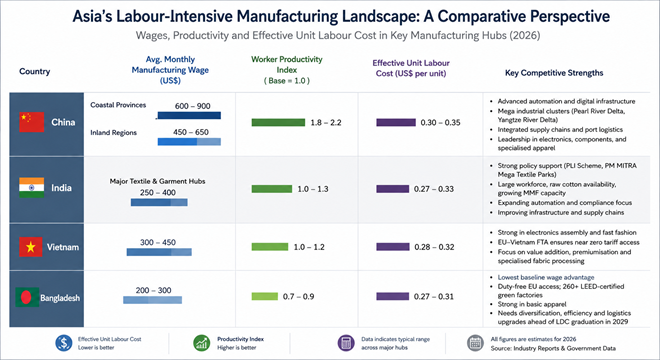
Asian Manufacturing Landscape Shifts As Productivity And Ecosystems Redefine Global Competitiveness
European Union apparel procurement softened notably during
the second quarter of 2026 compared to the corresponding period last year.
Official customs statistics reveal that overall garment import values and
shipment volumes contracted across major knitted and woven product
classifications. Knitted apparel under Harmonized System Code 61 witnessed
total import value fall 6.9% to 10032.54 million euros alongside a 7.2%
reduction in shipment volume to 571.76 kilotons, while average unit value edged
up marginally by 0.3% to 17.55 euros per kilogram. Woven apparel under
Harmonized System Code 62 recorded a 4.1% contraction in total import value to
9970.46 million euros and a 3.6% drop in volume to 406.51 kilotons, accompanied
by a 0.5% decrease in average unit values to 24.53 euros per kilogram.
Core Knitted Garment Classifications Face Contraction
Pronounced declines characterized the majority of essential
knitted clothing categories during this quarterly review. Inbound shipments of
knitted T shirts and vests fell 9.0% in value to 2569.12 million euros
alongside a 10.3% drop in volume. Men or boys knitted shirts experienced a
steep 15.4% drop in import value to 365.08 million euros, with inbound volume
declining 14.9%. Knitted babies garments recorded a sharp 18.1% value
contraction to 256.02 million euros alongside a 16.9% decrease in physical volume.
Men or boys knitted undergarments saw import value slide 18.0% to 295.64
million euros despite registering a 4.3% expansion in imported physical volume,
causing average unit values to collapse 21.4% to 11.73 euros per kilogram.
Resilience Across Specialized Knitted Outerwear and
Accessories
Selective growth niches demonstrated notable market strength
despite broad downward momentum across staple knitted classifications. Women or
girls knitted blouses achieved a 4.5% value expansion to 189.51 million euros,
supported by a 9.1% surge in realized unit values to 23.16 euros per kilogram.
Knitted women or girls overcoats posted strong expansion, with value rising
9.5% to 143.86 million euros and volume climbing 13.9% to 7.32 kilotons.
Miscellaneous knitted clothing accessories recorded an impressive 15.5% jump in
value to 58.37 million euros, accompanied by a 10.7% volume increase to 3.30
kilotons and a 4.3% gain in unit value.
Woven Apparel Segments Reflect Divergent Trajectories
Woven apparel categories experienced widespread declines
across mass retail segments alongside targeted expansion in fashion
accessories. Men or boys woven suits fell 7.3% in value to 2126.96 million
euros as volume decreased 6.9%. Woven men or boys’ shirts dropped 10.7% in
import value to 528.87 million euros on a 7.8% volume contraction. Woven
babies’ garments slipped 11.3% in value to 71.14 million euros alongside a
10.0% fall in quantity. Conversely, women or girls woven nightwear expanded
2.1% in value to 101.60 million euros while volume rose 7.5%. High fashion
accessory lines outperformed the broader market, with ties and cravats rising
12.8% in value to 11.01 million euros on a 16.0% volume increase. Handkerchiefs
gained 15.8% in value to 5.01 million euros, driven by a 22.2% surge in unit
values to 33.19 euros per kilogram.
Strategic Implications for Indian Garment Exporters
Shifting European sourcing patterns signal a selective
retail market where consumers prioritize premium outerwear and accessories
while curtailing staple purchases. Indian garment manufacturing hubs must
closely evaluate these structural adjustments to align export production
accordingly. Exporters supplying European retail chains can mitigate volume
downturns by expanding value added production in high realization categories
like women outerwear and tailored accessories. Modernizing factory operations and
maintaining competitive pricing structures will prove vital to preserving
market share across the European continent.
Shifting European sourcing patterns signal a selective retail market where consumers prioritize premium outerwear and accessories while curtailing staple purchases. Indian garment manufacturing hubs must closely evaluate these structural adjustments to align export production accordingly. Exporters supplying European retail chains can mitigate volume downturns by expanding value added production in high realization categories like women outerwear and tailored accessories. Modernizing factory operations and maintaining competitive pricing structures will prove vital to preserving market share across the European continent.
Subscribe To Textile Excellence Print Edition
If you wish to Subscribe to Textile Excellence Print Edition, kindly fill in the below form and we shall get back to you with details.
Newsletter
Subscribe To Textile Excellence Mailing List


- December 09, 2022
'There Is Very High Acceptance For India

- December 09, 2022
'Advanced Machines & Service, Customer C

- October 09, 2023
First-time In The World: Rieter’s Auto

- July 28, 2026
Arvind Eyes Leadership In India's Premiu

- June 01, 2020
Karl Mayer Enables Automated Production

- June 05, 2023
Ultimax - All New Revolutionary Rapier W

- June 09, 2025
DyStar Becomes A Wholly Owned Subsidiary

- July 28, 2026