
Karl Mayer Warp Knitting Technology Powers Global Mosquito Net Manufacturing
German textile machinery leader Karl Mayer has highlighted
the vital role of warp knitting technology in combating vector borne diseases
across the globe. Mosquitoes transmit severe life-threatening illnesses,
accounting for up to one million fatalities worldwide every single year.
Malaria represents the vast majority of these cases, having caused
approximately 597,000 deaths among roughly 263 million recorded infections in
2023. The World Health Organization continues to advocate long lasting
insecticidal nets as an indispensable frontline defence against insect bites.
These specialized protective textiles deliver high biological protection,
convenient everyday handling, and cost-effective production economics on modern
industrial machinery.
Protective netting combines mechanical physical barriers
with targeted chemical protection to safeguard vulnerable populations. The
technical documentation notes that "mosquito nets are designed to serve
both as a physical barrier and as a means of killing or repelling
mosquitoes". Effective fabric construction demands carefully engineered
stitch densities to permit sufficient ventilation while preventing insect
penetration. Fabrics must also satisfy strict mechanical durability standards.
Global health guidelines mandate a minimum bursting resistance of 505 kPa for
100 denier multifilament yarns and 220 kPa for 75 denier yarns. Polyester
fabrics absorb liquid insecticide emulsions during wet finishing stages,
whereas polyethylene nets integrate insecticidal agents directly into raw
granulates prior to yarn extrusion. This distinct processing difference allows
each material type to deliver reliable repellent properties tailored to
specific ambient climate conditions.
High precision machine engineering remains paramount because
structural irregularities in mesh dimensions can compromise human safety. Karl
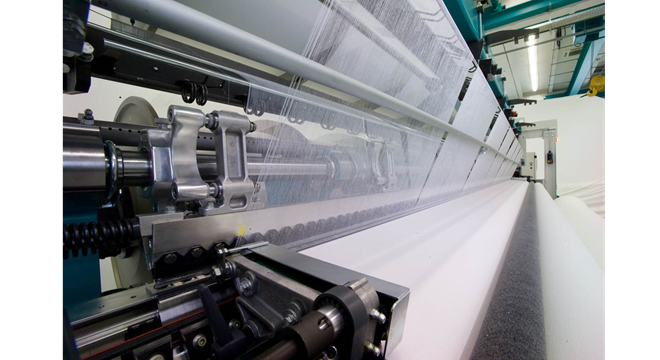
Mayer manufactures these specialized textiles primarily on two bar tricot
machines, featuring the advanced TM 2 and HKS 2-M models. Polyester filament
yarns are predominantly processed on gauge E28 or E32 configurations. High
density polyethylene monofilaments run on standard gauge E14 knitting set ups.
Certain heavy duty protective applications deploy three bar warp knitting
equipment utilizing gauge E18 arrangements. These advanced knitting systems
maintain superior mesh uniformity, dimensional stability, consistent fabric
weight, and high tear resistance across continuous commercial production
cycles.
Market demand for protective insect netting continues to
expand rapidly across international territories. Public health organizations
regularly distribute hundreds of millions of insecticidal nets throughout
Africa, establishing continuous replacement cycles every three to five years.
Commercial growth is further accelerated by rising consumer adoption across
recreational travel, camping, and outdoor domestic applications. Industry
research indicates the global mosquito net market stood at US$ 3.2 billion in
2025 and is projected to touch US$ 5.1 billion by 2034, registering a compound
annual growth rate of 5.8%. Global health agencies prioritize dependable
supplier networks capable of delivering defect free fabrics under demanding
delivery schedules. Scaled investments in advanced warp knitting infrastructure
position technical textile producers to serve expanding public health
initiatives while capturing lucrative export markets. Indian technical textile
manufacturers and warp knitters continue monitoring these precision machinery
capabilities to expand protective fabric capacities, fulfil institutional
healthcare contracts, and address critical international health needs.
Global health agencies prioritize dependable supplier networks capable of delivering defect free fabrics under demanding delivery schedules. Scaled investments in advanced warp knitting infrastructure position technical textile producers to serve expanding public health initiatives while capturing lucrative export markets. Indian technical textile manufacturers and warp knitters continue monitoring these precision machinery capabilities to expand protective fabric capacities, fulfil institutional healthcare contracts, and address critical international health needs.
Subscribe To Textile Excellence Print Edition
If you wish to Subscribe to Textile Excellence Print Edition, kindly fill in the below form and we shall get back to you with details.
Newsletter
Subscribe To Textile Excellence Mailing List


- December 09, 2022
'There Is Very High Acceptance For India

- December 09, 2022
'Advanced Machines & Service, Customer C

- October 09, 2023
First-time In The World: Rieter’s Auto

- July 28, 2026
Arvind Eyes Leadership In India's Premiu

- June 01, 2020
Karl Mayer Enables Automated Production

- June 05, 2023
Ultimax - All New Revolutionary Rapier W

- June 09, 2025
DyStar Becomes A Wholly Owned Subsidiary

- July 28, 2026