
Vietnam Powers US Cotton Exports As Global Supplies Tighten
Vietnam
has emerged as the key engine behind US cotton exports, even as the global
cotton market heads into another year of production falling short of
consumption.
The
United States exported an estimated 12.3 million bales in 2025/26, up 400,000
bales from the previous year. The country accounted for 27% of global cotton
exports, slightly below its 28% share in 2024/25 as Brazil continued to expand
shipments.
Vietnam
leads the buying
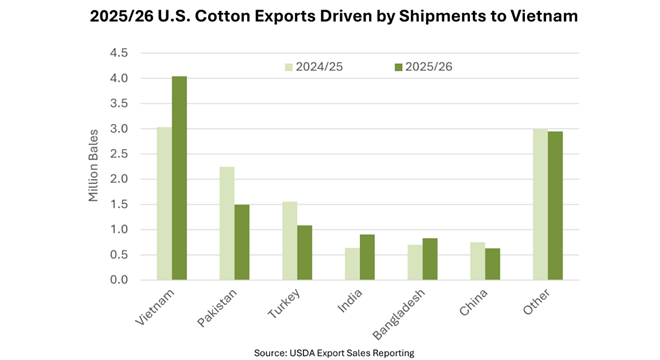
Vietnam
imported 4 million bales of US cotton during 2025/26, a record driven by higher
domestic mill consumption and overall cotton imports. Shipments to Vietnam
jumped by 1 million bales.
Higher
US exports to Vietnam, India and Bangladesh more than offset declining
shipments to several other markets. China continued its retreat as a US cotton
buyer, with 2025/26 shipments falling to a fraction of 2023/24 levels.
The
trend is continuing into the new season. At the start of 2026/27, US export
commitments stood at 4.3 million bales, 30% above the year-earlier level, with
Vietnam again the largest buyer.
Global
market gets tighter
The
US enters 2026/27 with estimated ending stocks of 4.15 million bales, slightly
above the previous year. The stocks-to-use ratio has risen to 30%, its highest
level in three years, providing some cushion going into the new season.
But
globally, the numbers are tighter. World cotton production is forecast at 117.3
million bales, down 300,000, while consumption is expected to remain at 122.9
million bales. That leaves consumption 5.6 million bales above production,
forcing major exporters to draw down stocks to meet demand.
Global
trade is forecast to rise 400,000 bales to 44.2 million, with Brazil and West
Africa supplying more cotton.
For
the US, exports are forecast to remain broadly unchanged in 2026/27 despite a
smaller crop. The USDA has also raised its projected season-average US farm
price by 3 cents to 78 cents per pound.
The
message from the numbers is clear: Vietnam is becoming increasingly important
to US cotton, while a global production-consumption gap is keeping the market
finely balanced.
For the US, exports are forecast to remain broadly unchanged in 2026/27 despite a smaller crop. The USDA has also raised its projected season-average US farm price by 3 cents to 78 cents per pound. The message from the numbers is clear: Vietnam is becoming increasingly important to US cotton, while a global production-consumption gap is keeping the market finely balanced.
Subscribe To Textile Excellence Print Edition
If you wish to Subscribe to Textile Excellence Print Edition, kindly fill in the below form and we shall get back to you with details.
Newsletter
Subscribe To Textile Excellence Mailing List


- December 09, 2022
'There Is Very High Acceptance For India

- December 09, 2022
'Advanced Machines & Service, Customer C

- October 09, 2023
First-time In The World: Rieter’s Auto

- July 28, 2026
Arvind Eyes Leadership In India's Premiu

- June 01, 2020
Karl Mayer Enables Automated Production

- June 05, 2023
Ultimax - All New Revolutionary Rapier W

- June 09, 2025
DyStar Becomes A Wholly Owned Subsidiary

- July 28, 2026