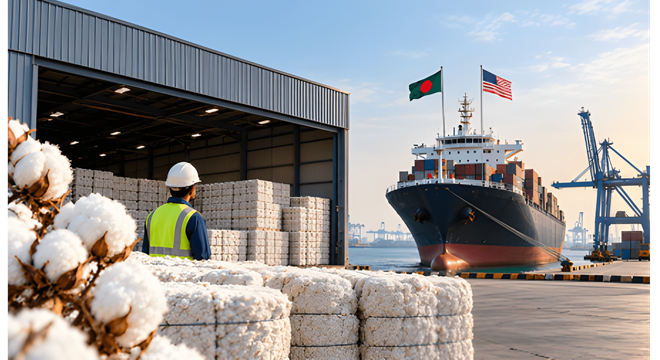
Bangladesh is about to change the way its textile mills buy American cotton. A privately operated US cotton warehouse is scheduled to open in Anwara, Chattogram, on November 18, allowing mills to buy cotton locally instead of waiting for individual shipments from the United States.
The facility is being established by AmeriBangla Corporation, led by Bangladeshi-American cotton trader Aswar Rahman, with a local partner. About 100 tonnes of cotton have already been shipped from a US port, with inventory expected to expand as demand grows.
90 days could become a lot less
Bangladesh’s textile mills typically wait nearly 90 days for imported cotton after placing an order. Local inventory could sharply reduce that lead time while giving mills greater flexibility in purchasing and reducing exposure to price swings.
US cotton costs somewhat more than some alternative supplies, but mill executives point to its quality, lower waste and reduced processing losses. Bangladesh imported US$ 346 million of US cotton in FY25, up from US$ 278 million in FY24, accounting for about 10% of total cotton imports.
AmeriBangla says direct sourcing from US farmers and ginners could make the warehouse supply around 10 cents per pound cheaper than prevailing rates. Traditional US cotton imports currently cost roughly 85 cents per pound delivered to Chattogram.
Envoy Textile has already tested trial shipments and says larger, reliable supplies could make the warehouse an important sourcing channel.
Trade deal adds another incentive
The warehouse could become even more significant if proposed US-Bangladesh trade arrangements provide tariff advantages for garments made with US cotton. Bangladesh’s apparel industry is awaiting formal US implementation guidelines.
Bangladesh exported US$ 8.69 billion of goods to the US in FY25, including US$ 4.95 billion of woven garments and US$ 2.60 billion of knitwear.
QUALITY VS COST
► US cotton quality higher, slightly more expensive
► Lower wastage
► Shorter lead times could offset higher purchase cost
Bangladesh’s US cotton imports
• Around 10% of total cotton imports
• $278m in FY24
• $346m in FY25
• Industry expects imports could reach $2b
For Bangladesh’s mills, the equation is increasingly straightforward: American cotton stored locally means shorter lead times, potentially lower sourcing costs and a possible trade advantage in the US market.
Bangladesh is widening its cotton sourcing, and India is losing share.
In 2025, Bangladesh imported 7.82 million bales of cotton. India supplied 1.24 million bales, down from 1.57 million in 2024. Its share fell to 15.9%, from 18.9%.
Brazil moved decisively ahead with around 2.11 million bales, while the US supplied 0.77 million and Australia 0.70 million. At the average import value for Bangladesh’s total cotton purchases, India’s 1.24 million bales would be worth roughly US$560 million.
The message for Indian cotton exporters is hard to miss. Proximity is no longer enough to lock in Bangladesh’s business. Mills have more origins to choose from, and Brazil, the US and Australia are taking a bigger slice of the sourcing basket.
India still has the advantage of geography. But if its share continues to slip, the question is no longer whether Bangladesh needs Indian cotton, it is how much of its cotton basket India can continue to hold.
Shifting cotton equation for India
With the US striking trade deals that improve market access for its cotton, global buyers could increasingly turn to American fibre. That could put pressure on demand for Indian cotton in export markets, potentially keeping more cotton within the domestic market and tempering price pressure.
But there is a catch: this only works if Indian farmers continue to grow cotton. If weak returns, weather risks or competing crops push farmers away from cotton, lower export demand may not translate into comfortable domestic supplies.
Bangladesh is set to open a US cotton warehouse in Chattogram, allowing mills to buy American cotton locally and potentially slash import lead times from nearly 90 days. The facility could also reduce sourcing costs and gain importance if US-Bangladesh trade arrangements offer tariff advantages for garments using US cotton. Meanwhile, Bangladesh is diversifying suppliers: India’s cotton share fell to 15.9% in 2025 from 18.9%, as Brazil, the US and Australia gained ground.
Polish this India’s cotton season is opening under pressure, with a September 25 industry survey projecting production around 10% below last season. Weather is the biggest risk, with uneven rainfall, high temperatures and pest pressure affecting crops across several states. Cotton prices are already firm, adding pressure on ginners and spinning mills. Export markets for Indian cotton may however be shrinking. US trade deals and tariff risks are changing the cotton